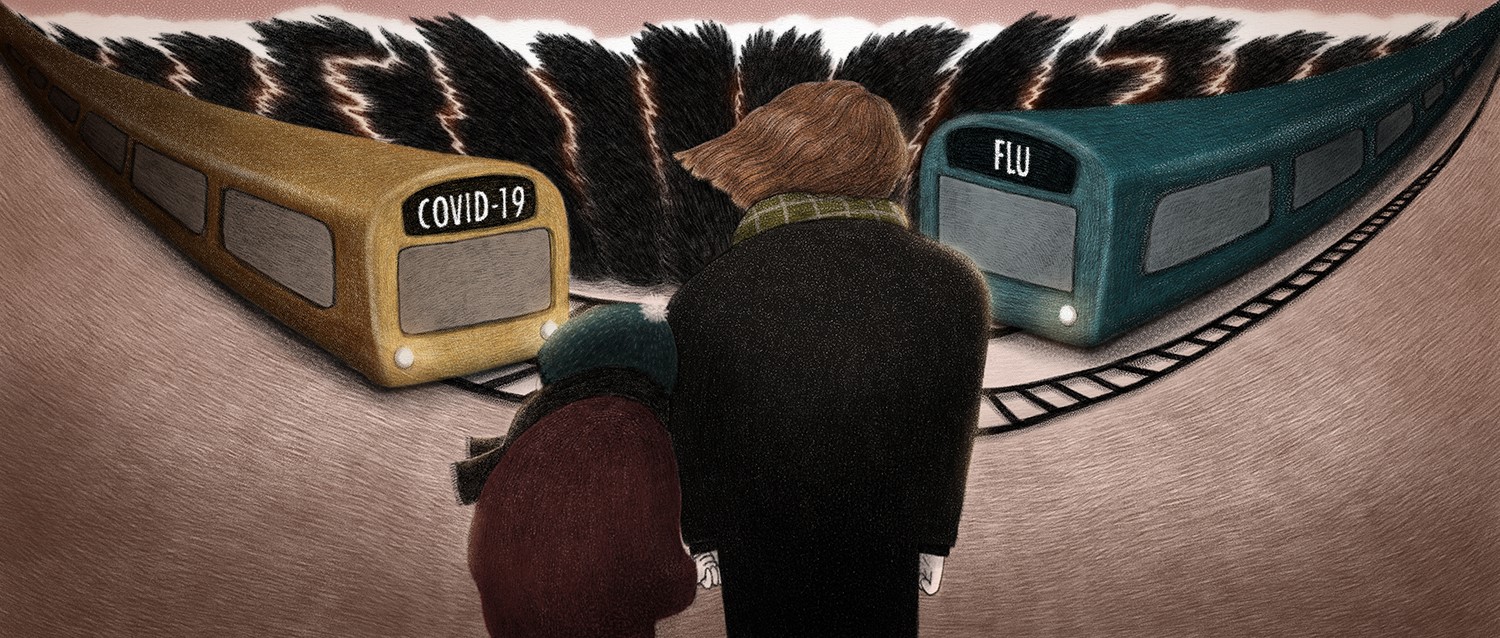
What happens if you catch flu and COVID-19 at the same time?
Peer reviewed by Dr Sarah JarvisAuthored by Andrea DowneyOriginally published 13 Nov 2020
Meets Patient’s editorial guidelines
- DownloadDownload
- Share
- Language
- Discussion
- Audio Version
- Add to preferred sources on Google
Thousands of people across the UK are living with tougher COVID-19 restrictions in a bid to curb infection rates ahead of winter. But each year winter also means a spike in flu cases, so what happens if you catch the flu and COVID-19 at the same time?
Feature illustrated by Pei-Hsin Cho.
Dr Robert Lambkin-Williams, a virologist for Virology Consult and Virustatic Shield, and Dr Ravi Tomar of Portland Medical explain whether you can catch both viruses at once and the risks if you do.
Double trouble
This year's flu season has the added complication of the coronavirus pandemic and having to distinguish between the symptoms of flu, colds and COVID-19. But can you catch multiple viruses at the same time? While it's quite rare, it is still possible to catch two respiratory viruses at once, Dr Lambkin-Williams says.
But as COVID-19, and our understanding of it, is still relatively new it's hard to say for certain how likely it is you can catch both the flu and COVID-19 viruses at once.
"There have been reports of patients who have contracted both flu and COVID-19 at the same time, but we are not yet clear on how co-infection occurs," Dr Tomar adds. "More evidence is needed before we can fully understand this, and how possible it is to contract both viruses at once."
Last month Public Health England warned that people who had been infected with both flu and COVID-19 faced serious consequences.
Their analysis of cases from January to April 2020 found people with both viruses are more than twice as likely to die as someone with coronavirus alone.
But Dr Tomar said more evidence is still needed. "The evidence comes from a study with small numbers, just 58 people, carried out in the UK at the start of the pandemic," he explains.
"Again, more evidence is needed before we really know how things pan out if you contract both viruses at once. But from what we do know, your symptoms will be more severe, and it may take you longer to get better."
Twice as bad?
It's difficult to say how you might feel if you do catch the flu and COVID-19 at the same time, again because of the limited evidence around it.
As we know, some people who have coronavirus are asymptomatic, meaning they don't have any symptoms at all, so you might not have severe symptoms if you catch flu and COVID-19.
But it's also possible you would feel much worse, Dr Lambkin-Williams says.
"You'll know if you've had flu viruses - sometimes it can floor you and other times you'll be relatively OK. If you have the two together it's entirely possible you would be much worse," he explains. "However, sometimes if we get two different viruses together, they have a fight amongst each other, and one will predominate and knock out the other one."
Dr Tomar adds that catching two viruses at once can make it harder for your immune system to fend off both at the same time.
"What we don’t know yet, is whether having flu or COVID-19 increases your chances of getting the other," he says. "You are likely to be more vulnerable, as viral infections damage tissue in your respiratory tract, making it harder for your body to fight off subsequent ones.
"Having inflamed lungs (which either disease can cause) also offers the opportunity for bacteria to take hold in there."
Risk factors
As with any illness, certain groups of people are more at risk.
The risk factors for catching the flu or COVID-19 are relatively similar. This includes the elderly and those who have underlying health conditions such as diabetes or respiratory conditions such as asthma. People in those groups are therefore more susceptible to catching flu and COVID-19 at the same time.
"The groups most at risk of contracting flu and COVID-19 at the same time are those generally considered to be more susceptible to contracting respiratory diseases," Dr Tomar says.
"These are people over 65, pregnant people and those with certain health conditions such as diabetes, asthma and heart conditions."
The best protection
The best way to protect yourself from both viruses is to follow government guidelines on COVID-19 and to get your flu vaccination.
"The absolute best thing we can all do this year is to get the flu vaccine as that will help protect us and others around us too," Dr Lambkin-Williams says.
Dr Tomar agrees, adding that anyone who is eligible for a flu vaccine should book one to help reduce pressure on the NHS.
This year the government has ramped up its flu vaccination programme to include more people, including children in the first year of secondary school, in a bid to keep flu numbers down and hospital beds free for COVID-19 patients. 50-64 year-olds who don't have any other conditions that would make them eligible will also be invited for NHS vaccination at the end of 2020 if there are enough vaccines available.
"People who are particularly vulnerable to flu will be contacted by their GP and, if they are, they should take this seriously and get vaccinated. For these people, it's free on the NHS," Dr Lambkin-Williams adds.
Dr Tomar reminds us that it's also important to follow COVID-19 safety guidelines. "To best protect themselves from these viruses, people should continue to adhere to the government guidelines of maintaining social distancing, wearing a mask in confined spaces and following strict hygiene measures," he says.
Those who are able to should wear a face mask where required, including on public transport, in shops and in restaurants and pubs when not sitting at your table. Social distancing must be maintained and you should wash your hands or use antiviral gel often.
Depending on where you live, restrictions on who you can see and what venues are open will differ through the government's tier system, so make sure you're up to date on the guidance for your area.
If you do think you have COVID-19 you should self-isolate and book a test as soon as possible. If your test is positive, you'll need to self-isolate for at least 10 days, and everyone you're in close contact with will need to self-isolate for 14 days from the last time they were in close contact with you.
Patient picks for General information

COVID-19
How to contribute to COVID-19 research
COVID-19 has been such a large part of our lives for so long that it's easy to forget it's a very new virus, and there is still a great deal to learn about it. To do that, the science community relies on members of the public - those who have had coronavirus and those who haven't - to sign up as research volunteers.
by Allie Anderson
COVID-19
How has COVID-19 impacted cancer patients?
Coronavirus has caused an unprecedented health crisis in the UK. As well as the need to treat and prevent the illness itself, the demand placed on the NHS, and the anxiety created in the general public, there has been an impact on the treatment of other diseases such as cancer.
by Gillian Harvey
About the author

Andrea Downey
About the reviewerView full bio

Dr Sarah Jarvis
Clinical Consultant
MA (Cantab), BM, BCh (Oxon), DRCOG, FRCGP, MBE
After training in medicine at Cambridge and Oxford, Dr Sarah Jarvis MBE became a GP.
Article history
Article also available in English, German, Spanish, French, Italian, Portuguese, Hindi, Hebrew, Arabic, and Swedish.
13 Nov 2020 | Originally published
Authored by:
Andrea Downey
Peer reviewed by
Dr Sarah Jarvis
Join the conversation
Share your thoughts or experiences with others in our patient communities.

Ask, share, connect.
Browse discussions, ask questions, and share experiences across hundreds of health topics.

Feeling unwell?
Assess your symptoms online for free
Sign up to the Patient newsletter
Your weekly dose of clear, trustworthy health advice - written to help you feel informed, confident and in control.
By subscribing you accept our Privacy Policy. You can unsubscribe at any time. We never sell your data.
More in cOVID-19
- Are vaccinations going to change during the pandemic?
- Coping with OCD as lockdown eases
- COVID-19 antibody tests: how do they work and who can get tested?
- Face coverings: what should you look for in a homemade mask?
- How has COVID-19 impacted cancer patients?
- How to cope with a fear of leaving lockdown
- How to make face masks and coverings more comfortable
- Should you worry about your lockdown drinking habits?
- Tips for restarting your exercise routine after lockdown
- What are the latest rules on face masks in the UK?
- Why are Black and Asian people at greater risk from COVID-19?
- Why are women so vulnerable to COVID-19 in pregnancy?
- Why it's normal to feel anxious about a post-COVID future