calcium voltage-gated channel subunit alpha1 F
Dernière mise à jour 21 juin 2024
Respecte les directives éditoriales
- TéléchargerTélécharger
- Partager
- Language
- Discussion
- Ask Patient
- Version audio
- Ajouter aux sources préférées sur Google
The CACNA1F gene belongs to a family of genes that provide instructions for making calcium channels. These channels, which transport positively charged calcium atoms (calcium ions) across cell membranes, play a key role in a cell's ability to generate and transmit electrical signals.
Normal function
The CACNA1F gene belongs to a family of genes that provide instructions for making calcium channels. These channels, which transport positively charged calcium atoms (calcium ions) across cell membranes, play a key role in a cell's ability to generate and transmit electrical signals.
The CACNA1F gene provides instructions for making one part (the alpha-1 subunit) of a calcium channel called CaV1.4. This subunit forms the hole (pore) in the cell membrane through which calcium ions can flow. CaV1.4 channels are found in many types of cells, although they play a particularly important role in a specialized tissue at the back of the eye called the retina. Within the retina, the channels are located in light-detecting cells called photoreceptors. The retina contains two types of photoreceptors: rods and cones. Rods are needed for vision in low light. Cones are needed for vision in bright light, including colour vision.
CaV1.4 channels play a critical role in normal vision. Studies suggest they help relay visual signals from rods and cones to other retinal cells called bipolar cells. This signaling is an essential step in the transmission of visual information from the eyes to the brain.
Conditions referring to this gene or chromosome
Other names
CAC1F_HUMAN
Cav1.4
Cav1.4alpha1
Related patient information and medicines
Patient information leaflet
Maladie des valves cardiaques
A heart valve that is diseased or damaged peuvent affect the flow of blood through the heart. If rheumatic fever is the cause then symptoms often start between the ages of 20 and 50 years, ... Other causes of heart valve disease Other causes of heart valve disease include: Deposits of calcium (calcification) in parts of the valve. This is the most.

Patient information leaflet
Jambes enflées
Ceci type may be called 'dependent oedema' by a healthcare professional. For most people, this oedema affects their legs and tends to improve overnight after you have had your legs up... Conditions causing low protein levels include malnutrition, nephrotic syndrome, liver failure, Liver failure and a gut condition called protein-losing.

Patient information leaflet
Angine de poitrine
Angina is a pain that comes from the heart. It is usually caused by narrowing of the heart's ... Other treatments that may be advised Other medicines to prevent angina pains A beta-blocker may be sufficient to prevent angina pains but other medicines are available if required. They fall into three main groups: Calcium-channel blockers Calcium.
Patient information leaflet
Phénomène de Raynaud
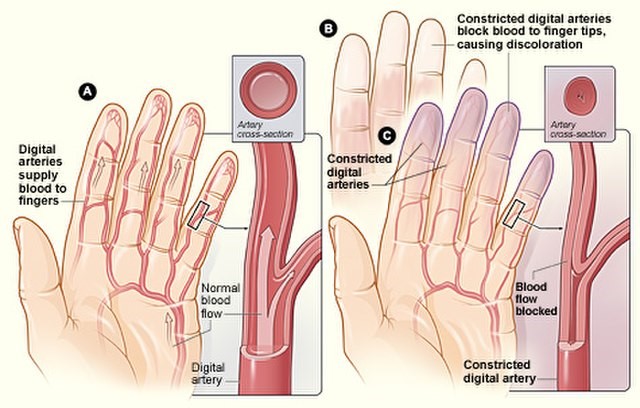
Treatment... Symptoms are much less likely to occur, and be less severe, if you keep warm (described above). Other treatments are needed only in some cases. Medication A calcium-channel blocker Calcium channel blockers called nifedipine Nifedipine may be advised if symptoms are severe. It works by 'opening up' (dilating) the small blood vessels..

Patient information leaflet
Fissure anale
These types of fissures are not dealt with in this leaflet. ServiceUpsellPlaceholder How common sont anal fissures. Anal fissures are common and probably affect about 1 in 350 people each year. Other medicines Some studies have shown that other medicines may also help relax the anal... For example, medicines called calcium-channel blockers Calcium.

Patient information leaflet
Cancer du rein
A swelling in the area over a kidney. Anaemia, which can cause tiredness and paleness. Some renal cell tumours produce abnormal amounts of certain hormones. This can lead to problems such as: A high blood calcium level which can cause various symptoms, such as increased thirst, feeling sick, tiredness, and constipation. Too many red blood cells.
Lectures complémentaires et références
- calcium voltage-gated channel subunit alpha1 F; MedlinePlus, National Library of Medicine.
- Bech-Hansen NT, Naylor MJ, Maybaum TA, Pearce WG, Koop B, Fishman GA, Mets M, Musarella MA, Boycott KM. Loss-of-function mutations in a calcium-channel alpha1-subunit gene in Xp11.23 cause incomplete X-linked congenital stationary night blindness. Nat Genet. 1998 Jul;19(3):264-7. doi: 10.1038/947.
- Boycott KM, Maybaum TA, Naylor MJ, Weleber RG, Robitaille J, Miyake Y, Bergen AA, Pierpont ME, Pearce WG, Bech-Hansen NT. A summary of 20 CACNA1F mutations identified in 36 families with incomplete X-linked congenital stationary night blindness, and characterization of splice variants. Hum Genet. 2001 Feb;108(2):91-7. doi: 10.1007/s004390100461.
- Hoda JC, Zaghetto F, Koschak A, Striessnig J. Congenital stationary night blindness type 2 mutations S229P, G369D, L1068P, and W1440X alter channel gating or functional expression of Ca(v)1.4 L-type Ca2+ channels. J Neurosci. 2005 Jan 5;25(1):252-9. doi: 10.1523/JNEUROSCI.3054-04.2005.
- Hoda JC, Zaghetto F, Singh A, Koschak A, Striessnig J. Effects of congenital stationary night blindness type 2 mutations R508Q and L1364H on Cav1.4 L-type Ca2+ channel function and expression. J Neurochem. 2006 Mar;96(6):1648-58. doi: 10.1111/j.1471-4159.2006.03678.x. Epub 2006 Feb 10.
- Jalkanen R, Bech-Hansen NT, Tobias R, Sankila EM, Mantyjarvi M, Forsius H, de la Chapelle A, Alitalo T. A novel CACNA1F gene mutation causes Aland Island eye disease. Invest Ophthalmol Vis Sci. 2007 Jun;48(6):2498-502. doi: 10.1167/iovs.06-1103.
- Jalkanen R, Mantyjarvi M, Tobias R, Isosomppi J, Sankila EM, Alitalo T, Bech-Hansen NT. X linked cone-rod dystrophy, CORDX3, is caused by a mutation in the CACNA1F gene. J Med Genet. 2006 Aug;43(8):699-704. doi: 10.1136/jmg.2006.040741. Epub 2006 Feb 27.
- Koschak A, Fernandez-Quintero ML, Heigl T, Ruzza M, Seitter H, Zanetti L. Cav1.4 dysfunction and congenital stationary night blindness type 2. Pflugers Arch. 2021 Sep;473(9):1437-1454. doi: 10.1007/s00424-021-02570-x. Epub 2021 Jul 1.
- MacDonald IM, Hoang S, Tuupanen S. X-Linked Congenital Stationary Night Blindness. 2008 Jan 16 [updated 2019 Jul 3]. In: Adam MP, Bick S, Mirzaa GM, Wallace SE, Amemiya A, editors. GeneReviews(R) [Internet]. Seattle (WA): University of Washington, Seattle; 1993-2026. Available from http://www.ncbi.nlm.nih.gov/books/NBK1245/
- McRory JE, Hamid J, Doering CJ, Garcia E, Parker R, Hamming K, Chen L, Hildebrand M, Beedle AM, Feldcamp L, Zamponi GW, Snutch TP. The CACNA1F gene encodes an L-type calcium channel with unique biophysical properties and tissue distribution. J Neurosci. 2004 Feb 18;24(7):1707-18. doi: 10.1523/JNEUROSCI.4846-03.2004.
- Peloquin JB, Rehak R, Doering CJ, McRory JE. Functional analysis of congenital stationary night blindness type-2 CACNA1F mutations F742C, G1007R, and R1049W. Neuroscience. 2007 Dec 5;150(2):335-45. doi: 10.1016/j.neuroscience.2007.09.021. Epub 2007 Sep 14.
- Strom TM, Nyakatura G, Apfelstedt-Sylla E, Hellebrand H, Lorenz B, Weber BH, Wutz K, Gutwillinger N, Ruther K, Drescher B, Sauer C, Zrenner E, Meitinger T, Rosenthal A, Meindl A. An L-type calcium-channel gene mutated in incomplete X-linked congenital stationary night blindness. Nat Genet. 1998 Jul;19(3):260-3. doi: 10.1038/940.
- Wutz K, Sauer C, Zrenner E, Lorenz B, Alitalo T, Broghammer M, Hergersberg M, de la Chapelle A, Weber BH, Wissinger B, Meindl A, Pusch CM. Thirty distinct CACNA1F mutations in 33 families with incomplete type of XLCSNB and Cacna1f expression profiling in mouse retina. Eur J Hum Genet. 2002 Aug;10(8):449-56. doi: 10.1038/sj.ejhg.5200828.
- Wygledowska-Promienska D, Swierczynska M, Spiewak D, Pojda-Wilczek D, Tronina A, Dorecka M, Smedowski A. Aland Island Eye Disease with Retinoschisis in the Clinical Spectrum of CACNA1F-Associated Retinopathy-A Case Report. Int J Mol Sci. 2024 Mar 2;25(5):2928. doi: 10.3390/ijms25052928.
- Zeitz C, Robson AG, Audo I. Congenital stationary night blindness: an analysis and update of genotype-phenotype correlations and pathogenic mechanisms. Prog Retin Eye Res. 2015 Mar;45:58-110. doi: 10.1016/j.preteyeres.2014.09.001. Epub 2014 Oct 13.
Partagez vos pensées ou expériences avec les autres dans notre communautés de patients.
Accès simple à des traitements fiables et à des services de santé en ligne.
Common conditions
Get help with common conditions through the NHS, without a GP appointment.





Inscrivez-vous à la newsletter Patient
Votre dose hebdomadaire de conseils de santé clairs et fiables - rédigés pour vous aider à vous sentir informé, confiant et maître de la situation.
En vous abonnant, vous acceptez notre Politique de confidentialité. Vous pouvez vous désabonner à tout moment. Nous ne vendons jamais vos données.