Hernie
Revu par des pairs par Dr Colin Tidy, MRCGPDernière mise à jour par Dr Toni Hazell, FRCGPDernière mise à jour 22 janv. 2023
Respecte les directives éditoriales
- TéléchargerTélécharger
- Partager
- Language
- Discussion
- Version audio
- Ajouter aux sources préférées sur Google
Une hernie se produit lorsqu'une partie interne du corps pousse à travers un point faible dans la paroi musculaire ou tissulaire environnante. Cette fiche concerne les hernies abdominales, qui surviennent lorsqu'une faiblesse dans la paroi de l'abdomen (paroi abdominale) entraîne le protrusion de certains contenus de la cavité abdominale. Certaines hernies nécessitent une intervention chirurgicale. Il existe désormais différents types d'interventions, qui sont généralement très efficaces.
En un coup d'œil
Une hernie se produit lorsque du tissu traverse une faiblesse de votre paroi abdominale, provoquant souvent une bosse.
Ils ne sont généralement pas douloureux mais peuvent faire mal, surtout après une activité, et la bosse peut disparaître en position allongée.
Le traitement est généralement conseillé car les hernies peuvent s'agrandir ou le contenu peut être piégé ou étranglé.
La chirurgie est recommandée pour la réparation, souvent en ambulatoire, en utilisant un filet pour renforcer la zone.
La récupération après une chirurgie de réparation de hernie est souvent rapide, certaines personnes reprenant le travail en deux semaines.
What are the symptoms of a hernia ?
Sometimes a hernia is noticed after a strain - for example, after lifting a heavy object. Sometimes one may develop for no good reason and you may simply notice a small lump, usually in the groin area. Usually, at first, the lump can be pushed back but may pop out after straining again. Coughing is a common strain that brings them out. The swelling often disappears when you lie down.
Hernias are not usually painful but many people feel an ache over a hernia, which worsens after doing any activity. In time, they might become bigger as the gap in their muscle or ligament tissue becomes larger. Sometimes, in men, they track down into the scrotum.
Why do they need treatment?
Although having a hernia is not usually a serious condition, treatment to fix it is usually advised for two reasons:
It may gradually become bigger and more uncomfortable.
The contents of the hernia may become trapped in the weak point in the abdominal wall. This can cause bowel obstruction with severe pain, nausea and vomiting (incarcerated hernia).
There is a small chance the hernia might strangulate:
This happens when the bowel (intestine) that comes through the gap in the weak spot becomes squeezed. This can cut off the blood supply to the portion of intestine in the hernia.
This can lead to severe pain and some damage to the part of the intestines in the hernia.
A strangulated hernia is uncommon and is usually dealt with by emergency surgery.
The risk of strangulation is greater with a femoral hernia than with an inguinal hernia. The risk is also greater with smaller hernias. In some areas, NHS funding for hernia repair is not automatically given and your GP or surgeon may need to apply for this.
How are hernias repaired?
A small operation is recommended. Wearing a support (truss) was a method used in the past but is now not recommended.
The operation is one of the most common operations performed by surgeons. The repair can usually be performed as a day case so that there is no need to stay overnight in hospital. A hernia can either be repaired under a local or a general anaesthetic. This will depend on the actual type of operation needed.
There are now various different ways of repairing a hernia, which will depend on many factors. For example, the type of hernia, the size of the hernia, and your general health. Your surgeon will be able to discuss the type of operation with you in more detail.
Inguinal hernia repair
This can be done by opening the tummy (abdomen) or by a 'keyhole' operation. The keyhole option is becoming more popular with surgeons as the recovery is quicker compared to having an open operation. However, research suggests that there is little difference in complication rates between the two procedures. The keyhole operation is performed through three tiny cuts, the largest of which is only around 1.5 cm in size.
It is more common that inguinal hernias be repaired by using a mesh. This is a thin sheet of material which is usually stitched or glued over the hole of the hernia. This has been shown to be stronger and more effective than sewing the edges of the hole together. With time, the mesh safely becomes incorporated into the muscle layer, which results in a very strong, permanent repair.
Femoral hernia repair
As the hole through which a femoral hernia has to pass is very tight, there is a significant chance that any bowel that passes into it will become strangulated. This means that a femoral repair should be repaired early. Femoral hernias are usually repaired using a mesh although some surgeons favour open repair.
Incisional hernia repair
Incisional hernias vary enormously in size. Again, a mesh is usually used, especially for larger hernias.
Umbilical and paraumbilical hernia repair
Smaller hernias are usually repaired by an operation which simply closes the defect with stitches. However, umbilical and paraumbilical hernias over 2 cm in length are usually repaired by using a mesh.
Epigastric hernia repair
The operation dissects out the contents of the hernia and closes the gap in the linea alba (a fibrous structure that runs down the front of the abdomen) so that the hernia can't happen again.
Newer techniques mean that people tend to be off work for much shorter periods than in the past. Even workers in heavy work can often be back in two weeks. The operation is usually very successful. However, hernias can return (recur) in a small number of people, when a further operation may be advised.
What are the types of hernia?
The most common types are listed here:
Hernie
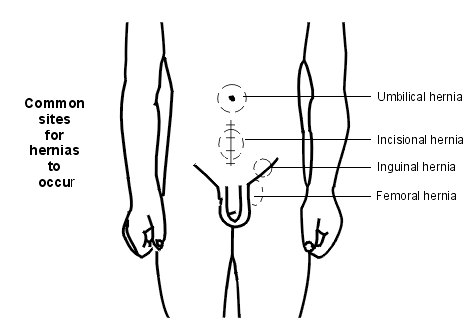
Hernie inguinale
This is the most common type. They are more likely in males, as they have a small tunnel in the tissues of their groins which occurred when they were developing as a baby. This tunnel allowed the testicles (testes) to come down from the tummy (abdomen) into the scrotum. Tissue from the intestines can also pass into this tunnel, forming an inguinal hernia.
There are two main types:
Indirect, which are usually congenital and common in boys.
Direct, which are more common in adult men.
They can occur in both sides of the body.
Hernias in groin areas
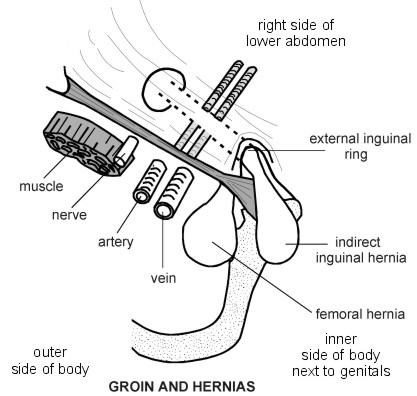
Hernie fémorale
This also occurs when some tissue pushes through in the groin. It occurs a little lower down than where an inguinal hernia occurs, and it tends to be smaller. It occurs more commonly in women.
Hernie incisionnelle
This occurs when tissue pushes through a previous scar or wound. It is more common if you have had a scar in the past that has not healed well. For example, if the wound had an infection after the operation. It usually occurs within two years of having an operation.
Epigastric hernia
These present with a lump in the middle of the body, usually between the belly button and the sternum (breastbone). Presentation is usually between the ages of 20 and 50 and they are more common in men than in women. They are usually repaired surgically because small epigastric hernias are at risk of strangulation, and large ones are uncomfortable.
Umbilical and paraumbilical hernias
These occur when some tissue pushes through the abdomen near to the belly button (umbilicus). Umbilical hernias can be present from birth and in most cases the hernia goes back in and the muscles re-seal on their own before the baby is 1 year old. They will generally be repaired if they persist beyond 5 years of age or if they are very large.
Umbilical hernias may develop in adults with being overweight (obesity) and excessive accumulation of fluid within the peritoneum of the abdomen. The peritoneum is a lining of the abdomen and consists of two layers, one which lines the abdominal wall and the other which covers the organs in the abdomen.
Paraumbilical hernias occur in adults and appear above the umbilicus. Although they are generally small, they usually need repairing because there is a risk of intestines contained within them becoming strangulated.
Who develops hernias?
They may occur in adults as a result of the strain which raises the pressure in the tummy (abdomen), causing a weakness or tear in the abdominal wall. This can be caused by:
Being overweight or pregnant.
Lifting, carrying or pushing heavy loads.
Straining on the toilet.
Sélections des patients pour Autres affections digestives

Santé digestive
Pancréatite chronique
La pancréatite chronique peut provoquer des douleurs abdominales, une mauvaise digestion, le diabète et d'autres complications. L'alcool en est la cause principale. Le traitement comprend des analgésiques, d'autres médicaments et, surtout, l'arrêt définitif de la consommation d'alcool. Une chirurgie est parfois nécessaire.
par Dr Doug McKechnie, MRCGP

Santé digestive
Œsophage de Barrett
In Barrett's oesophagus the cells that line the lower gullet (oesophagus) are abnormal. The main cause is long-standing reflux of acid from the stomach into the oesophagus. People with Barrett's oesophagus have an increased risk of developing cancer of the oesophagus. The risk is small. However, you may be advised to have regular endoscopies to detect precancerous changes to the cells in the oesophagus. If precancerous changes develop then treatment to remove or destroy the precancerous cells may be advised.
par Dr Colin Tidy, MRCGP
Questions fréquemment posées
Les hernies peuvent-elles disparaître d'elles-mêmes sans chirurgie ?
Pour la plupart des types de hernies, surtout chez les adultes, elles ne disparaîtront pas d'elles-mêmes. Cependant, les hernies ombilicales présentes dès la naissance chez les bébés peuvent souvent se résorber et les muscles se refermer avant que le bébé n'ait 1 an.
Quelle est la période de récupération après une chirurgie de la hernie ?
Les techniques chirurgicales plus récentes signifient que les gens ont tendance à être absents du travail pendant des périodes beaucoup plus courtes qu'auparavant. Même ceux qui effectuent un travail physique peuvent souvent revenir dans les deux semaines. L'opération est généralement très réussie.
Y a-t-il des complications à long terme si une hernie n'est pas traitée ?
Si une hernie n'est pas traitée, elle peut progressivement devenir plus grande et plus inconfortable. Le contenu peut également se retrouver piégé, entraînant une obstruction intestinale avec des douleurs sévères, des nausées et des vomissements (hernie incarcérée). Il existe également un petit risque d'étranglement, où l'apport sanguin à l'intestin piégé est coupé, ce qui peut entraîner des douleurs sévères et des dommages.
Est-il possible qu'une hernie revienne après avoir été réparée chirurgicalement ?
Oui, les hernies peuvent revenir (récidiver) chez un petit nombre de personnes, même après une opération réussie. Si cela se produit, une nouvelle opération peut être conseillée pour traiter la récidive.
Que signifie une hernie décrite comme 'incarcérée' ?
Une hernie incarcérée signifie que le contenu de la hernie, tel qu'une boucle intestinale, est coincé dans le point faible de la paroi abdominale. Cela peut entraîner des symptômes graves tels qu'une obstruction intestinale, des douleurs sévères, des nausées et des vomissements.
Lectures complémentaires et références
- Castorina S, Luca T, Privitera G, et al; An evidence-based approach for laparoscopic inguinal hernia repair: lessons learned from over 1,000 repairs. Clin Anat. 2012 Sep;25(6):687-96. doi: 10.1002/ca.22022. Epub 2012 Jan 24.
- Lockhart K, Dunn D, Teo S, et al; Mesh versus non-mesh for inguinal and femoral hernia repair. Cochrane Database Syst Rev. 2018 Sep 13;9:CD011517. doi: 10.1002/14651858.CD011517.pub2.
- International guidelines for groin hernia management. Hernia. 2018 Feb;22(1):1-165. doi: 10.1007/s10029-017-1668-x. Epub 2018 Jan 12.
- Kockerling F, Simons MP; Current Concepts of Inguinal Hernia Repair. Visc Med. 2018 Apr;34(2):145-150. doi: 10.1159/000487278. Epub 2018 Mar 26.
À propos de l'auteurVoir la biographie complète

Dr Toni Hazell, FRCGP
MBBS, BSc, FRCGP, DFSRH, Dip GU med, DRCOG, DCH (London, UK, 2000)
Le Dr Toni Hazell a obtenu son diplôme de l'École de médecine de l'hôpital St. Mary et a effectué son VTS à l'hôpital Northwick Park.
À propos du critiqueVoir la biographie complète

Dr Colin Tidy, MRCGP
Médecin généraliste, Auteur médical
MBBS, MRCGP, MRCP (Paediatrics), DCH
Le Dr Colin Tidy est un médecin du NHS, basé dans l'Oxfordshire.
Historique de l'article
Les informations sur cette page sont rédigées et examinées par des cliniciens qualifiés.
Article également disponible en Anglais, Allemand, Espagnol, Français, Italien, Portugais, Hindi, Hébreu, Arabe, and Suédois.
Prochaine révision prévue : 21 janv. 2028
22 janv. 2023 | Dernière version

Demandez, partagez, connectez-vous.
Parcourez les discussions, posez des questions et partagez vos expériences sur des centaines de sujets de santé.

Vous ne vous sentez pas bien ?
Évaluez vos symptômes en ligne gratuitement
Inscrivez-vous à la newsletter Patient
Votre dose hebdomadaire de conseils de santé clairs et fiables - rédigés pour vous aider à vous sentir informé, confiant et maître de la situation.
En vous abonnant, vous acceptez notre Politique de confidentialité. Vous pouvez vous désabonner à tout moment. Nous ne vendons jamais vos données.
Plus sur la santé digestive
- Diarrhée aiguë chez les enfants
- Pancréatite aiguë
- Hépatite auto-immune
- Diarrhée due aux acides biliaires
- Cholécystite
- Clostridioides difficile
- Cryptosporidium
- Diverticules
- Test immunochimique fécal
- Giardia
- Helicobacter pylori
- Hépatite
- Prurit anal
- Laxatifs
- Norovirus
- Cholangite sclérosante primitive
- Salmonella
- Symptômes de l'appendicite
- Diarrhée du tout-petit
- Diarrhée du voyageur