Masses abdominales
Revu par Dr Toni Hazell, FRCGPDernière mise à jour par Dr Philippa Vincent, MRCGPDernière mise à jour 30 juil. 2024
Respecte les directives éditoriales
- TéléchargerTélécharger
- Partager
- Language
- Discussion
- Version audio
- Ajouter aux sources préférées sur Google
Une masse abdominale est une bosse ressentie dans le ventre (abdomen). Il existe de nombreuses causes différentes de masse abdominale. Une consultation médicale urgente doit être demandée si une nouvelle masse est détectée dans l'abdomen.
En un coup d'œil
Une masse abdominale est une grosseur dans le ventre.
Il peut être ressenti ou découvert lors d'un examen pour d'autres symptômes comme des douleurs abdominales.
Les symptômes peuvent inclure des douleurs, des changements dans les habitudes intestinales, une perte de poids ou du sang dans les urines.
Les causes varient en fonction de l'emplacement de la masse et peuvent aller de parties normales du corps à des conditions plus graves comme le cancer.
Le diagnostic implique souvent un examen physique, des tests sanguins, urinaires ou de selles, et des examens d'imagerie.
Treatment depends on the cause; some masses may not need treatment.
What is an abdominal mass?
An abdominal mass is a lump in the tummy (abdomen). The abdomen contains many different structures including the:
Stomach and gut (bowel).
Foie.
Kidneys and bladder.
Womb (uterus) and ovaries in women.
Major blood vessels - for example, the aorta.
The position of the mass will help to determine which structure the mass is arising from.
The abdomen is traditionally divided into nine areas:
Just below the ribs on the right side (right upper quadrant/hypogastrium).
Just below the ribs in the middle (epigastrium).
Just below the ribs on the left side (left upper quadrant/hypogastrium).
Right side of the middle abdomen (right loin/lumbar region).
Around the tummy button (periumbilical).
Left side of the middle abdomen (left loin/lumbar region).
Right side of the lower abdomen (right lower quadrant/inguinal or iliac region).
Middle of the lower abdomen (suprapubic and pelvis).
Left side of the lower abdomen (left lower quadrant/inguinal or iliac region).
Abdominopelvic regions
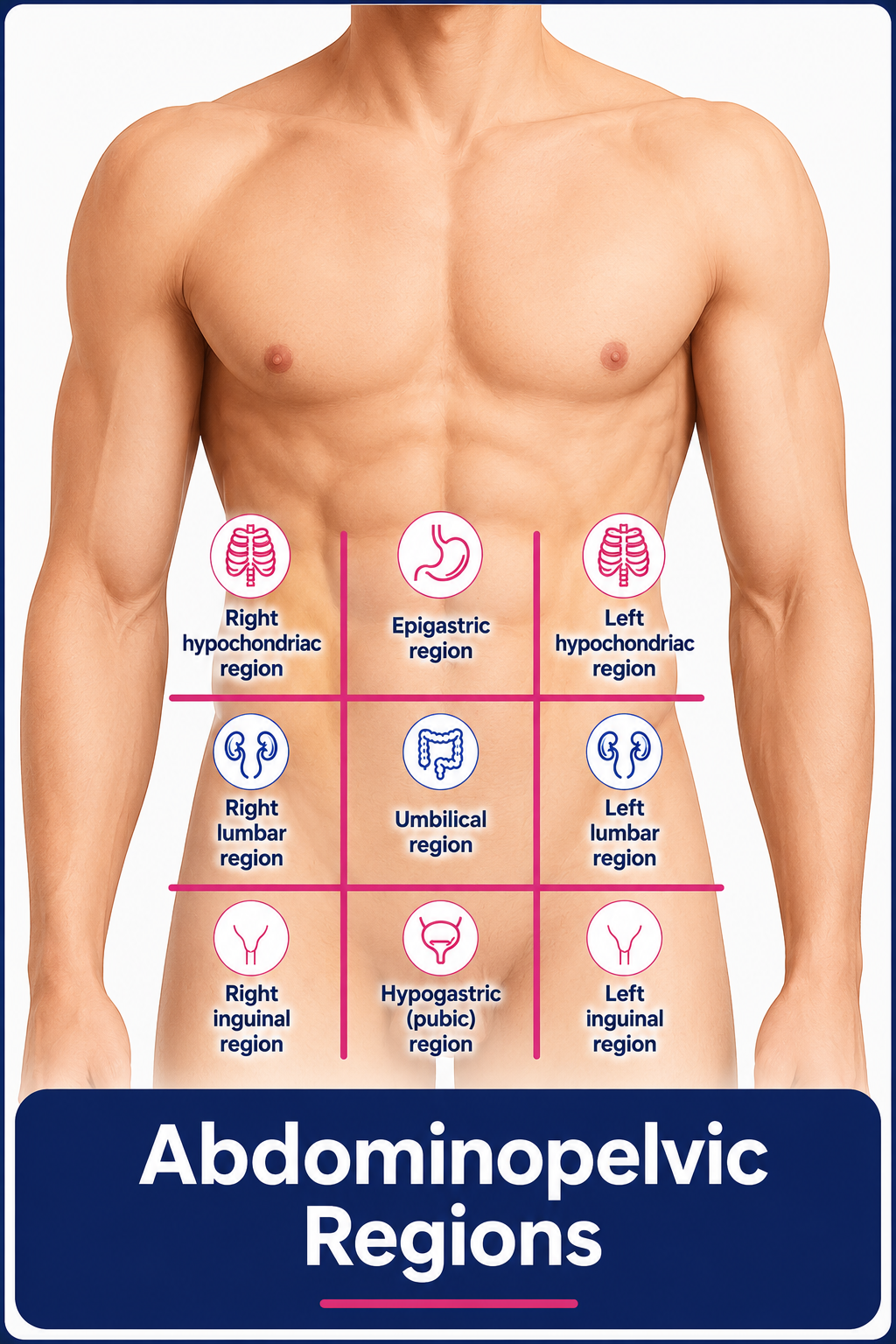
© Blausen.com staff (2014). "Medical gallery of Blausen Medical 2014". WikiJournal of Medicine 1 (2). DOI:10.15347/wjm/2014.010. ISSN 2002-4436., CC BY 3.0 , via Wikimedia Commons
Often nowadays, the abdomen is described in quadrants rather than using the nine areas. These are described as the right upper, right lower, left upper and left lower quadrants.
Abdominal mass symptoms
It is possible to feel a lump in the stomach (the mass in your own abdomen) before any other symptom but, much more frequently, it is first felt by a doctor examining the abdomen because of a different symptom, such as abdominal pain.
Therefore, it is more usual to become aware of a mass in the abdomen because of other symptoms such as:
A mass in the kidney may also cause sang dans les urines. Other symptoms will depend on the cause of the mass.
Abdominal mass causes
The possible cause of the abdominal mass will depend on where it is in the abdomen. The following lists are examples of the more common causes of an abdominal mass in each area. A lump (swelling) that can be seen and felt over the front of the abdomen (abdominal wall) may also be a skin lump, a lipoma (fatty lump) or a hernie.
Quadrant supérieur droit
Liver: enlarged liver (hepatomegaly), un cancer du foie. There are many causes of an enlarged liver, including infection, une insuffisance cardiaque, liver cancer, alcoholic liver disease et maladie du foie gras.
Gallbladder: cholécystite, cancer of the bile duct in the liver (cholangiocarcinoma).
Épigastre
Estomac: for example, un cancer de l'estomac.
Pancreas: for example, a pancreatic abcès ou cancer of the pancreas.
Ribcage: at the very bottom of the rib cage in the centre of the body, there is a small bone called the xiphisternum. In some people this bone sticks out and can feel like a lump. This is entirely normal and can be easily diagnosed by a doctor on clinical examination.
Quadrant supérieur gauche
Spleen: enlarged spleen (splenomegaly). There are many causes of an enlarged spleen, including la leucémie, lymphome, thalassémie, la drépanocytose, paludisme et fièvre glandulaire.
Estomac: for example, un cancer de l'estomac.
Pancreas: for example, an abscess or cancer of the pancreas.
Gut (bowel): for example, colon cancer.
Kidney: for example, cancer du rein.
Right loin
Kidney: for example, cancer du rein.
Periumbilical
Enlarged part of the major blood vessel (aorta): aortic aneurysm.
Left loin
Kidney: for example, cancer du rein.
Right lower quadrant
Bowel: for example, colon cancer.
Kidney: for example, cancer du rein.
Ovary: for example, cancer of the ovary.
Suprapubic and pelvis
Vessie: for example, a distended bladder caused by a blockage preventing you from emptying the bladder - such as in l'hypertrophie de la prostate in men.
Utérus: for example, la grossesse, fibroids.
Ovary: for example, kyste ovarien, cancer de l'ovaire.
Abdominal aorta: for example, a pulsatile mass due to an abdominal aortic aneurysm.
Left lower quadrant
Bowel: for example, constipation, colon cancer, maladie diverticulaire.
Kidney: for example, cancer du rein.
Ovary: for example, cancer of the ovary.
Diagnosing an abdominal mass
What tests are needed?
There are lots of different causes of an abdominal mass. Doctors will ask about various other symptoms and do a physical examination of the abdomen. Further tests depend on what they find, and what they think the cause might be.
Examples of tests that might be needed include:
Blood tests - for example, a CA-125 test to look for ovarian cancer.
Urine tests - to look for hidden blood in the urine which can be a sign of cancer du rein ou bladder cancer.
Stool tests - a qFIT test is a test to look for hidden blood in the stool which can be a sign of bowel cancer.
Scans or other imaging, such as:
Les échographies; abdominal ultrasound and sometimes transvaginal ultrasound scans.
Depending on the scan results, sometimes a biopsie (sample) of the mass is needed. This would be done in hospital. It might require an operation, depending on where the mass is.
Blood, stool and urine tests can be done by a GP; others need to be done by a hospital team.
If the GP suspects that the mass might be due to cancer, they are likely to make an urgent referral to the hospital - suspected cancer pathways mean that patients should have been seen and investigated within 28 days of referral. Often particular tests are needed before the hospital referral can be sent (for example, a qFIT result may be needed in advance).
Cancer is one cause of an abdominal mass, but there are many others. Most people referred to hospital for suspected cancer end up with normal or reassuring test results. For instance, fibromes are a common cause of a pelvic mass in women, but are not cancerous.
Abdominal mass treatment
Treatment options will depend on the cause of the abdominal mass. If the mass isn't cancer, and isn't causing any problems, no treatment may be needed. Treatment for le cancer depends on the type of cancer and how advanced it is. Depending on what the mass is, an operation to remove it may be possible.
Complications of an abdominal mass
There are lots of different causes of an abdominal mass. Complications differ depending on the cause.
In general, masses can cause:
Pressure symptoms. A large mass in the abdomen can press on other organs. This might cause bloating, abdominal swelling, a reduced appetite, leg swelling and pain.
Other complications depend on the cause of the mass. For example:
Uterine (womb) fibromes can cause heavy menstrual bleeding et l'anémie.
Personnes avec maladie polykystique des reins, which causes enlarged kidneys with multiple fluid-filled cysts in them, can develop l'hypertension artérielle et problèmes rénaux.
Cancer can spread to other organs.
Sélections des patients pour Autres affections digestives

Santé digestive
Œsophagite à éosinophiles
L'œsophage est le conduit alimentaire qui relie la bouche à l'estomac. L'inflammation de l'œsophage est connue sous le nom d'œsophagite. Généralement, l'inflammation est causée par l'acide qui remonte de l'estomac (une condition connue sous le nom de reflux acide). Chez certaines personnes, cependant, elle peut être causée par une condition connue sous le nom d'œsophagite à éosinophiles. Dans l'œsophagite à éosinophiles, certains types de globules blancs (appelés éosinophiles) s'accumulent en grand nombre dans la paroi de l'œsophage, provoquant une inflammation. Cela se produit chez les enfants et les adultes. La condition peut être contrôlée en modifiant votre régime alimentaire et/ou en prenant des stéroïdes. Occasionnellement, une opération pour étirer l'œsophage à l'aide d'un télescope (endoscope) peut être nécessaire.
par Dr Rachel Hudson, MRCGP

Santé digestive
Œsophage de Barrett
In Barrett's oesophagus the cells that line the lower gullet (oesophagus) are abnormal. The main cause is long-standing reflux of acid from the stomach into the oesophagus. People with Barrett's oesophagus have an increased risk of developing cancer of the oesophagus. The risk is small. However, you may be advised to have regular endoscopies to detect precancerous changes to the cells in the oesophagus. If precancerous changes develop then treatment to remove or destroy the precancerous cells may be advised.
par Dr Colin Tidy, MRCGP
Questions fréquemment posées
Si je ressens une masse dans mon abdomen, cela signifie-t-il que c'est grave ?
Pas nécessairement. Bien qu'une masse abdominale puisse être un symptôme d'une affection grave, il existe de nombreuses autres causes qui ne sont ni graves ni cancéreuses. Par exemple, les fibromes chez les femmes sont une cause fréquente de masse pelvienne et ne sont pas cancéreux. Même si des tests sont effectués pour un cancer suspecté, la plupart des gens obtiennent des résultats normaux ou rassurants.
Qu'est-ce que le xiphisternum et pourquoi pourrait-il se sentir comme une bosse ?
Le xiphisternum est un petit os situé tout en bas de la cage thoracique au centre du corps. Chez certaines personnes, cet os peut ressortir et être pris pour une bosse. Cela est considéré comme tout à fait normal et peut être facilement identifié par un médecin lors d'un examen physique.
Une masse abdominale peut-elle affecter mon appétit ou provoquer un gonflement de mes jambes ?
Oui, une grosse masse abdominale peut appuyer sur d'autres organes, entraînant divers symptômes. Ces symptômes de pression peuvent inclure des ballonnements, un gonflement abdominal général, une diminution de l'appétit et un gonflement des jambes.
Combien de temps faudra-t-il pour obtenir un diagnostic si mon médecin généraliste soupçonne un cancer en raison d'une masse abdominale ?
Si votre médecin généraliste soupçonne qu'une masse abdominale pourrait être due à un cancer, il est probable qu'il fasse une demande de consultation urgente à l'hôpital. Les parcours de suspicion de cancer visent à ce que les patients soient vus et que les investigations soient complétées dans les 28 jours suivant la demande. Parfois, des tests spécifiques comme un résultat qFIT peuvent être nécessaires avant que la demande de consultation à l'hôpital puisse être envoyée.
Une masse abdominale peut-elle être traitée sans chirurgie ?
Le traitement d'une masse abdominale dépend entièrement de sa cause sous-jacente. Si la masse n'est pas cancéreuse et ne pose aucun problème, aucun traitement peut ne pas être nécessaire. Pour d'autres causes, le traitement peut impliquer des médicaments, des changements de mode de vie ou d'autres procédures médicales, la chirurgie étant l'une des options selon la nature de la masse et son emplacement.
Lectures complémentaires et références
- Cancer suspecté : reconnaissance et orientation; Directive NICE (2015 - dernière mise à jour avril 2026)
À propos de l'auteurVoir la biographie complète

Dr Philippa Vincent, MRCGP
Médecin généraliste, Auteur médical
MB BS, Bsc, MRCGP (2000), DCH, DFSRH, DRCOG
Dr Philippa Vincent est un médecin généraliste du NHS travaillant dans le nord de Londres.
À propos du critiqueVoir la biographie complète

Dr Toni Hazell, FRCGP
MBBS, BSc, FRCGP, DFSRH, Dip GU med, DRCOG, DCH (London, UK, 2000)
Le Dr Toni Hazell a obtenu son diplôme de l'École de médecine de l'hôpital St. Mary et a effectué son VTS à l'hôpital Northwick Park.
Historique de l'article
Les informations sur cette page sont rédigées et examinées par des cliniciens qualifiés.
Article également disponible en Anglais, Allemand, Espagnol, Français, Italien, Portugais, Hindi, Hébreu, Arabe, and Suédois.
Prochaine révision prévue : 29 juil. 2027
30 juil. 2024 | Dernière version

Demandez, partagez, connectez-vous.
Parcourez les discussions, posez des questions et partagez vos expériences sur des centaines de sujets de santé.

Vous ne vous sentez pas bien ?
Évaluez vos symptômes en ligne gratuitement
Inscrivez-vous à la newsletter Patient
Votre dose hebdomadaire de conseils de santé clairs et fiables - rédigés pour vous aider à vous sentir informé, confiant et maître de la situation.
En vous abonnant, vous acceptez notre Politique de confidentialité. Vous pouvez vous désabonner à tout moment. Nous ne vendons jamais vos données.
Plus sur la santé digestive
- Fistule anale
- Œsophage de Barrett
- Clostridioides difficile
- Maladie cœliaque
- Diarrhée
- Intoxication alimentaire chez les enfants
- Gastro-entérite
- Giardia
- Syndrome de Gilbert
- Maladie inflammatoire de l'intestin
- Prurit anal
- Laxatifs
- Préparations locales pour les troubles anaux
- Stéatose hépatique non alcoolique
- Hémorroïdes
- Cholangite sclérosante primitive
- Inhibiteurs de la pompe à protons
- Salmonella
- Diarrhée du tout-petit
- Ventre ballonné, gaz et flatulences