Shoulder examination
Peer reviewed by Dr Toni Hazell, FRCGPLast updated by Dr Hayley Willacy, FRCGP Last updated 30 Jan 2023
Meets Patient’s editorial guidelines
- DownloadDownload
- Share
- Language
- Discussion
- Audio Version
- Add to preferred sources on Google
Medical Professionals
Professional Reference articles are designed for health professionals to use. They are written by UK doctors and based on research evidence, UK and European Guidelines. You may find one of our health articles more useful.
What is a shoulder examination?
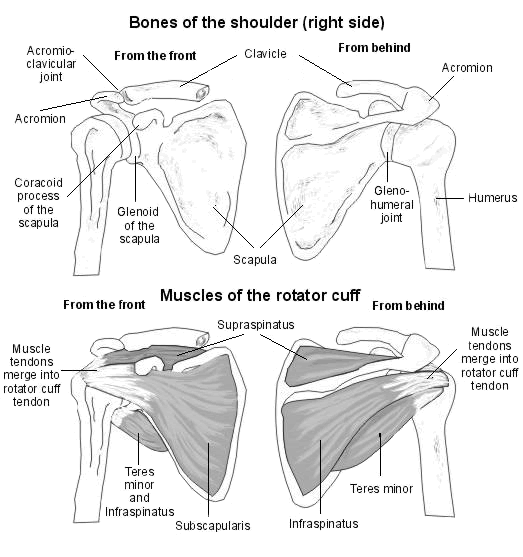
Shoulder examination is a practical skill which requires background knowledge of anatomy, of normal shoulder function and of abnormalities affecting the shoulder. The likely diagnosis will have been derived from the history. The necessary skills can be developed by examining colleagues or patients. The background knowledge can be learned with the help of pictures and video clips.
Rotator cuff
Inspection
View from the rear, with the patient standing straight. Look for lateral symmetry, swelling, position of scapula and signs of muscle wasting.
Palpation
Palpate all over the shoulder girdle, acromioclavicular joint, deltoid and supraspinatus muscles and scapular borders feeling for pain and tenderness, crepitus, effusions, deformities and abnormal muscle development.1
Range of movement
Perform the following with the patient seated:2
External rotation - with the patient's elbow at right angles and held into side, turn the arm outwards as far as possible (expected 70°).
Internal rotation - with the patient's elbow held into side, raise the arm as far as possible up the patient's back (expected level T5).
Forward flexion - start with the patient's arm at their side and lift the arm forwards and upwards as far as possible (expected 150-170°).
Extension - with the arm by the patient's side, lift the arm backwards as far as possible (expected 40°).
Abduction - with the arm at the patient's side, lift the arm away from the body as far as possible, continuing past the horizontal by allowing the shoulder to rotate externally, bringing the hand behind the head (expected 160-180°).
Adduction - draw the patient's arm across the anterior chest wall as far as possible (expected 30-40°).
Signs in individual joint problems3
Acromioclavicular joint
Ask the patient to place their hand on their opposite shoulder. If gentle pressure on the joint elicits pain, this is indicative of acromioclavicular joint inflammation (cross-arm horizontal adduction test).
Glenohumeral joint
With the patient lying on their back and their arm at right angles over the edge of the couch, gently push their wrist downwards. The patient will complain if the joint is unstable (apprehension test). With the patient lying on their back and the scapula stable, support their elbow and gently move the humeral head up and down in the glenoid fossa, by pressing anteriorly and posteriorly on the upper humerus, to assess laxity.
Impingement tests4
Turn the patient's arm so that the thumb points downwards and lift their arm outwards and upwards. With the patient standing and their arm abducted at right angles, support the elbow and rotate the forearm internally. In both tests, pain on movement indicates impingement of the rotator cuff.
Rotator cuff tests5
With the patient seated and elbows tucked into their sides, ask the patient to push both outwards and inwards, against resistance, in order to assess strength.
Supraspinatus
Ask the patient to hold both arms stretched out straight and level with the shoulders and thumbs pointed downwards. Assess strength by asking the patient to push the forearms both upwards and downwards against resistance.
Exclusive updates for healthcare professionals
Stay informed with the latest clinical updates, professional insights, and evidence-based guidance. The Patient Pro newsletter curates essential content for healthcare professionals—delivered straight to your inbox.
By subscribing you accept our Privacy Policy. You can unsubscribe at any time. We never sell your data.
Further reading and references
- Shoulder Examination - OSCE Guide; Geeky Medics
- Yang S, Kim TU, Kim DH, et al; Understanding the physical examination of the shoulder: a narrative review. Ann Palliat Med. 2021 Feb;10(2):2293-2303. doi: 10.21037/apm-20-1808. Epub 2021 Feb 2.
- Gismervik SO, Drogset JO, Granviken F, et al; Physical examination tests of the shoulder: a systematic review and meta-analysis of diagnostic test performance. BMC Musculoskelet Disord. 2017 Jan 25;18(1):41. doi: 10.1186/s12891-017-1400-0.
- Shoulder Examination; A Practical Guide to Clinical Medicine 2005, University of California
- Range of Movement; Sports Coach
- Cotter EJ, Hannon CP, Christian D, et al; Comprehensive Examination of the Athlete's Shoulder. Sports Health. 2018 Jul-Aug;10(4):366-375. doi: 10.1177/1941738118757197. Epub 2018 Feb 14.
- Garving C, Jakob S, Bauer I, et al; Impingement Syndrome of the Shoulder. Dtsch Arztebl Int. 2017 Nov 10;114(45):765-776. doi: 10.3238/arztebl.2017.0765.
- Ujsasi D, Filipovic K, Zvekic-Svorcan J, et al; The Applicability of Provocative Functional Tests in the Diagnosis of Rotator Cuff Muscle Injuries of the Best University Athletes. Biomed Res Int. 2022 Oct 13;2022:7728277. doi: 10.1155/2022/7728277. eCollection 2022.
About the authorView full bio

Dr Hayley Willacy, FRCGP
General Practitioner, Medical Author
MBChB (1992), DRCOG, DFFP, MRCOG (Part 1) MRCGP (2007), DFSRH (2013), MSc - medical education (2020)
Dr Hayley Willacy was an NHS GP working in northwest England, who retired from clinical practice in 2022 after 30 years.
About the reviewerView full bio

Dr Toni Hazell, FRCGP
MBBS, BSc, FRCGP, DFSRH, Dip GU med, DRCOG, DCH (London, UK, 2000)
Dr. Toni Hazell qualified from St. Mary’s Hospital Medical School and did her VTS at Northwick Park Hospital.
Article history
Article also available in English, German, Spanish, French, Italian, Portuguese, Hindi, Hebrew, Arabic, and Swedish.
Next review due: 29 Jan 2028
30 Jan 2023 | Latest version

Ask, share, connect.
Browse discussions, ask questions, and share experiences across hundreds of health topics.

Feeling unwell?
Assess your symptoms online for free
More in history and examination
- Abdominal distension and bloating
- Aching joints - assessment, investigations and management in primary care
- Chronic cough in children
- Delirium
- Epiphora
- Examination of the cranial nerves
- Exercise tolerance testing
- Facial pain
- Femoral nerve lesion
- Gastrointestinal history and examination
- Halitosis
- Hearing testing and screening in young children
- Heart auscultation
- Itching
- Left upper quadrant pain
- Lower urinary tract symptoms in women
- Nystagmus
- Orbital swellings
- UpdatedScreening for cognitive impairment
- Shoulder pain