Ongle incarné
Ongle incarné
Revu par Dr Colin Tidy, MRCGPDernière mise à jour par Dr Doug McKechnie, MRCGPDernière mise à jour 3 juil. 2024
Respecte les directives éditoriales
- TéléchargerTélécharger
- Partager
- Language
- Discussion
- Version audio
- Ajouter aux sources préférées sur Google
Ingrown toenails are a common condition which may cause discomfort or become infected. You might see the condition described as 'ingrowing' but both terms mean the same thing. Various treatments can be given by a doctor or nurse, or a person qualified to diagnose and treat foot disorders (a podiatrist). See a doctor if you have symptoms of infection around the nail, particularly if you have diabetes, a poor immune system or any other foot problem.
En un coup d'œil
An ingrown toenail occurs when the side of the nail cuts into the surrounding skin.
Il peut causer de la douleur, des rougeurs, un gonflement, et parfois une infection avec du pus.
Des chaussures mal ajustées, une coupe incorrecte des ongles et une transpiration excessive peuvent les provoquer.
Vous pourriez avoir besoin de consulter un médecin si les symptômes persistent ou montrent des signes d'infection.
L'ablation chirurgicale d'une partie de l'ongle peut être nécessaire pour les cas persistants.
Prévenez les ongles incarnés en coupant les ongles droits et en portant des chaussures bien ajustées.
What is an ingrown toenail?
The nail becomes ingrown when the side of the nail cuts into the skin next to the nail. This can become painful. The skin next to the nail may also become infected or inflamed.
Any toe can be affected but it is usually the big toe. Ingrowing toenails are a common problem, especially in teenagers and young adults. However, ingrown toenails can also occur in babies or toddlers.
What causes ingrown toenails?
An ingrown toenail is usually caused by a sharp spike of nail growing into the skin beside it.
This can happen as a result of various factors, including:
Not trimming your nails correctly.
Wearing poorly-fitting shoes.
Wearing tight socks.
Sweating a lot.
Deformed nails.
Injury to the toenail.
Fungal infection of the toenail.
As a side-effect of the medication isotretinoin.
Shoes which force the toes towards each other encourage the nail to grow into the skin. For example, tight shoes, high heels and pointed-toe shoes. Additionally, active, sporty people may be more prone to ingrown toenails as they sweat more.
What does an ingrown toenail look like?
Ongle incarné
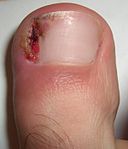
© ExistentialExplosion at English Wikipedia, CC0, via Wikimedia Commons
Early on, the skin around the ingrown nail may become reddened and feels slightly tender. If it progresses and becomes infected, it may become more swollen, red and painful.
If the infection gets worse, there may be some fluid (pus) oozing from around the nail. Ingrown toenail pus is usually yellow or green. The nail will become even more painful and there may be an overgrowth of skin around it.
Treating an ingrown toenail at home
If the ingrowing part of the nail is small, a non-surgical fix may be possible. It may be prevented from becoming worse, and sometimes cured, by the following. This treatment may be given by a podiatrist or other healthcare professional, or you may be shown how to do it yourself.
Soak the toe in water for 10 minutes to soften the folds of skin around the affected nail.
Then, using a cotton wool bud, push the skin fold over the ingrown nail down and away from the nail. Do this starting at the root of the nail and move the cotton wool bud towards the end of the nail.
Repeat each day for a few weeks, allowing the nail to grow.
As the end of the nail grows forward, push a tiny piece of cotton wool or dental floss under it to help the nail grow over the skin and not grow into it. Change the cotton wool or dental floss each time you soak your foot.
Do not cut the nail but allow it to grow forward until it is clear of the end of the toe. Then cut straight across the nail, and not rounded off at the end.
There are variations on this method - the principle is to keep the skin from growing over the edge of the nail.
Infected ingrown toenails
If the nail fold becomes infected, symptoms of infection are increasing pain, swelling and redness near the ingrown nail, and yellow or green pus near the nail or under the nearby skin. If the infection is getting worse, you may have a throbbing pain, redness spreading over the toe, or a high temperature (fever).
Antibiotics may be needed to treat infection. It can also help to soak your feet in warm salty water, then carefully dry your feet.
Do I need to contact a doctor for an ingrown toenail?
Severe ingrown toenails are usually treated by a GP or nurse, or a person qualified to diagnose and treat foot disorders (a podiatrist). In some cases, surgery is helpful.
Contact a doctor if:
You have persistent and troublesome symptoms from the ingrown nail.
You have symptoms of infection (as above). If you also have diabetes or a système immunitaire affaibli (immunosuppression), see a doctor urgently, as infections will need treating quickly.
You have a condition affecting the nerves or feeling (sensation) in your foot. For example, if you have loss of feeling due to diabetes (diabetic neuropathy) affecting the feet. This is because a loss of sensation or nerve damage can make you unaware of problems in the foot, such as a deep infection. So, you will need careful assessment and monitoring. You may be referred to a foot clinic or a podiatrist.
For persistent ingrown toenails
Removing part of the nail may be necessary. This is usually done by a podiatrist. The usual procedure is as follows:
Local anaesthetic will be injected into the base of the toe to make the procedure painless and numb the toe.
The toenail is then cut with scissors longways a few millimetres in from the offending edge.
It is cut right up to the base of the toenail and the offending edge can then be pulled out.
A small amount of acid (called phenol) is often put on the exposed part of the nail bed. This helps to stop the edge of nail regrowing and causing another ingrown nail.
The nail is then dressed.
Once the anaesthetic wears off, the toe may be sore so you may need mild painkillers such as paracetamol for a day or so. You will probably have to wear a bandage for about two weeks. During this time you will not be able to have a bath or go swimming. You also will not be able to do any strenuous exercise, such as running. After the procedure, the nail will regrow but will be narrower than before.
How to prevent ingrown toenails
Cut your nails straight across; do not cut your toenails too short or too low at the sides. The corner of the nail should be visible above the skin. (Tip: it is easier to cut nails after a bath or shower, when they are softer.)
Keep your feet clean and dry. Let air get to your toes when possible.
Wear shoes that fit properly - avoid tight shoes and use cotton socks rather than synthetic.
If you have diabetes, you should take extra care when cutting your nails:
Cut the nail straight across or follow the shape of the end of the toe, but be very careful not to cut too low at the sides of the nail.
Gently file any sharp edges with a nail file.
If you have any loss of feeling in your feet, you should visit a podiatrist to have your nails trimmed, rather than doing it yourself.
If you can't see your feet or nails very well, you should visit a podiatrist to have your nails trimmed, rather than doing it yourself.
Sélections des patients pour Nail disorders
Santé de la peau, des ongles et des cheveux
Psoriasis des ongles
Psoriasis is a persistent (chronic) skin condition which tends to flare up from time to time. About half of the people who have psoriasis also have changes affecting their nails. Psoriatic nail disease is very variable in appearance and severity. Psoriasis affecting the nails can be mild and not need any treatment. More severe nail psoriasis is often difficult to treat but modern treatments can be effective.
par Dr Doug McKechnie, MRCGP

Santé de la peau, des ongles et des cheveux
Paronychie
Paronychia is a common infection of the skin around the nails of the fingers or toes. It may be acute or chronic. Treatment is not always needed but usually involves antibiotic medicines for bacterial infections. Occasionally antifungal medicines for infection caused by a yeast (candida) are used. Occasionally steroid creams may be used for the skin around the nail. Rarely a small operation is needed to drain the pus that may have collected.
par Dr Philippa Vincent, MRCGP
Questions fréquemment posées
Pourquoi y a-t-il du pus qui sort de mon orteil ?
Du pus suintant autour de l'ongle, souvent jaune ou vert, indique qu'un ongle incarné peut être infecté. Cela peut également s'accompagner d'une douleur accrue, d'un gonflement et d'une rougeur.
Puis-je nager après avoir fait retirer une partie de mon ongle incarné ?
Après une intervention pour retirer une partie d'un ongle incarné, vous devrez probablement porter un bandage pendant environ deux semaines. Pendant cette période, vous devriez éviter de prendre des bains ou de nager, ainsi que les exercices physiques intenses comme la course à pied.
Un ongle incarné peut-il également affecter mes ongles des mains ?
Bien que n'importe quel orteil puisse être affecté, les ongles incarnés surviennent généralement sur le gros orteil. L'article précise que les ongles incarnés sont un problème lié aux ongles des pieds et ne mentionne pas que les ongles des mains sont affectés.
À quelle fréquence les ongles incarnés se produisent-ils ?
Les ongles incarnés sont un problème courant, touchant particulièrement les adolescents et les jeunes adultes. Cependant, ils peuvent également survenir chez les bébés ou les tout-petits.
Quel type de chaussures devrais-je porter pour éviter les ongles incarnés ?
Pour prévenir les ongles incarnés, vous devriez porter des chaussures qui vous vont bien et éviter les chaussures serrées, les talons hauts et les chaussures à bout pointu qui forcent vos orteils à se rapprocher. Utiliser des chaussettes en coton plutôt que des synthétiques peut également aider.
Lectures complémentaires et références
- Ingrown toenails; DermNet NZ
- Eekhof JA, Van Wijk B, Knuistingh Neven A, et al; Interventions for ingrowing toenails. Cochrane Database Syst Rev. 2012 Apr 18;(4):CD001541. doi: 10.1002/14651858.CD001541.pub3.
- Park DH, Singh D; The management of ingrowing toenails. BMJ. 2012 Apr 3;344:e2089. doi: 10.1136/bmj.e2089.
- Bryant A, Knox A; Ingrown toenails: the role of the GP. Aust Fam Physician. 2015 Mar;44(3):102-5.
- Livingston MH, Coriolano K, Jones SA; Nonrandomized assessment of ingrown toenails treated with excision of skinfold rather than toenail (NAILTEST): An observational study of the Vandenbos procedure. J Pediatr Surg. 2017 May;52(5):832-836. doi: 10.1016/j.jpedsurg.2017.01.029. Epub 2017 Jan 29.
- Mayeaux EJ Jr, Carter C, Murphy TE; Ingrown Toenail Management. Am Fam Physician. 2019 Aug 1;100(3):158-164.
À propos de l'auteurVoir la biographie complète

Dr Doug McKechnie, MRCGP
Rédacteur Médical
MA, MBBS, MSc, DRCOG, MRCP(UK), MRCGP(2021), FHEA
Le Dr Doug McKechnie est un médecin généraliste du NHS travaillant à Londres. Il travaille à plein temps en clinique et est également le chef adjoint du module de Pratique Clinique et Professionnelle à l'École de Médecine de l'University College London.
À propos du critiqueVoir la biographie complète

Dr Colin Tidy, MRCGP
Médecin généraliste, Auteur médical
MBBS, MRCGP, MRCP (Paediatrics), DCH
Le Dr Colin Tidy est un médecin du NHS, basé dans l'Oxfordshire.
Historique de l'article
Les informations sur cette page sont rédigées et examinées par des cliniciens qualifiés.
Article également disponible en Anglais, Allemand, Espagnol, Français, Italien, Portugais, Hindi, Hébreu, Arabe, and Suédois.
Prochaine révision prévue : 3 juil. 2027
3 juil. 2024 | Dernière version

Demandez, partagez, connectez-vous.
Parcourez les discussions, posez des questions et partagez vos expériences sur des centaines de sujets de santé.

Vous ne vous sentez pas bien ?
Évaluez vos symptômes en ligne gratuitement
Inscrivez-vous à la newsletter Patient
Votre dose hebdomadaire de conseils de santé clairs et fiables - rédigés pour vous aider à vous sentir informé, confiant et maître de la situation.
En vous abonnant, vous acceptez notre Politique de confidentialité. Vous pouvez vous désabonner à tout moment. Nous ne vendons jamais vos données.
Plus sur la santé de la peau, des ongles et des cheveux
- Pemphigoïde bulleuse
- Maladie des griffes du chat
- Engelures
- Dermatite de contact
- Morsures de chien et de chat
- Folliculite
- Infection fongique du cuir chevelu
- Hidradénite suppurée
- Urticaire
- Piqûres et morsures d'insectes
- Épilation au laser
- Sclérodermie localisée
- Tache de vin
- Prévenir le cancer de la peau
- Purpura
- Dermatite séborrhéique
- Verrues séborrhéiques
- Zona
- Soleil et coups de soleil
- Sclérodermie systémique