Électrocardiogramme
ECG
Revu par Dr Hayley Willacy, FRCGP Dernière mise à jour par Dr Colin Tidy, MRCGPDernière mise à jour 20 nov. 2023
Respecte les directives éditoriales
- TéléchargerTélécharger
- Partager
- Language
- Discussion
- Version audio
- Ajouter aux sources préférées sur Google
An electrocardiogram (ECG) records the electrical activity of the heart. The heart produces tiny electrical impulses which spread through the heart muscle to make the heart contract.
These impulses can be detected by the ECG machine. An ECG may be used to help find the cause of symptoms such as the feeling of a 'thumping heart' (palpitations) or chest pain. Sometimes it is done as part of routine tests - for example, for high blood pressure, or before an operation.
The ECG test is painless and harmless. (The ECG machine records electrical impulses coming de the body - it does not put any electricity into the body.)
En un coup d'œil
An electrocardiogram (ECG) records the heart's electrical activity.
It can detect abnormal heart rhythms, past or present heart attacks, and an enlarged heart.
Small metal electrodes are placed on the chest and connected to an ECG machine.
The test usually takes about five minutes.
An ECG is a safe procedure with very few risks.
A healthcare professional interprets the ECG results in context with your medical history.
What does an electrocardiogram (ECG) show?
The electrodes placed on the different parts of the body detect electrical impulses coming from different directions within the heart. There are normal patterns for each electrode. Various heart disorders produce abnormal patterns. The heart disorders that can be detected include:
Rythmes cardiaques anormaux. If the heart rate is very fast, very slow, or irregular. There are various types of irregular heart rhythm with characteristic ECG patterns.
A heart attack (myocardial infarction) and if it was recent or some time ago. Heart attacks cause damage to heart muscle and it heals with scar tissue. These can be detected by abnormal ECG patterns.
An enlarged heart. Basically, this causes bigger impulses than normal.
What does a normal ECG look like?
When reviewing an ECG, the healthcare professional will look at several different aspects.
These include the rate (how fast the heart is beating), the rhythm (whether the heartbeat is regular or irregular), the cardiac axis (direction of electrical spread within the heart), and an analysis of the different parts of the electrical wave.
The points of interest may vary depending on the reason for an ECG - for example, a doctor reviewing an ECG done in the emergency department for acute douleur thoracique will be looking for signs of a heart attack. In contrast, for a routine ECG arranged by a GP who has noticed an irregular heartbeat, they may be particularly looking for an irregularity and absent P waves. These are a sign of atrial fibrillation, a common cause of heartbeat irregularities.
In recent years we have become more aware of the importance of the QT interval, the distance between two parts of the electrical wave. Some drugs should not be used if the patient has a prolonged QT interval and therefore this will usually be looked at when interpreting an ECG.
How is an ECG done?
Small metal electrodes are stuck on to the chest. Wires from the electrodes are connected to the ECG machine. The machine detects and amplifies the electrical impulses that occur at each heartbeat and records them on to a paper or computer. A few heartbeats are recorded from different sets of electrodes.
How long does an ECG take?
The test takes about five minutes to do. Sometimes a small ECG machine can be worn for prolonged periods to see whether there is an irregular heart rhythm. This is called an ambulatory electrocardiogram.
Are there any risks with an ECG?
There are few, if any, risks related to an ECG. Some people may experience a skin rash where electrodes were placed, but this usually goes away without treatment.
An ECG only monitors the electrical activity of the heart. It does not emit any electricity and is therefore completely safe, even during pregnancy.
Is an ECG result always accurate?
Any test can have a false positive, or false negative result done. It is crucial that an ECG is read by a professional who has the skills to do so, so that they can interpret the trace in conjunction with the clinical history and examination. Some changes will have a significant impact on the need for future tests, or treatment, whereas others will be less important.
Sélections des patients pour Tests cardiaques

Tests et investigations
Scintigraphie de perfusion myocardique
Une scintigraphie de perfusion myocardique utilise une petite quantité de substance radioactive pour voir à quel point le flux sanguin vers les muscles du cœur (le myocarde) est bon. Souvent, cette scintigraphie est réalisée après un exercice léger pour observer la réponse du muscle cardiaque sous stress.
par Dr Colin Tidy, MRCGP
Tests et investigations
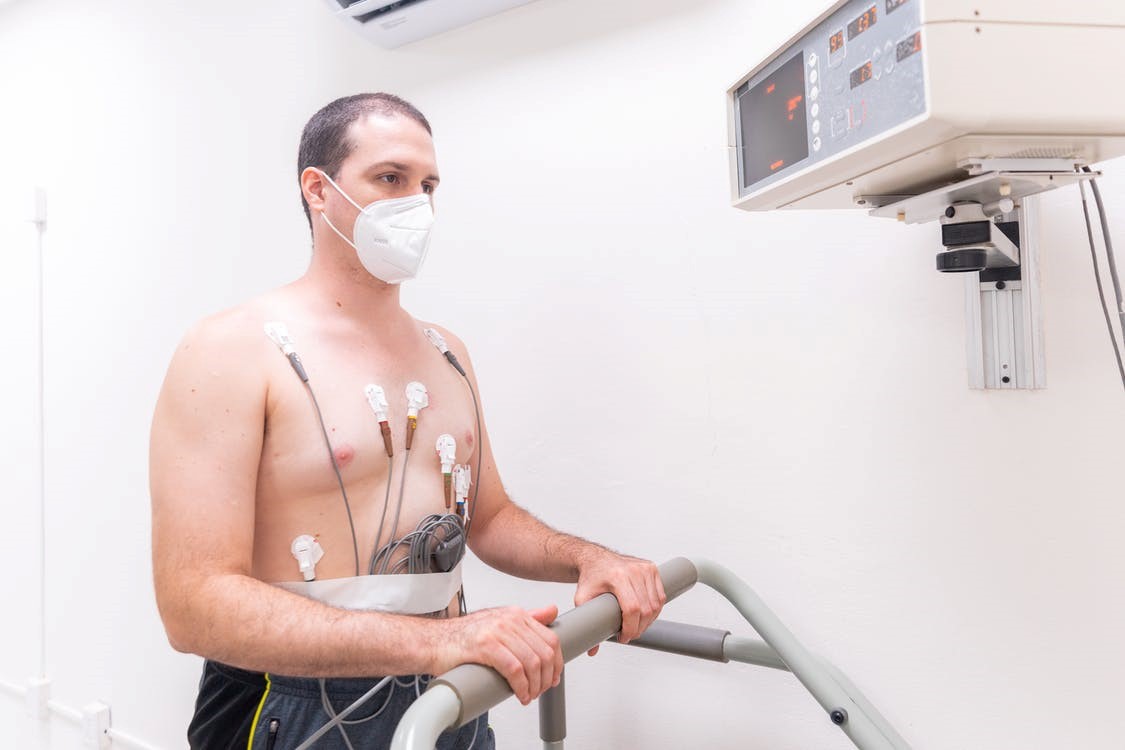
Test d'effort
Un test d'effort (ETT) enregistre l'activité électrique du cœur pendant l'exercice. Il est particulièrement utile chez les patients qui ressentent des douleurs thoraciques lors d'efforts. Il est également utilisé pour détecter si des anomalies du rythme cardiaque peuvent être déclenchées par l'exercice.
par Dr Philippa Vincent, MRCGP
Questions fréquemment posées
What is an ECG scan?
An electrocardiogram (ECG) is a test that detects the electrical impulses generated by the heart. It records these impulses to help identify various heart conditions.
How long does a typical ECG test take?
The standard ECG test usually takes about five minutes to complete. However, some types, like an ambulatory electrocardiogram, can involve wearing a smaller ECG machine for much longer periods to monitor heart rhythms over time.
Are there any risks associated with having an ECG?
An ECG is a very safe procedure with few risks. It purely monitors the electrical activity of your heart and does not emit any electricity. Some people might get a temporary skin rash where the electrodes were placed, but this usually clears up on its own. It is considered safe even during pregnancy.
How is an ECG performed on a woman?
An ECG is performed by attaching small metal electrodes to the chest and connecting them via wires to an ECG machine. This process is the same for both men and women.
Lectures complémentaires et références
- Bibliothèque ECG
- Birnbaum Y, Wilson JM, Fiol M, et al; ECG diagnosis and classification of acute coronary syndromes. Ann Noninvasive Electrocardiol. 2014 Jan;19(1):4-14. doi: 10.1111/anec.12130. Epub 2013 Dec 30.
- Attia ZI, Harmon DM, Behr ER, et al; Application of artificial intelligence to the electrocardiogram. Eur Heart J. 2021 Dec 7;42(46):4717-4730. doi: 10.1093/eurheartj/ehab649.
- Perez-Riera AR, Barbosa-Barros R, Daminello-Raimundo R, et al; Main artifacts in electrocardiography. Ann Noninvasive Electrocardiol. 2018 Mar;23(2):e12494. doi: 10.1111/anec.12494. Epub 2017 Sep 20.
À propos de l'auteurVoir la biographie complète

Dr Colin Tidy, MRCGP
Médecin généraliste, Auteur médical
MBBS, MRCGP, MRCP (Paediatrics), DCH
Le Dr Colin Tidy est un médecin du NHS, basé dans l'Oxfordshire.
À propos du critiqueVoir la biographie complète

Dr Hayley Willacy, FRCGP
Médecin généraliste, Auteur médical
MBChB (1992), DRCOG, DFFP, MRCOG (Part 1) MRCGP (2007), DFSRH (2013), MSc - medical education (2020)
Le Dr Hayley Willacy était médecin généraliste au NHS travaillant dans le nord-ouest de l'Angleterre, qui a pris sa retraite de la pratique clinique en 2022 après 30 ans.
Historique de l'article
Les informations sur cette page sont rédigées et examinées par des cliniciens qualifiés.
Article également disponible en Anglais, Allemand, Espagnol, Français, Italien, Portugais, Hindi, Hébreu, Arabe, and Suédois.
Prochaine révision prévue : 18 nov. 2028
20 nov. 2023 | Dernière version

Demandez, partagez, connectez-vous.
Parcourez les discussions, posez des questions et partagez vos expériences sur des centaines de sujets de santé.

Vous ne vous sentez pas bien ?
Évaluez vos symptômes en ligne gratuitement
Inscrivez-vous à la newsletter Patient
Votre dose hebdomadaire de conseils de santé clairs et fiables - rédigés pour vous aider à vous sentir informé, confiant et maître de la situation.
En vous abonnant, vous acceptez notre Politique de confidentialité. Vous pouvez vous désabonner à tout moment. Nous ne vendons jamais vos données.
Plus dans les tests et enquêtes
- Électrocardiogramme ambulatoire
- Amniocentèse
- Tests au baryum
- Scintigraphie osseuse
- Dépistage du sein
- Enzymes cardiaques
- Dépistage du col de l'utérus
- Cystoscopie
- Échographie endoscopique
- Test immunochimique fécal
- Numération formule sanguine et frottis sanguin
- Test de tolérance au glucose
- Tests auditifs
- Hyponatrémie
- Tests de fonction hépatique
- Études de conduction nerveuse
- Test auditif néonatal
- Examens physiques pour nouveau-né
- Test PSA
- Trait drépanocytaire