Breast augmentation
Enlargement
Peer reviewed by The British Association of Plastic Surgeons (BAAPS)Authored by The British Association of Plastic Surgeons (BAAPS)Originally published 23 Mar 2016
Meets Patient’s editorial guidelines
- DownloadDownload
- Share
- Language
- Discussion
- Audio Version
- Add to preferred sources on Google
This page has been archived.
It has not been reviewed recently and is not up to date. External links and references may no longer work.
This leaflet is provided by the British Association of Aesthetic Plastic Surgeons, the professional body responsible for the advancement of education and safety in aesthetic plastic surgery.
At a glance
Breast size is largely determined by genetics and can change with weight, pregnancy, and ageing.
Breast augmentation surgery uses implants to increase breast size.
Breast implants consist of a silicone shell filled with silicone gel or saline.
Implants are typically inserted through incisions under the breast, around the nipple, or in the armpit.
Capsular contracture, scarring, and implant visibility are potential complications.
There is no evidence that silicone breast implants cause breast cancer or autoimmune diseases.
Causes of small breasts
The size of breasts is genetically determined. Once developed, the breasts may fluctuate in size in response to changes in weight, pregnancy and breast feeding.
The aging process causes the shape of the breasts to change so that they gradually droop (called ptosis). This effect is greater following pregnancy, breast feeding and in particular after a large weight loss. Most women have breasts of slightly different sizes, but occasionally a very marked difference may develop.
The operation
Breasts can be made larger by placing an implant either under the breast tissue or behind the muscle on which the breast lies. Implants are usually inserted through incisions in the fold under the breast (ie the inframammary fold). Alternatively, the incisions may be made around the areola or in the armpit.
Breast implants
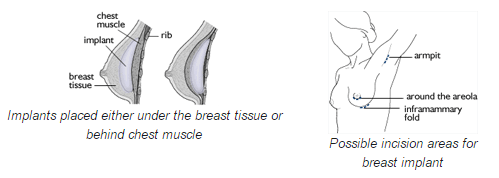
Breast implants
A breast implant consist of an outer shell and a filling material which is most often silicone gel or sometimes salt water (referred to as saline). Some implants are round and others are shaped more like a natural breast referred to as teardrop or anatomical implants. Either can give excellent results. The manufacturers' life expectancy of breast implants is 10 or more years, although implants can stay in without problems for a much longer time.
Expectations and complications
Breast augmentation has for many years been the most common cosmetic procedure in the UK which is testimony to its safety and ability to achieve a satisfying outcome in most patients. However, no surgical procedure is without risk and understanding these risks as well as having a realistic expectation is essential.
When any foreign material is inserted in the body it makes a protective coating around it which in most women forms a thin membrane that remains undetectable externally. In a few women however the reaction to the implant is greater and this is referred to as a capsule as the membrane becomes much thicker. The capsule around the implant can become thickened and contracted. The newer designs of implants have features to reduce the likelihood of this happening. This problem occurs to some extent in around 5 or 6% of patients and usually starts at about a year after surgery although it may take many years to become noticeable when looking at the chest. This can lead to pain, and/or an abnormally hard feel of the implant in the breast. Treatment may be needed and occasionally removal of the implant. Breast augmentation does not usually interfere in breast feeding, and there is no evidence that any silicone is found in breast milk. The presence of breast implants may interfere in mammography, which is an X-ray screening method for breast cancer. Special X-ray views can be taken to minimise this interference and studies have shown that the sensitivity of detecting a breast cancer in patients who have had implants is not reduced compared to normal women who do not have implants.
Most women have some degree of asymmetry between breasts and breast augmentation may occasionally exaggerate this difference. A breast that has an underlying implant will not necessarily feel like a normal breast, and some women may be acutely aware of the implant as a foreign body within the breast. The size and shape of the breast following breast augmentation surgery will adjust with time and can be unpredictable. It is also not always possible to create a cleavage with breast augmentation. Please remember that the weight of the implant may influence the age-related changes that normally take place in breasts. Movement of the fluid which fills the implant may occasionally be seen through the skin, this being more likely in the saline (salt water) filled implants, and less likely in the more viscous silicone implants, which also have a more natural feel. Breast augmentation will always leave scars on the breast or in the armpit, and although the scars will settle over 12 or more months, the appearance of the scars does vary between different individuals. This scarring is placed in such a position as to minimize visibility even when wearing a swimming costume. Complications that occur with breast augmentation include those associated with all forms of surgery, as well as the specific problems of bleeding and infection. Any infection that may occur in the tissue around the implant can usually be treated with antibiotics, but may require surgical removal of the implant.
Safety of silicone
Whatever the filling of the implant, the outer layer is made of silicone which is a firm type of material referred to as silicone elastomer. Silicon is a naturally occurring element which becomes silicone when it is combined with carbon hydrogen and oxygen. Silicone is manufactured into many items including cosmetics, foods and medical implants. Many studies have been conducted to establish whether silicone breast implants cause certain diseases. As a result of these studies we can say that at present there is no evidence to suggest that silicone breast implants are associated with an increased incidence of breast cancer. There is also no evidence to suggest that these implants cause autoimmune diseases such as rheumatoid arthritis.
Content used with permission from the British Association of Aesthetic Plastic Surgeons website: Breast Augmentation (Enlargement). Copyright for this leaflet is with the BAAPS.
Disclaimer
This leaflet is designed to supply useful information but is not to be regarded as advice specific to any particular case. It does not replace the need for a thorough consultation and all prospective patients should seek the advice of a suitably qualified medical practitioner. The BAAPS accepts no liability for any decision taken by the reader in respect of the treatment they decide to undertake.
Patient picks for Cosmetic surgery
Surgery and procedures
Laser hair removal
This leaflet is provided by the British Association of Aesthetic Plastic Surgeons, the professional body responsible for the advancement of education and safety in aesthetic plastic surgery.
by The British Association of Plastic Surgeons (BAAPS)

Surgery and procedures
Laser eye surgery
Laser eye surgery is becoming increasingly popular as a permanent alternative to wearing glasses or contact lenses.
by Dr Colin Tidy, MRCGP
Frequently asked questions
Does breast augmentation affect the feel of breasts?
A breast with an underlying implant may not feel the same as a normal breast. Some women might be very aware of the implant as a foreign object within the breast.
Can I expect a perfect, natural look after breast augmentation?
The size and shape of the breast after augmentation surgery will change over time and can be unpredictable. It is also not always possible to create a cleavage with breast augmentation.
Will breast implants prevent me from getting breast cancer screenings?
Breast implants can interfere with mammography, which is an X-ray screening method for breast cancer. However, special X-ray views can be taken to minimise this interference, and studies show that the ability to detect breast cancer in patients with implants is not reduced compared to women without implants.
What is capsule formation and how common is it?
When any foreign material, such as a breast implant, is inserted into the body, it forms a protective coating. In a small number of women (around 5-6%), this reaction can be greater, causing the membrane around the implant, called a capsule, to become much thicker and contract. Newer implant designs aim to reduce this problem. It usually starts about a year after surgery but can take many years to become noticeable. It can lead to pain, an abnormally hard feel, and may require treatment or even implant removal.
What happens if there's an infection around the implant?
If an infection occurs in the tissue around the implant, it can usually be treated with antibiotics. However, in some cases, surgical removal of the implant may be necessary.
About the authorView full bio

The British Association of Plastic Surgeons (BAAPS)
The British Association of Aesthetic Plastic Surgeons (BAAPS) is the professional body for Plastic Surgeons in the UK.
About the reviewerView full bio
The British Association of Plastic Surgeons (BAAPS)
The British Association of Aesthetic Plastic Surgeons (BAAPS) is the professional body for Plastic Surgeons in the UK.
Article history
Article also available in English, German, Spanish, French, Italian, Portuguese, Hindi, Hebrew, Arabic, and Swedish.
23 Mar 2016 | Originally published
Authored by:
The British Association of Plastic Surgeons (BAAPS)Peer reviewed by
The British Association of Plastic Surgeons (BAAPS)
Join the conversation
Share your thoughts or experiences with others in our patient communities.

Ask, share, connect.
Browse discussions, ask questions, and share experiences across hundreds of health topics.

Feeling unwell?
Assess your symptoms online for free
Sign up to the Patient newsletter
Your weekly dose of clear, trustworthy health advice - written to help you feel informed, confident and in control.
By subscribing you accept our Privacy Policy. You can unsubscribe at any time. We never sell your data.
More in surgery and procedures
- Anaesthetic for hip or knee replacement
- Arthroscopy and arthroscopic surgery
- Bone marrow biopsy and aspiration
- Botox
- Breast reduction
- Colposcopy and cervical treatments
- Deep vein thrombosis
- Endobronchial ultrasound-guided transbronchial needle aspiration
- Endometrial biopsy
- Epidural pain relief after surgery
- ERCP
- Gastroscopy
- Hysterectomy
- Hysteroscopy
- Laser hair removal
- Preventing infection after splenectomy
- Sickness after anaesthetic
- Sigmoidoscopy
- Vasectomy
- Weight loss surgery