Biopsie de l'endomètre
Évalué par des pairs Dr Colin Tidy, MRCGPDernière mise à jour par Dr Doug McKechnie, MRCGPDernière mise à jour 7 Jun 2023
Respecte les directives éditoriales
- TéléchargerTélécharger
- Partager
- Language
- Discussion
- Version audio
- Ajouter aux sources préférées sur Google
Dans cette série :Règles et problèmes menstruelsAbsence de règlesRègles abondantesSyndrome prémenstruelFibromesComment retarder une période
An endometrial biopsy is a medical procedure where some tissue from the inner lining of the womb (uterus) is removed, and then examined under a microscope. It is a short day-case procedure. The sample is taken with a tube which is passed through the vagina.
En un coup d'œil
Une biopsie de l'endomètre vérifie la muqueuse de l'utérus, souvent pour enquêter sur des saignements anormaux.
Cette procédure ambulatoire prend de 10 à 15 minutes, similaire à un test de frottis.
Un tube fin prélève des échantillons de tissu de la muqueuse utérine pour une analyse en laboratoire.
La procédure peut être inconfortable ou douloureuse, comme des crampes menstruelles.
Des crampes légères et des saignements légers sont courants pendant quelques jours par la suite.
Consultez votre médecin en urgence en cas de douleur intense, de saignement abondant, de pertes malodorantes ou de fièvre.
What can an endometrial biopsy show?
The point of an endometrial biopsy is to check the lining of the womb. Most commonly, this is done to check abnormal vaginal bleeding. For example in women who have bleeding after their menopause, or bleeding between their menstrual cycles.
The test is done to check for cancer of the uterus (endometrial cancer). It is also to look for a thickening of the lining of the womb, called l'hyperplasie endométriale. The biopsy sample is checked, under a microscope, for abnormal cells or cancer cells. Most times, when this test is done, it shows that there is no cancer, but it is important to be sure.
An endometrial biopsy is also sometimes done in women who are having treatment for l'infertilité. In this case, the biopsy is to see if the lining of the womb has grown enough to be ready for a fertilised egg to be implanted.
How do they do an endometrial biopsy?
There are two ways to take an endometrial biopsy:
An aspiration biopsy (often called a Pipelle biopsy).
Des hysteroscopy - looking into the womb using a camera, and finding an area to biopsy.
This leaflet describes the procedure for an aspiration biopsy. See the hysteroscopy leaflet for more information about that procedure.
An endometrial biopsy is a very quick test, and takes about 10 to 15 minutes. It is done as an outpatient procedure, in a hospital or community clinic, or sometimes a GP surgery.
To perform a endometrial biopsy, you will be asked to undress from the waist down and to lie on the examination couch with your knees bent and your legs apart. It is similar to having a smear test. Much like for a smear test or a pelvic exam, a plastic instrument called a speculum is put into your vagina to open it up.
The health professional doing the biopsy will then be able to see the neck of the womb (cervix) at the end of the speculum. A local anaesthetic is sometimes applied to the cervix. Sometimes a forceps-type instrument called a tenaculum is used to grip the cervix and hold it steady.
A speculum
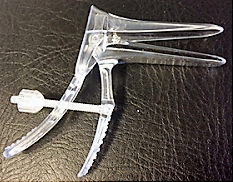
A thin tube is then passed through the speculum into your vagina, through the cervix and into the womb. Most commonly the type of tube used currently is a Pipelle® cannula, although there are other types. The tube is moved up and down the inside lining of the womb, and sucks up some tissue as it does so.
This is done a number of times to reach several parts of the lining of the womb. This tissue sample from the lining of the womb is then placed in liquid (called formalin) to preserve it until it reaches the lab where it will be examined under the microscope.
Once the sample has been taken, the speculum is removed, and you can get dressed and go home.
Are endometrial biopsies painful?
Endometrial biopsies are uncomfortable, and some women find them painful. If you can manage to relax the muscles of your vagina as the speculum is inserted, it is less uncomfortable.
Those muscles are under your control (try it now!) and if they are not squeezed tightly shut, the speculum will pass more easily. It may be painful as the tube is passed through your cervix, and you may feel some cramping as the sample is being taken from the lining of the womb.
The pain can be the same type of pain that you experience in a period, because the pain is caused by the same muscles of the uterus contracting. However, it can be more painful or intense. That said, for most women this is bearable.
Some doctors recommend taking a pain reliever such as ibuprofen 30 mins to 1 hour before the procedure to reduce any pain. Ask your healthcare team if this is something they recommend for you.
You may continue to have some period-like cramping pains for a day or so afterwards, and if you need a painkiller you can use whatever you normally use for period pains. For example, ibuprofène, ou paracétamol.
What to expect after an endometrial biopsy
As above, you may have some crampy period pains in the lower part of your tummy on and off for a day or two after the procedure. You may also have some light bleeding, like a period. This does not usually last longer than a few days. Use a sanitary towel if you need one.
You should be able to drive straight after the procedure and go about your normal day.
Y a-t-il des complications ?
It is very unusual to have complications after an endometrial biopsy. Rarely, the tube used can go right through the womb wall (perforate it). Occasionally there can be a lot of bleeding afterwards. Occasionally an infection can develop afterwards.
If you experience severe pain, have a lot of bleeding, or develop a smelly des écoulements ou fièvre in the week after the procedure, then see your doctor urgently.
How long do endometrial biopsy results take?
This will depend on your local laboratory, but usually takes between one and four weeks. The health professional who did the test will usually notify you of the result. They would normally tell you at the time of the biopsy how this will happen - it might be by phone, by letter, or in person at your next appointment.
Who can't have an endometrial biopsy?
In certain circumstances, an endometrial biopsy is not advisable. This includes:
Si vous êtes enceinte.
If you have a condition which causes you to bleed more easily, such as problems with your blood clotting system.
If you have an infection of your womb, cervix, vagina or pelvis.
Sélections des patients pour Biopsie

Chirurgie et procédures
Biopsie
Une biopsie est un test médical dans lequel un petit échantillon de tissu est prélevé d'une partie du corps. L'échantillon de tissu est examiné au microscope par un spécialiste. En observant les minuscules cellules qui composent l'échantillon de tissu, le spécialiste peut aider à établir un diagnostic. Remarque : les informations ci-dessous ne sont qu'un guide général. Les dispositions et la manière dont les tests sont effectués peuvent varier d'un hôpital à l'autre. Suivez toujours les instructions données par votre médecin ou votre hôpital local.
par Dr Philippa Vincent, MRCGP

Chirurgie et procédures
Biopsie hépatique
Une biopsie du foie consiste à prélever un petit échantillon de tissu du foie. Les cellules hépatiques peuvent ensuite être examinées en détail. Elle est utilisée pour diagnostiquer et surveiller certaines conditions. Remarque : les informations ci-dessous ne sont qu'un guide général. Les dispositions et la manière dont les tests sont effectués peuvent varier d'un hôpital à l'autre. Il est essentiel de toujours suivre les instructions données par l'hôpital où la procédure est effectuée.
par Dr Philippa Vincent, MRCGP
Questions fréquemment posées
Que dois-je faire si je ressens de la douleur ou des saignements pendant une période prolongée après la biopsie ?
Bien qu'une douleur crampante et des saignements légers soient normaux pendant un jour ou deux après une biopsie de l'endomètre, vous devez contacter votre médecin de toute urgence si vous ressentez une douleur intense, beaucoup de saignements, ou si vous développez des pertes malodorantes ou de la fièvre dans la semaine suivant la procédure. Cela pourrait être le signe d'une complication.
Can I eat or drink before an endometrial biopsy?
L'article ne précise aucune restriction alimentaire ou hydrique avant une biopsie de l'endomètre. Cependant, il mentionne que vous pouvez prendre un analgésique 30 à 60 minutes avant l'intervention si cela est recommandé par votre équipe de soins de santé.
Quelles activités devrais-je éviter après une biopsie de l'endomètre ?
L'article indique que vous devriez pouvoir conduire immédiatement après la procédure et reprendre vos activités normales. Il ne mentionne aucune activité spécifique à éviter, mais suggère d'utiliser une serviette hygiénique en cas de légers saignements.
Lectures complémentaires et références
- Dickson JM, Delaney B, Connor ME; Primary care endometrial sampling for abnormal uterine bleeding: a pilot study. J Fam Plann Reprod Health Care. 2017 Oct;43(4):296-301. doi: 10.1136/jfprhc-2017-101735. Epub 2017 Aug 19.
- Narice BF, Delaney B, Dickson JM; Endometrial sampling in low-risk patients with abnormal uterine bleeding: a systematic review and meta-synthesis. BMC Fam Pract. 2018 Jul 30;19(1):135. doi: 10.1186/s12875-018-0817-3.
À propos de l'auteurVoir la biographie complète

Dr Doug McKechnie, MRCGP
Rédacteur Médical
MA, MBBS, MSc, DRCOG, MRCP(UK), MRCGP(2021), FHEA
Le Dr Doug McKechnie est un médecin généraliste du NHS travaillant à Londres. Il travaille à plein temps en clinique et est également le chef adjoint du module de Pratique Clinique et Professionnelle à l'École de Médecine de l'University College London.
À propos du critiqueVoir la biographie complète

Dr Colin Tidy, MRCGP
Médecin généraliste, Auteur médical
MBBS, MRCGP, MRCP (Paediatrics), DCH
Le Dr Colin Tidy est un médecin du NHS, basé dans l'Oxfordshire.
Historique de l'article
Les informations sur cette page sont rédigées et examinées par des cliniciens qualifiés.
Article également disponible en Anglais, Allemand, Espagnol, Français, Italien, Portugais, Hindi, Hébreu, Arabe, and Suédois.
Prochaine révision prévue : 12 mai 2028
7 Jun 2023 | Dernière version

Demandez, partagez, connectez-vous.
Parcourez les discussions, posez des questions et partagez vos expériences sur des centaines de sujets de santé.

Vous ne vous sentez pas bien ?
Évaluez vos symptômes en ligne gratuitement
Inscrivez-vous à la newsletter Patient
Votre dose hebdomadaire de conseils de santé clairs et fiables - rédigés pour vous aider à vous sentir informé, confiant et maître de la situation.
En vous abonnant, vous acceptez notre Politique de confidentialité. Vous pouvez vous désabonner à tout moment. Nous ne vendons jamais vos données.