Autosomal dominant hyper-IgE syndrome
Dernière mise à jour 5 Dec 2024
Respecte les directives éditoriales
- TéléchargerTélécharger
- Partager
- Language
- Discussion
- Version audio
- Ajouter aux sources préférées sur Google
Autosomal dominant hyper-IgE syndrome (AD-HIES), formerly known as Job syndrome, is a condition that affects several body systems, particularly the immune system. Recurrent infections are common in people with this condition. Affected individuals tend to have frequent bouts of pneumonia, which are caused by certain kinds of bacteria that infect the lungs and cause inflammation. Inflammation is a normal immune system response to injury and foreign invaders (such as bacteria). However, excessive inflammation can damage body tissues. Recurring pneumonia often results in the formation of air-filled cysts (pneumatoceles) in the lungs. Frequent skin infections and an inflammatory skin disorder called eczema are also very common in AD-HIES. These skin problems cause rashes, blisters, accumulations of pus (abscesses), open sores, and scaling.
Description
Autosomal dominant hyper-IgE syndrome (AD-HIES), formerly known as Job syndrome, is a condition that affects several body systems, particularly the immune system. Recurrent infections are common in people with this condition. Affected individuals tend to have frequent bouts of pneumonia, which are caused by certain kinds of bacteria that infect the lungs and cause inflammation. Inflammation is a normal immune system response to injury and foreign invaders (such as bacteria). However, excessive inflammation can damage body tissues. Recurring pneumonia often results in the formation of air-filled cysts (pneumatoceles) in the lungs. Frequent skin infections and an inflammatory skin disorder called eczema are also very common in AD-HIES. These skin problems cause rashes, blisters, accumulations of pus (abscesses), open sores, and scaling.
For unknown reasons, people with AD-HIES have abnormally high levels of an immune system protein called immunoglobulin E (IgE) in the blood. IgE normally triggers an immune response against foreign invaders in the body, particularly parasitic worms, and is involved in allergies. However, IgE is not needed for these roles in people with AD-HIES, and it is unclear why affected individuals have such high levels of the protein without having allergies.
AD-HIES also affects other parts of the body, including the bones and teeth. Many people with AD-HIES have skeletal abnormalities such as an unusually large range of joint movement (hyperextensibility), an abnormal curvature of the spine (scoliosis), reduced bone density (osteopenia), and a tendency for bones to fracture easily. A common dental abnormality in this condition is that the primary (baby) teeth do not fall out at the usual time during childhood but are retained as the adult teeth grow in. Other signs and symptoms of AD-HIES can include abnormalities of the arteries that supply blood to the heart muscle (coronary arteries), distinctive facial features, and structural abnormalities of the brain, which do not affect a person's intelligence.
Inheritance patterns
The source lists the following possible inheritance patterns: Autosomal recessive; Autosomal dominant. More than one pattern can apply in different cases.
Related genes
Other names
AD-HIES
Autosomal dominant HIES
Autosomal dominant hyper-IgE recurrent infection syndrome
Autosomal dominant hyperimmunoglobulin E recurrent infection syndrome
Autosomal dominant Job syndrome
Buckley syndrome
Job syndrome
Job's syndrome
Job-Buckley syndrome
STAT3 deficiency
STAT3-deficient hyper IgE syndrome
Related patient information and medicines

Patient information leaflet
Syndrome de Marfan
Syndrome de Marfan (named after Dr Antoine Marfan, the French doctor who first described it in 1896) is a genetic disorder which people are born with and which lasts lifelong. Marfan syndrome can affect different people in different ways. You may have a history of Marfan syndrome in your family. If you have Marfan syndrome, you have a 50:50 chance of.

Patient information leaflet
Syndrome de vibration main-bras
Syndrome de vibration main-bras (sometimes abbreviated to HAVS) causes changes in the sensation of the fingers which can lead to permanent numbness of fingers, muscle weakness and, in some cases, bouts of white finger. It is caused by working with vibrating tools. It would be unusual to develop hand-arm vibration syndrome without using vibrating tools.

Patient information leaflet
syndrome d'Ehlers-Danlos
La Ehlers-Danlos syndromes (EDS) are a group of conditions that affect the stretchiness and strength of supporting tissues in the body, including skin, joints, blood vessels and internal organs. What are the Ehlers-Danl... These can be inherited via hérédité autosomique dominante (for hypermobile, classical and venous EDS) which means one in two.

Patient information leaflet
Syndrome de Turner
Syndrome de Turner is a genetic condition that only affects girls. The most characteristic features of the syndrome are being short, having certain physical features (detailed below), and ovaries that do not work properly. Although there is no cure, there are treatments that can help most girls with Turner syndrome lead relatively normal lives. What.

Patient information leaflet
syndrome de Down
Down's syndrome (also known as Down syndrome) is a genetic chromosome problem. Someone with Down's syndrome has an extra copy of chromosome 21 in the cells of their body. All people with Down's syndrome have some degree of learning disability. Down's syndrome may be detected before birth (prenatally) or after birth (postnatally). It cannot be.
Patient information leaflet
Cardiomyopathie hypertrophique
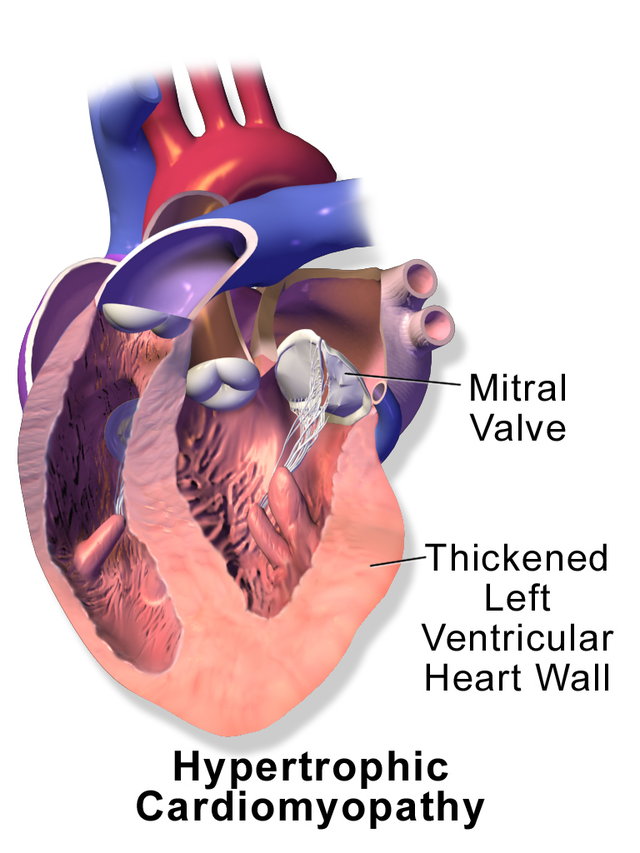
Dans cardiomyopathie hypertrophique le heart muscle becomes thickened (hypertrophies) in parts of the heart. In the normal heart, the muscle cells are regular and patterned. In hypertrophic cardiomyopathy the cells of the heart m... If a couple (where one person has HCM) has a child, there is a 1 in 2 chance of the child being affected. This pattern.
Lectures complémentaires et références
- Autosomal dominant hyper-IgE syndrome; MedlinePlus, National Library of Medicine.
- Beziat V, Li J, Lin JX, Ma CS, Li P, Bousfiha A, Pellier I, Zoghi S, Baris S, Keles S, Gray P, Du N, Wang Y, Zerbib Y, Levy R, Leclercq T, About F, Lim AI, Rao G, Payne K, Pelham SJ, Avery DT, Deenick EK, Pillay B, Chou J, Guery R, Belkadi A, Guerin A, Migaud M, Rattina V, Ailal F, Benhsaien I, Bouaziz M, Habib T, Chaussabel D, Marr N, El-Benna J, Grimbacher B, Wargon O, Bustamante J, Boisson B, Muller-Fleckenstein I, Fleckenstein B, Chandesris MO, Titeux M, Fraitag S, Alyanakian MA, Leruez-Ville M, Picard C, Meyts I, Di Santo JP, Hovnanian A, Somer A, Ozen A, Rezaei N, Chatila TA, Abel L, Leonard WJ, Tangye SG, Puel A, Casanova JL. A recessive form of hyper-IgE syndrome by disruption of ZNF341-dependent STAT3 transcription and activity. Sci Immunol. 2018 Jun 15;3(24):eaat4956. doi: 10.1126/sciimmunol.aat4956.
- Chandesris MO, Melki I, Natividad A, Puel A, Fieschi C, Yun L, Thumerelle C, Oksenhendler E, Boutboul D, Thomas C, Hoarau C, Lebranchu Y, Stephan JL, Cazorla C, Aladjidi N, Micheau M, Tron F, Baruchel A, Barlogis V, Palenzuela G, Mathey C, Dominique S, Body G, Munzer M, Fouyssac F, Jaussaud R, Bader-Meunier B, Mahlaoui N, Blanche S, Debre M, Le Bourgeois M, Gandemer V, Lambert N, Grandin V, Ndaga S, Jacques C, Harre C, Forveille M, Alyanakian MA, Durandy A, Bodemer C, Suarez F, Hermine O, Lortholary O, Casanova JL, Fischer A, Picard C. Autosomal dominant STAT3 deficiency and hyper-IgE syndrome: molecular, cellular, and clinical features from a French national survey. Medicine (Baltimore). 2012 Jul;91(4):e1-e19. doi: 10.1097/MD.0b013e31825f95b9.
- Farmand S, Sundin M. Hyper-IgE syndromes: recent advances in pathogenesis, diagnostics and clinical care. Curr Opin Hematol. 2015 Jan;22(1):12-22. doi: 10.1097/MOH.0000000000000104.
- Freeman AF, Avila EM, Shaw PA, Davis J, Hsu AP, Welch P, Matta JR, Hadigan C, Pettigrew RI, Holland SM, Gharib AM. Coronary artery abnormalities in Hyper-IgE syndrome. J Clin Immunol. 2011 Jun;31(3):338-45. doi: 10.1007/s10875-011-9515-9. Epub 2011 Apr 15.
- Freeman AF, Collura-Burke CJ, Patronas NJ, Ilcus LS, Darnell D, Davis J, Puck JM, Holland SM. Brain abnormalities in patients with hyperimmunoglobulin E syndrome. Pediatrics. 2007 May;119(5):e1121-5. doi: 10.1542/peds.2006-2649. Epub 2007 Apr 16.
- Freeman AF, Kleiner DE, Nadiminti H, Davis J, Quezado M, Anderson V, Puck JM, Holland SM. Causes of death in hyper-IgE syndrome. J Allergy Clin Immunol. 2007 May;119(5):1234-40. doi: 10.1016/j.jaci.2006.12.666. Epub 2007 Mar 1.
- Frey-Jakobs S, Hartberger JM, Fliegauf M, Bossen C, Wehmeyer ML, Neubauer JC, Bulashevska A, Proietti M, Frobel P, Noltner C, Yang L, Rojas-Restrepo J, Langer N, Winzer S, Engelhardt KR, Glocker C, Pfeifer D, Klein A, Schaffer AA, Lagovsky I, Lachover-Roth I, Beziat V, Puel A, Casanova JL, Fleckenstein B, Weidinger S, Kilic SS, Garty BZ, Etzioni A, Grimbacher B. ZNF341 controls STAT3 expression and thereby immunocompetence. Sci Immunol. 2018 Jun 15;3(24):eaat4941. doi: 10.1126/sciimmunol.aat4941.
- Holland SM, DeLeo FR, Elloumi HZ, Hsu AP, Uzel G, Brodsky N, Freeman AF, Demidowich A, Davis J, Turner ML, Anderson VL, Darnell DN, Welch PA, Kuhns DB, Frucht DM, Malech HL, Gallin JI, Kobayashi SD, Whitney AR, Voyich JM, Musser JM, Woellner C, Schaffer AA, Puck JM, Grimbacher B. STAT3 mutations in the hyper-IgE syndrome. N Engl J Med. 2007 Oct 18;357(16):1608-19. doi: 10.1056/NEJMoa073687. Epub 2007 Sep 19.
- Hox V, O'Connell MP, Lyons JJ, Sackstein P, Dimaggio T, Jones N, Nelson C, Boehm M, Holland SM, Freeman AF, Tweardy DJ, Olivera A, Metcalfe DD, Milner JD. Diminution of signal transducer and activator of transcription 3 signaling inhibits vascular permeability and anaphylaxis. J Allergy Clin Immunol. 2016 Jul;138(1):187-199. doi: 10.1016/j.jaci.2015.11.024. Epub 2016 Mar 2.
- Minegishi Y, Saito M, Tsuchiya S, Tsuge I, Takada H, Hara T, Kawamura N, Ariga T, Pasic S, Stojkovic O, Metin A, Karasuyama H. Dominant-negative mutations in the DNA-binding domain of STAT3 cause hyper-IgE syndrome. Nature. 2007 Aug 30;448(7157):1058-62. doi: 10.1038/nature06096. Epub 2007 Aug 5.
- Renner ED, Torgerson TR, Rylaarsdam S, Anover-Sombke S, Golob K, LaFlam T, Zhu Q, Ochs HD. STAT3 mutation in the original patient with Job's syndrome. N Engl J Med. 2007 Oct 18;357(16):1667-8. doi: 10.1056/NEJMc076367. No abstract available.
- Siegel AM, Stone KD, Cruse G, Lawrence MG, Olivera A, Jung MY, Barber JS, Freeman AF, Holland SM, O'Brien M, Jones N, Nelson CG, Wisch LB, Kong HH, Desai A, Farber O, Gilfillan AM, Rivera J, Milner JD. Diminished allergic disease in patients with STAT3 mutations reveals a role for STAT3 signaling in mast cell degranulation. J Allergy Clin Immunol. 2013 Dec;132(6):1388-96. doi: 10.1016/j.jaci.2013.08.045. Epub 2013 Nov 1.
Participez à la conversation
Partagez vos pensées ou expériences avec les autres dans notre communautés de patients.

Demandez, partagez, connectez-vous.
Parcourez les discussions, posez des questions et partagez vos expériences sur des centaines de sujets de santé.
Inscrivez-vous à la newsletter Patient
Votre dose hebdomadaire de conseils de santé clairs et fiables - rédigés pour vous aider à vous sentir informé, confiant et maître de la situation.
En vous abonnant, vous acceptez notre Politique de confidentialité. Vous pouvez vous désabonner à tout moment. Nous ne vendons jamais vos données.