Familial restrictive cardiomyopathy
Dernière mise à jour 30 sept. 2025
Respecte les directives éditoriales
- TéléchargerTélécharger
- Partager
- Language
- Discussion
- Version audio
- Ajouter aux sources préférées sur Google
Familial restrictive cardiomyopathy is a genetic form of heart disease. For the heart to beat normally, the heart (cardiac) muscle must contract and relax in a coordinated way. Oxygen-rich blood from the lungs travels first through the upper chambers of the heart (the atria), and then to the lower chambers of the heart (the ventricles).
Description
Familial restrictive cardiomyopathy is a genetic form of heart disease. For the heart to beat normally, the heart (cardiac) muscle must contract and relax in a coordinated way. Oxygen-rich blood from the lungs travels first through the upper chambers of the heart (the atria), and then to the lower chambers of the heart (the ventricles).
In people with familial restrictive cardiomyopathy, the heart muscle is stiff and cannot fully relax after each contraction. Impaired muscle relaxation causes blood to back up in the atria and lungs, which reduces the amount of blood in the ventricles.
Familial restrictive cardiomyopathy can appear anytime from childhood to adulthood. The first signs and symptoms of this condition in children are failure to gain weight and grow at the expected rate (failure to thrive), extreme tiredness (fatigue), and fainting. Children who are severely affected may also have abnormal swelling or puffiness (edema), increased blood pressure, an enlarged liver, an abnormal buildup of fluid in the abdominal cavity (ascites), and lung congestion. Some children with familial restrictive cardiomyopathy do not have any obvious signs or symptoms, but they may die suddenly due to heart failure. Without treatment, the majority of affected children survive only a few years after they are diagnosed.
Adults with familial restrictive cardiomyopathy typically first develop shortness of breath, fatigue, and a reduced ability to exercise. Some individuals have an irregular heart beat (arrhythmia) and may also experience a sensation of fluttering or pounding in the chest (palpitations) and dizziness. Abnormal blood clots are commonly seen in adults with this condition. Without treatment, approximately one-third of adults with familial restrictive cardiomyopathy do not survive more than five years after diagnosis.
Inheritance patterns
The source lists the following possible inheritance patterns: Autosomal dominant. More than one pattern can apply in different cases.
Related genes
Other names
Cardiomyopathy, restrictive
RCM
Related patient information and medicines
Patient information leaflet
Cardiomyopathie dilatée
Dilated cardiomyopathy is a condition where the heart muscle becomes stretched and thin. The heart becomes enlarged (dilates) and pumps blood less well. Dilated cardiomyopathy is uncommon, but it is the most common type of cardiomyopathy. Another possibility is that an unknown viral infection may be responsible. About one in four people with.

Patient information leaflet
Maladies cardiaques
Heart rhythm problems See the separate leaflet called Abnormal Heart Rhythms (Arrhythmias). Cardiomyopathy Cardiomyopathies are diseases that affect the heart muscle. There are several types: Hypertrophic cardiomyopathy. Dilated cardiomyopathy. Restrictive cardiomyopathy: this is a rare form of cardiomyopathy in which the heart muscle is not able.

Patient information leaflet
Sarcoïdose
Heart Sarcoidosis can affect your heartbeat by making it slower ou irregular. Damage to your lungs, caused ... This is known as cor pulmonale and can lead to heart failure if left untreated. Your heart can also become generally enlarged in sarcoidosis, known as cardiomyopathy. This means that your heart cannot beat as strongly or effectively and.

Patient information leaflet
Hémochromatose
Haemochromatosis symptoms Symptoms of haemochromatosis usually start between the ages of 30 and 50 years. Disease of the heart muscle (cardiomyopathy). Most of these symptoms are found in other dis... The possible complications of haemochromatosis include: Diabetes due to damage to the pancreas. Cœur disease -for example it can lead to the heart.
Patient information leaflet
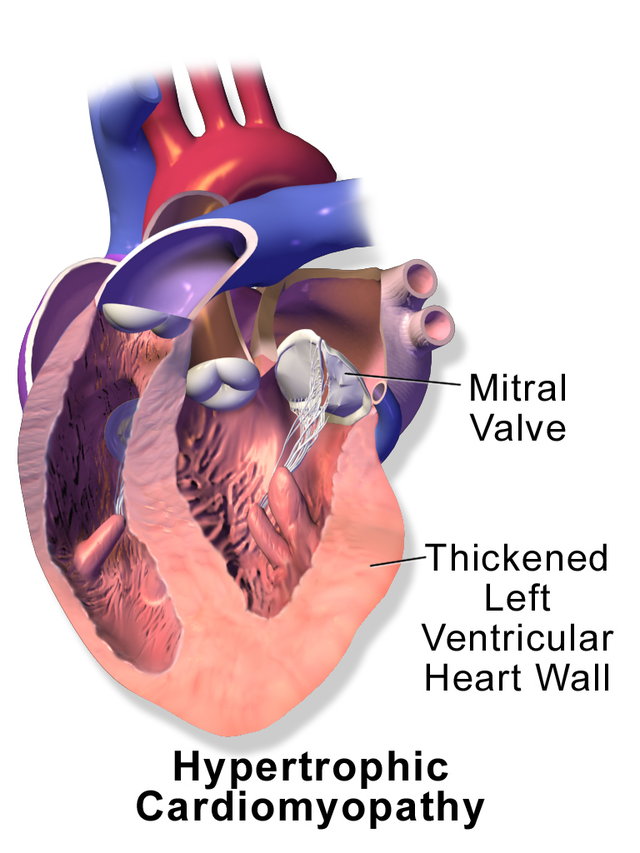
Cardiomyopathie hypertrophique
Dans cardiomyopathie hypertrophique le heart muscle becomes thickened (hypertrophies) in parts of the heart. In the normal heart, the muscle cells are regular and patterned. Hypertrophic cardiomyopathy is a disease in which the heart muscle becomes thickened. The muscle surrounding the left ventricle is the area commonly a... How common is.

Patient information leaflet
Dystrophie musculaire de Duchenne
This type of treatment has improved over recent years, which has helped to improve the quality of life and outlook for people with DMD. Heart (cardiac) complications Teenagers and adults with DMD may develop a cœur problem called la cardiomyopathie , which means weakness du heart muscle. With DMD, the cardiomyopathy does not usually cause much in.
Lectures complémentaires et références
- Familial restrictive cardiomyopathy; MedlinePlus, National Library of Medicine.
- Elliott P, Andersson B, Arbustini E, Bilinska Z, Cecchi F, Charron P, Dubourg O, Kuhl U, Maisch B, McKenna WJ, Monserrat L, Pankuweit S, Rapezzi C, Seferovic P, Tavazzi L, Keren A. Classification of the cardiomyopathies: a position statement from the European Society Of Cardiology Working Group on Myocardial and Pericardial Diseases. Eur Heart J. 2008 Jan;29(2):270-6. doi: 10.1093/eurheartj/ehm342. Epub 2007 Oct 4.
- Kaski JP, Syrris P, Burch M, Tome-Esteban MT, Fenton M, Christiansen M, Andersen PS, Sebire N, Ashworth M, Deanfield JE, McKenna WJ, Elliott PM. Idiopathic restrictive cardiomyopathy in children is caused by mutations in cardiac sarcomere protein genes. Heart. 2008 Nov;94(11):1478-84. doi: 10.1136/hrt.2007.134684. Epub 2008 May 8.
- Mogensen J, Arbustini E. Restrictive cardiomyopathy. Curr Opin Cardiol. 2009 May;24(3):214-20. doi: 10.1097/hco.0b013e32832a1d2e. No abstract available.
- Muchtar E, Blauwet LA, Gertz MA. Restrictive Cardiomyopathy: Genetics, Pathogenesis, Clinical Manifestations, Diagnosis, and Therapy. Circ Res. 2017 Sep 15;121(7):819-837. doi: 10.1161/CIRCRESAHA.117.310982.
- Nihoyannopoulos P, Dawson D. Restrictive cardiomyopathies. Eur J Echocardiogr. 2009 Dec;10(8):iii23-33. doi: 10.1093/ejechocard/jep156.
- Sen-Chowdhry S, Syrris P, McKenna WJ. Genetics of restrictive cardiomyopathy. Heart Fail Clin. 2010 Apr;6(2):179-86. doi: 10.1016/j.hfc.2009.11.005.
- Xu Q, Dewey S, Nguyen S, Gomes AV. Malignant and benign mutations in familial cardiomyopathies: insights into mutations linked to complex cardiovascular phenotypes. J Mol Cell Cardiol. 2010 May;48(5):899-909. doi: 10.1016/j.yjmcc.2010.03.005. Epub 2010 Mar 16.
Historique de l'article
Article également disponible en Anglais, Allemand, Espagnol, Français, Italien, Portugais, Hindi, Hébreu, Arabe, and Suédois.
30 sept. 2025 | Dernière version
1 Jan 2011 | Publié à l'origine
Participez à la conversation
Partagez vos pensées ou expériences avec les autres dans notre communautés de patients.

Demandez, partagez, connectez-vous.
Parcourez les discussions, posez des questions et partagez vos expériences sur des centaines de sujets de santé.
Inscrivez-vous à la newsletter Patient
Votre dose hebdomadaire de conseils de santé clairs et fiables - rédigés pour vous aider à vous sentir informé, confiant et maître de la situation.
En vous abonnant, vous acceptez notre Politique de confidentialité. Vous pouvez vous désabonner à tout moment. Nous ne vendons jamais vos données.