Hypomyelination with brainstem and spinal cord involvement and leg spasticity
Dernière mise à jour 18 août 2023
Respecte les directives éditoriales
- TéléchargerTélécharger
- Partager
- Language
- Discussion
- Ask Patient
- Version audio
- Ajouter aux sources préférées sur Google
Hypomyelination with brainstem and spinal cord involvement and leg spasticity (HBSL) is a condition that affects the brain and spinal cord (central nervous system). In particular, the condition affects nerves in specific regions (called tracts) within the spinal cord and the brainstem, which is the part of the brain that connects to the spinal cord. HBSL is a form of leukodystrophy, which is a group of conditions that involve abnormalities of the nervous system's white matter. The white matter consists of nerve fibers covered by a fatty substance, called myelin, that insulates the fibers and promotes the rapid transmission of nerve impulses. In HBSL, the nervous system has a reduced ability to form myelin (hypomyelination).
Sélections vidéo pour Conditions génétiquesBibliothèque vidéo
Description
Hypomyelination with brainstem and spinal cord involvement and leg spasticity (HBSL) is a condition that affects the brain and spinal cord (central nervous system). In particular, the condition affects nerves in specific regions (called tracts) within the spinal cord and the brainstem, which is the part of the brain that connects to the spinal cord. HBSL is a form of leukodystrophy, which is a group of conditions that involve abnormalities of the nervous system's white matter. The white matter consists of nerve fibers covered by a fatty substance, called myelin, that insulates the fibers and promotes the rapid transmission of nerve impulses. In HBSL, the nervous system has a reduced ability to form myelin (hypomyelination).
In HBSL, early development of motor skills (such as rolling over and sitting) may be normal, but movement problems typically begin within the infant's first year. However, in some individuals, these problems do not appear until adolescence. The characteristic feature of HBSL is muscle stiffness (spasticity) in the legs that worsens over time. Most people with HBSL are unable to walk independently. Other neurological problems in affected individuals can include abnormal side-to-side movements of the eyes (nystagmus), weak muscle tone (hypotonia) in the torso, and mild intellectual disability.
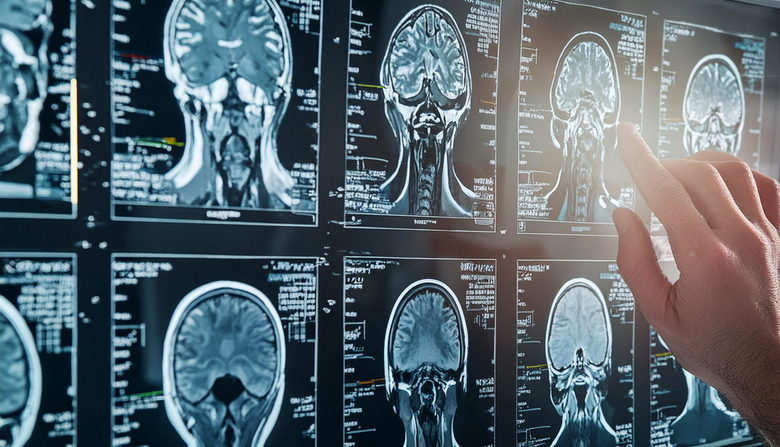
Distinct changes in the brains of people with HBSL can be seen using magnetic resonance imaging (MRI). These characteristic abnormalities typically involve specific regions (called tracts) within the brainstem and spinal cord, especially the pyramidal tract, lateral corticospinal tract, and the dorsal column.
Inheritance patterns
The source lists the following possible inheritance patterns: Autosomal recessive. More than one pattern can apply in different cases.
Related genes
Other names
Aspartyl-tRNA synthetase deficiency
HBSL
Hypomyelination with brain stem and spinal cord involvement and leg spasticity
Related patient information and medicines
Patient information leaflet
Sclérose en plaques
Multiple sclerosis is a disorder of the brain and spinal cord. In most cases, episodes of symptoms come and go for several years. Although there is no cure for multiple sclerosis, various medicines and therapies may reduce the number of flare-ups and can help to ease symptoms and disability. Multiple sclerosis (MS) is a disease where patches of.
Patient information leaflet
Relaxants musculaires
Baclofen, diazepam, methocarbamol and tizanidine act on the central nervous system (brain and spinal cord). Cannabis extract works on the brain and spinal cord as well as the muscles. In most cases it i... Motor neurone disease Baclofen, tizanidine, dantrolene, and gabapentin are sometimes used for muscle stiffness or spasticity in people with.
Patient information leaflet
Spondylose cervicale
This leaflet is aimed at people who have been told they have spondylose cervicale as a cause of leur neck symptoms. Cervical spondylosis is a 'wear and tear' of the vertebrae and discs in the neck. It is a normal part of ageing and does not cause symptoms in many people. The spinal cord, which contains nervous tissue carrying messages to and from.
Patient information leaflet
Neuropathie diabétique
Diabetic neuropathy is a type of nerve damage that can occur if you have type 1 diabetes Type 1 diabetes or type 2 diabetes Type 2 diabetes. Your peripheral nervous system is a network of nerves called peripheral nerves. These transmit information between your central nervous system (your brain and spinal cord) and all the other parts of your.
Patient information leaflet
Crampes aux jambes
Leg cramps are common and most common in the calf muscles. They can occur in any muscle group. The cause is not known in most cases. However, some medications and diseases... Quinine tablets may be advised as a last resort if the cramps occur regularly. What are leg cramps. A leg cramp is a pain that comes from a leg muscle. It is a muscle spasm,.

Patient information leaflet
Hernie discale
A slipped disc est un old-fashioned term and does not truly describe what happens in this condition. It is more common to refer to it as a "disc prolapse", "disc herniation" or "disc bulge". All the discs are the same - they have a stronger fibrous outer part a... The spinal cord contains the nerves cela come from the brain. Nerves from the spinal.
Lectures complémentaires et références
- Hypomyelination with brainstem and spinal cord involvement and leg spasticity; MedlinePlus, National Library of Medicine.
- Frohlich D, Suchowerska AK, Spencer ZH, von Jonquieres G, Klugmann CB, Bongers A, Delerue F, Stefen H, Ittner LM, Fath T, Housley GD, Klugmann M. In vivocharacterization of the aspartyl-tRNA synthetase DARS: Homing in on the leukodystrophy HBSL. Neurobiol Dis. 2017 Jan;97(Pt A):24-35. doi: 10.1016/j.nbd.2016.10.008. Epub 2016 Nov 2.
- Frohlich D, Suchowerska AK, Voss C, He R, Wolvetang E, von Jonquieres G, Simons C, Fath T, Housley GD, Klugmann M. Expression Pattern of the Aspartyl-tRNA Synthetase DARS in the Human Brain. Front Mol Neurosci. 2018 Mar 20;11:81. doi: 10.3389/fnmol.2018.00081. eCollection 2018.
- Taft RJ, Vanderver A, Leventer RJ, Damiani SA, Simons C, Grimmond SM, Miller D, Schmidt J, Lockhart PJ, Pope K, Ru K, Crawford J, Rosser T, de Coo IF, Juneja M, Verma IC, Prabhakar P, Blaser S, Raiman J, Pouwels PJ, Bevova MR, Abbink TE, van der Knaap MS, Wolf NI. Mutations in DARS cause hypomyelination with brain stem and spinal cord involvement and leg spasticity. Am J Hum Genet. 2013 May 2;92(5):774-80. doi: 10.1016/j.ajhg.2013.04.006.
- Wolf NI, Toro C, Kister I, Latif KA, Leventer R, Pizzino A, Simons C, Abbink TE, Taft RJ, van der Knaap MS, Vanderver A. DARS-associated leukoencephalopathy can mimic a steroid-responsive neuroinflammatory disorder. Neurology. 2015 Jan 20;84(3):226-30. doi: 10.1212/WNL.0000000000001157. Epub 2014 Dec 19.
Partagez vos pensées ou expériences avec les autres dans notre communautés de patients.
Accès simple à des traitements fiables et à des services de santé en ligne.
Common conditions
Get help with common conditions through the NHS, without a GP appointment.





Inscrivez-vous à la newsletter Patient
Votre dose hebdomadaire de conseils de santé clairs et fiables - rédigés pour vous aider à vous sentir informé, confiant et maître de la situation.
En vous abonnant, vous acceptez notre Politique de confidentialité. Vous pouvez vous désabonner à tout moment. Nous ne vendons jamais vos données.