Leg cramps
Peer reviewed by Dr Philippa Vincent, MRCGPLast updated by Dr Surangi Mendis, MRCGPLast updated 21 Sept 2023
Meets Patient’s editorial guidelines
- DownloadDownload
- Share
- Language
- Discussion
- Audio Version
- Add to preferred sources on Google
Leg cramps are common and most common in the calf muscles. They can occur in any muscle group. The cause is not known in most cases. However, some medications and diseases can cause leg cramps. Regular calf stretching exercises may prevent leg cramps. Quinine tablets may be advised as a last resort if the cramps occur regularly.
At a glance
A leg cramp is a painful, involuntary muscle spasm, usually in the calf.
They typically last a few minutes, and the muscle may be tender for up to 24 hours.
Leg cramps are common, especially in older people and often occur at night.
Most leg cramps have no known cause, but some medicines or conditions can be a factor.
Stretching and massaging the affected muscle can relieve a cramp.
Regular calf stretching exercises are often recommended to help prevent cramps.
See a doctor if you take certain medicines, have other symptoms, or your cramps are frequent.
What are leg cramps?
A leg cramp is a pain that comes from a leg muscle. It is a muscle spasm, which occurs when a muscle contracts too hard. This is an involuntary contraction, meaning that the affected person has no control over how and when it occurs. It usually occurs in a calf muscle, below and behind a knee. The small muscles of the feet, or muscles elsewhere in the leg, are sometimes affected.
Charley horse is another term used for leg cramps. This name tends to be used more in the US.
How long do leg cramps last?
A cramp pain typically lasts a few minutes. In some cases it lasts just seconds but in some can last up to 10 minutes. The severity of the pain varies. The muscle may remain tender for up to 24 hours after a leg cramp. Leg cramps usually occur at rest, most commonly at night in bed. They are often called night cramps. It can become a distressing condition if the cramp pain causes waking at night and sleep is regularly disturbed.
Who gets leg cramps?
Many people have an occasional leg cramp. However, they occur more frequently in some people, even daily. They are more common in older people. About 1 in 3 people over the age of 60 and about half of people over the age of 80 have regular leg cramps. About 4 in 10 people who have leg cramps have at least three per week.
What causes leg cramps?
Unknown cause (idiopathic leg cramps)
In most cases the cause is not known. One theory is that cramps occur when a muscle that is already in a shortened position is stimulated to contract. As the muscle is already shortened, to contract further may cause the muscle to go into spasm.
Secondary causes
In some cases, the cramps may be a symptom of another problem. For example:
Some medicines can cause cramps as a side-effect, or make cramps occur more often. These include: 'water' tablets called thiazide diuretics and loop diuretics, nifedipine, cimetidine, salbutamol, statins, terbutaline, lithium, penicillamine and phenothiazines (prochlorperazine, perphenazine, chlorpromazine).
Over-exertion of muscles.
Lack of fluid in the body (dehydration).
Conditions that cause alterations in the balance of salts in the bloodstream (such as a high or low sodium or potassium level).
Some people who have kidney (renal) dialysis have leg cramps.
Pregnancy - usually in the later stages.
An untreated underactive thyroid gland.
Peripheral arterial disease, where narrowing of the leg arteries causes poor circulation.
Excess alcohol.
Rare causes which include 'scarring' of the liver (cirrhosis), lead poisoning and an inflammatory condition called sarcoidosis.
With the above conditions the cramps would just be one of various other symptoms. Therefore, if a person with leg cramps is otherwise well and has no other unexplained symptoms, they are likely to be of unknown cause (idiopathic) and not due to a secondary cause.
Note: leg cramps are different to a condition called restless legs syndrome. In this condition the legs can be uncomfortable, creeping sensations are felt in the legs and it is relieved by walking about.
What causes leg cramps at night?
Leg cramps commonly occur at night in bed, as the natural position we lie in is with the knees slightly bent (flexed) and with feet pointing slightly downwards. In this position the calf muscle is relatively shortened and may be prone to cramps. This theory explains why stretching the muscles may cure the problem.
How to get rid of leg cramps
Stretching and massaging the affected muscle can usually relieve an attack of cramp. Most cramps soon ease off. Painkillers are not usually helpful as they do not act quickly enough. However, a painkiller such as paracetamol may help to ease muscle discomfort and tenderness that sometimes persist for up to 24 hours after a cramp has gone.
General measures will help with cramp in any muscle, but the stretches mentioned will only benefit calf muscle cramp.
Preventing leg cramps
If cramps do not occur often then no particular treatment is usually needed. However, if the leg cramps are frequent, ways to prevent them may be considered.
Consider medication (where appropriate) or other conditions
Discuss with a doctor if you take any of the medicines listed above. They may be causing the leg cramps, or making them recur more often. Alternatives may be available. Also, if other symptoms occur apart from cramps, see a doctor. He or she may suggest an examination or do some checks to rule out a secondary cause for the cramps.
Stretching exercises
Diagram of a Stretching Exercise
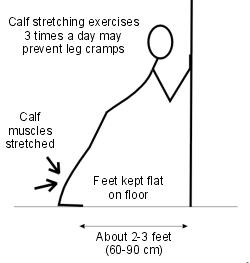
Stretching exercises are commonly advised. However, there is a lack of good research evidence to prove that they work. One research study concluded that stretching exercises did reduce the number and severity of cramps; however, another study did not confirm this. Nevertheless, many doctors and those who experience regular leg cramps feel that regular calf stretching does help. If it works, no tablets will be needed to prevent the cramps.
At first, do stretching exercises of affected muscles for about five minutes, three times a day. Do the last exercise shortly before bedtime. If the cramps ease off, the exercise may then only be needed once or twice a day to keep the cramps away.
To stretch calf muscles, stand about 60-90 cm from a wall. Then, keeping the soles of the feet flat on the floor, bend forwards and lean on the wall. The calf muscles will be felt to stretch. Do this several times, each time for as long as possible. It may take a week or so of exercises before an improvement is seen. So, it is worth attempting a 2- to 4-week trial of regular calf stretching exercises to see if the cramps ease off. They may not go completely, but their frequency and/or severity may reduce.
Posture of the legs when resting in bed
Positions which prevent the calf muscle from shortening whilst sleeping may help. The following are not proven treatments (from research); however, some experts believe that they help to prevent cramps:
Using a pillow to prop the feet up in bed while sleeping on the back.
Hanging the feet over the end of the bed while sleeping on the front.
Keeping blankets loose at the foot of the bed to prevent toes and feet from pointing downwards during sleep.
Quinine is used as a last resort
Quinine may reduce the number and/or severity of leg cramps although it might not stop them altogether. One tablet at bedtime is the normal dose.
However, there are a number of serious side-effects associated with quinine, including heart rhythm problems (arrythmias). Therefore, quinine is only used as a last resort when other treatments have not worked and the leg cramps are frequent and are affecting quality of life.
Other treatments
Other medicines have been suggested as possible treatments for leg cramps. These include magnesium, diltiazem, vitamin B complex, vitamin E, naftidrofuryl, orphenadrine and verapamil.
In general, these are not currently recommended, as most studies involving them found that they do not work very well in most people. Quinine remains the main treatment. However, a trial of one of these medicines may be suggested by a doctor if quinine has not worked or it caused troublesome side-effects.
Patient picks for Muscle problems

Bones, joints and muscles
Muscular dystrophy
Muscular dystrophy is an inherited (genetic) disorder causing muscle weakness. There are different types of muscular dystrophy, which vary as to how severe they are, ranging from very mild to severe. The different types also vary as to what age they begin. If muscular dystrophy is suspected, tests can help to make an accurate diagnosis. Other people in the family can also be tested to see if they have a muscular dystrophy gene. Muscular dystrophy cannot be cured but there are various treatments which can help.
by Dr Doug McKechnie, MRCGP

Bones, joints and muscles
Myasthenia gravis
Myasthenia gravis (MG) is a condition where muscles become easily tired and weak. It is due to a problem with how the nerves stimulate the muscles to tighten (contract). The muscles around the eyes are commonly affected first. This causes drooping eyelids and double vision. Treatment is usually effective. However, relapses are common and many people with myasthenia gravis have long-term difficulties with their daily activities.
by Dr Caroline Wiggins, MRCGP
Frequently asked questions
Can dehydration cause leg cramps?
Yes, dehydration, which is a lack of fluid in the body, is listed as one of the potential secondary causes of leg cramps. Ensuring you are adequately hydrated may help prevent them.
What is the difference between leg cramps and restless legs syndrome?
Leg cramps are different from restless legs syndrome. Leg cramps involve a painful, involuntary muscle contraction, usually in the calf. Restless legs syndrome, in contrast, is characterised by uncomfortable, creeping sensations in the legs, which are typically relieved by walking around.
Are there any specific medical conditions more commonly associated with leg cramps?
Yes, several medical conditions can be associated with leg cramps as a secondary symptom. These include conditions that cause an imbalance of salts in the bloodstream (like high or low sodium or potassium), kidney dialysis, pregnancy, an untreated underactive thyroid gland, and peripheral arterial disease which affects circulation in the legs. Rare causes also include cirrhosis, lead poisoning, and sarcoidosis.
What is 'idiopathic leg cramp'?
Idiopathic leg cramp refers to cases where the cause of the cramp is unknown. This is actually the most common reason for leg cramps. One theory suggests they occur when a muscle that is already in a shortened position is stimulated to contract, leading to a spasm.
If I get leg cramps, does it mean I have a serious underlying health problem?
Not usually. In most cases, the cause of leg cramps is unknown and not due to a serious problem. If you are otherwise well and experiencing leg cramps without any other unexplained symptoms, they are likely to be idiopathic. However, if you have other symptoms in addition to leg cramps, it's worth discussing this with a doctor to rule out any secondary causes.
Further reading and references
- Quinine: reminder of dose-dependent QT-prolonging effects; updated medicine interactions; GOV.UK, 2017
- Luo L, Zhou K, Zhang J, et al; Interventions for leg cramps in pregnancy. Cochrane Database Syst Rev. 2020 Dec 4;12:CD010655. doi: 10.1002/14651858.CD010655.pub3.
- Hawke F, Sadler SG, Katzberg HD, et al; Non-drug therapies for the secondary prevention of lower limb muscle cramps. Cochrane Database Syst Rev. 2021 May 17;5:CD008496. doi: 10.1002/14651858.CD008496.pub3.
- Leg cramps; NICE CKS, December 2022 (UK access only)
- Saguil A, Lauters R; Quinine for Leg Cramps. Am Fam Physician. 2016 Feb 1;93(3):177-8.
About the authorView full bio

Dr Surangi Mendis, MRCGP
Consultant and Medical Author
MBBS, BSc (1st), MRCGP (2014), DFSRH, PGcert otology and audiology
Surangi Mendis is a consultant in Audiovestibular Medicine and Neuro-otology at The Royal National ENT and Eastman Dental Hospitals, UCLH.
About the reviewerView full bio

Dr Philippa Vincent, MRCGP
General Practitioner, Medical Author
MB BS, Bsc, MRCGP (2000), DCH, DFSRH, DRCOG
Dr Philippa Vincent is an NHS GP working in North London.
Article history
Article also available in English, German, Spanish, French, Italian, Portuguese, Hindi, Hebrew, Arabic, and Swedish.
Next review due: 19 Sept 2028
21 Sept 2023 | Latest version
Join the conversation
Share your thoughts or experiences with others in our patient communities.

Ask, share, connect.
Browse discussions, ask questions, and share experiences across hundreds of health topics.

Feeling unwell?
Assess your symptoms online for free
Sign up to the Patient newsletter
Your weekly dose of clear, trustworthy health advice - written to help you feel informed, confident and in control.
By subscribing you accept our Privacy Policy. You can unsubscribe at any time. We never sell your data.
More in bones, joints and muscles
- Ankylosing spondylitis
- Back pain in children
- Biological medicines for rheumatoid arthritis
- Cervical rib
- Ehlers-Danlos syndrome
- Hamstring injury
- Hip fracture
- Knee and kneecap pain
- Lupus
- Meniscal tears
- Metatarsal fractures
- Osteoporosis
- Preventing steroid-induced osteoporosis
- Primary bone cancer
- Repetitive strain injury
- Shin splints
- Shoulder pain
- Slipped disc
- Systemic sclerosis
- Thoracic back pain