Parathyroid cancer
Dernière mise à jour 18 Aug 2020
Respecte les directives éditoriales
- TéléchargerTélécharger
- Partager
- Language
- Discussion
- Version audio
- Ajouter aux sources préférées sur Google
Parathyroid cancer is a rare cancer that usually affects people in their forties or fifties and occurs in one of the four parathyroid glands. The parathyroid glands are located in the neck and secrete parathyroid hormone, which enhances the release of calcium into the blood.
Description
Parathyroid cancer is a rare cancer that usually affects people in their forties or fifties and occurs in one of the four parathyroid glands. The parathyroid glands are located in the neck and secrete parathyroid hormone, which enhances the release of calcium into the blood.
In about 90 percent of cases, the early signs of parathyroid cancer are high levels of parathyroid hormone (hyperparathyroidism) and calcium (hypercalcemia) in the blood. In these cases, the cancer is described as hormonally functional because the parathyroid glands are producing excess hormone.
Many individuals with hormonally functional parathyroid cancer develop hypercalcemic crisis, in which calcium levels in the blood are very high. Neurological problems can develop, including changes in mood and depression. About 30 percent of individuals with hypercalcemia due to parathyroid cancer develop kidney and skeletal problems. These problems include increased urine production (polyuria), deposits of calcium in the kidneys (nephrocalcinosis) leading to the formation of kidney stones (nephrolithiasis), bone pain, bone loss, and increased bone fractures. Abdominal pain, inflammation of the pancreas (pancreatitis), sores (ulcers) in the lining of the digestive tract, nausea, vomiting, weight loss, and fatigue are also common.
About 10 percent of cases of parathyroid cancer are described as hormonally nonfunctional. In these cases, levels of parathyroid hormone and calcium are normal. The signs and symptoms of hormonally nonfunctional parathyroid cancer are related to the tumour obstructing nearby structures in the neck. These problems include difficulty swallowing (dysphagia) and speaking (dysarthria), a hoarse voice, shortness of breath (dyspnea), or vocal cord paralysis.
Up to 85 percent of individuals with parathyroid survive at least 5 years after they are diagnosed. The disease recurs in approximately half of individuals. If cancer does recur, it will commonly be within 3 years of the original diagnosis and up to 78 percent of people with recurrent cancer survive at least 5 years. Hormonally nonfunctional parathyroid cancer has a lower survival rate because it is often found at a later stage, as it does not have early signs such as increased calcium and parathyroid hormone levels.
In hormonally functional parathyroid cancer, death is usually caused by organ failure (usually kidney failure) due to prolonged hypercalcemia and not directly due to the tumour. In hormonally nonfunctional parathyroid cancer, the cause of death is typically related to the tumour itself, such as its impact on the function of nearby structures or its spread to other tissues (metastasis).
Inheritance patterns
The source lists the following possible inheritance patterns: Not inherited; Autosomal dominant. More than one pattern can apply in different cases.
Related genes
Other names
Cancer of the parathyroid
Cancer of the parathyroid gland
Carcinoma of parathyroid gland
Malignant neoplasm of parathyroid
Malignant neoplasm of parathyroid gland
Malignant parathyroid gland neoplasm
Malignant parathyroid gland tumour
Malignant parathyroid neoplasm
Malignant parathyroid tumour
Malignant tumour of parathyroid
Malignant tumour of parathyroid gland
Parathyroid adenocarcinoma
Parathyroid carcinoma
Parathyroid gland cancer
Parathyroid gland carcinoma
Parathyroid neoplasms
Related patient information and medicines
Patient information leaflet
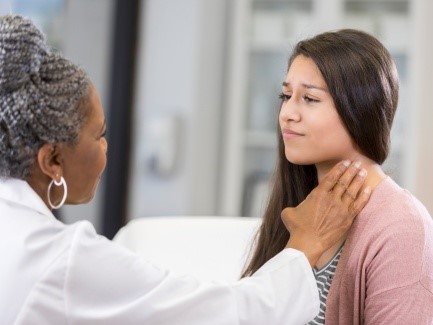
Problèmes de thyroïde et de parathyroïde
This leaflet gives a brief overview of the thyroid and parathyroid glands and the common medical problems which can occur with these. What are the thyroid and parathyroid glands... The hormone produced by the parathyroid also helps to control the amount of these essential minerals. Types of thyroid disorders Cancer of the thyroid (thyroid cancer)..
Patient information leaflet
Hyperparathyroïdie
Hyperparathyroidism occurs when too much parathyroid hormone is released by the parathyroid glands in the neck. There is a non-cancerous (benign) tumour of one of your parathyroid glands. Parathyroid carcinoma. Very rarely, primary hyperparathyroidism est caused by cancer in one de le parathyroid glands. It is usually not clear why pa... However,.
Patient information leaflet
Hypoparathyroïdie
For example, during surgery o... Sometimes the parathyroid glands sont removed car of potential cancer, or as a treatment for overactive parathyroid glands. Radiotherapy treatment for a cancer in the neck or the chest can damage the parathyroid glands and make them underactive. Certain medicines used in the treatment of cancers can do the same..
Patient information leaflet
Cancer de la thyroïde
Thyroid cancer is not a very common type of cancer. There are different types of thyroid cancer which have different treatments. What is thyroid cancer. Thyroid cancer is cancer of the thyroid gland, which is a small gland in the neck. See the separate leaflet called Thyroid Problèmes (also including Parathyroid Glands) to read more about the.
Patient information leaflet
Types de cancer
...tal Cancer) Gynaecological Cancer Hodgkin's Lymphoma Kidney Cancer Leukaemia Lung Cancer Mouth Cancer (Oral Cancer) Neck Lumps and Bumps Neuroblastoma Non-Hodgkin's Lymphoma Oesophageal Cancer Ovarian Cancer Pancreatic Cancer Penile Cancer Primary Bone Cancer Primary Liver Cancer Prostate Cancer Retinoblastoma Rhabdomyosarcoma Scrotal Lumps,.

Patient information leaflet
Causes du cancer
Certains facteurs de risque sont connus pour augmenter la probabilité qu'une ou plusieurs de vos cellules deviennent anormales et conduisent au cancer. How does cancer start. The body is made up from millions of tiny cells. Different parts of the body such as organs, bones, muscles, skin and blood are made up from different specialised cells. Most cells have a centre.
Lectures complémentaires et références
- Parathyroid cancer; MedlinePlus, National Library of Medicine.
- Cetani F, Pardi E, Marcocci C. Update on parathyroid carcinoma. J Endocrinol Invest. 2016 Jun;39(6):595-606. doi: 10.1007/s40618-016-0447-3. Epub 2016 Mar 21.
- Goswamy J, Lei M, Simo R. Parathyroid carcinoma. Curr Opin Otolaryngol Head Neck Surg. 2016 Apr;24(2):155-62. doi: 10.1097/MOO.0000000000000234.
- McClenaghan F, Qureshi YA. Parathyroid cancer. Gland Surg. 2015 Aug;4(4):329-38. doi: 10.3978/j.issn.2227-684X.2015.05.09.
- Serrano-Gonzalez M, Shay S, Austin J, Maceri DR, Pitukcheewanont P. A germline mutation of HRPT2/CDC73 (70 G>T) in an adolescent female with parathyroid carcinoma: first case report and a review of the literature. J Pediatr Endocrinol Metab. 2016 Sep 1;29(9):1005-12. doi: 10.1515/jpem-2016-0109.
- Wang L, Han D, Chen W, Zhang S, Wang Z, Li K, Gao Y, Zou S, Yang A. Non-functional parathyroid carcinoma: a case report and review of the literature. Cancer Biol Ther. 2015;16(11):1569-76. doi: 10.1080/15384047.2015.1070989. Epub 2015 Sep 25.
- Westin G. Molecular genetics and epigenetics of nonfamilial (sporadic) parathyroid tumours. J Intern Med. 2016 Dec;280(6):551-558. doi: 10.1111/joim.12458. Epub 2016 Apr 12.
Participez à la conversation
Partagez vos pensées ou expériences avec les autres dans notre communautés de patients.

Demandez, partagez, connectez-vous.
Parcourez les discussions, posez des questions et partagez vos expériences sur des centaines de sujets de santé.
Inscrivez-vous à la newsletter Patient
Votre dose hebdomadaire de conseils de santé clairs et fiables - rédigés pour vous aider à vous sentir informé, confiant et maître de la situation.
En vous abonnant, vous acceptez notre Politique de confidentialité. Vous pouvez vous désabonner à tout moment. Nous ne vendons jamais vos données.