growth hormone 1
Dernière mise à jour 18 Aug 2020
Respecte les directives éditoriales
- TéléchargerTélécharger
- Partager
- Language
- Discussion
- Ask Patient
- Version audio
- Ajouter aux sources préférées sur Google
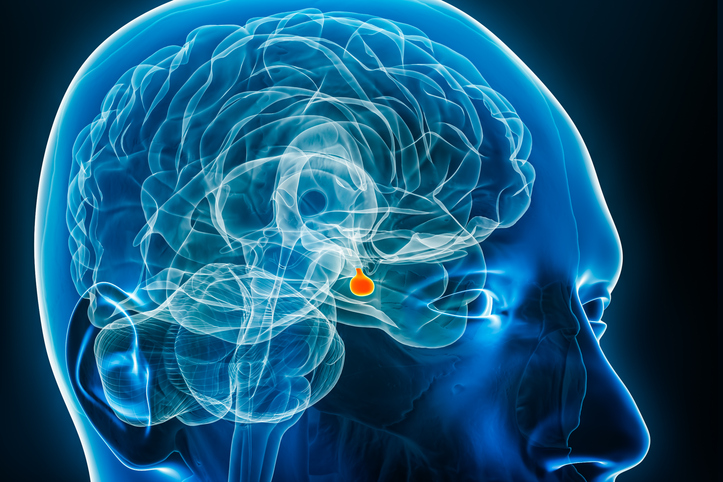
La GH1 gene provides instructions for making the growth hormone protein. Growth hormone is produced in the growth-stimulating somatotropic cells of the pituitary gland, which is located at the base of the brain. Growth hormone is necessary for the normal growth of the body's bones and tissues. The production of growth hormone is triggered when two other hormones are turned on (activated): ghrelin, which is produced in the stomach; and growth hormone releasing hormone, which is produced in a part of the brain called the hypothalamus. Ghrelin and growth hormone releasing hormone also stimulate the release of growth hormone from the pituitary gland. The release of growth hormone into the body peaks during puberty and reaches a low point at about age 55.
Sélections vidéo pour GènesBibliothèque vidéo
Normal function
La GH1 gene provides instructions for making the growth hormone protein. Growth hormone is produced in the growth-stimulating somatotropic cells of the pituitary gland, which is located at the base of the brain. Growth hormone is necessary for the normal growth of the body's bones and tissues. The production of growth hormone is triggered when two other hormones are turned on (activated): ghrelin, which is produced in the stomach; and growth hormone releasing hormone, which is produced in a part of the brain called the hypothalamus. Ghrelin and growth hormone releasing hormone also stimulate the release of growth hormone from the pituitary gland. The release of growth hormone into the body peaks during puberty and reaches a low point at about age 55.
Cells in the liver respond to growth hormone and trigger the production of a protein called insulin-like growth factor-I (IGF-I). This protein stimulates cell growth and cell maturation (differentiation) in many different tissues, including bone. The production of IGF-I by the actions of growth hormone is a major contributor to the promotion of growth.
Growth hormone also plays a role in many chemical reactions (metabolic processes) in the body. By acting on specific tissues, growth hormone is involved in protein production and the breakdown (metabolism) of fats and carbohydrates.
Conditions referring to this gene or chromosome
Other names
GH
GH-N
GHN
hGH-N
pituitary growth hormone
SOMA_HUMAN
somatotrophin (ST)
somatotropin
somatotropin (ST)
Related patient information and medicines

Patient information leaflet
Acromégalie
Acromégalie is a rare, progressive condition in which you make too much growth hormone. Rarely, acromegaly is caused by an overproduction of a hormone called growth hormone-releasing hormone (GHRH), which comes from the hypothalamus in the brain. Note : the rest of this leaflet is about acromégalie in adults. The goal de le un traitement is to lower.
Patient information leaflet
Troubles de l'hypophyse
This leaflet gives a brief overview of the pituitary gland et le hormones it makes. The pituitary gland is found at the base of the brain and is 'pea-sized'. Cushing's syndrome Prolactinoma. Prolactinoma Conditions where the pituitary gland fails to produce enough hormones include: Carence en hormone de croissance chez l'adulte. Diabetes insipidus Diabetes.

Patient information leaflet
Syndrome de Turner
Medication treatments The most important medication treatments are: Growth hormone This is sometimes started as early as 12-24 months of age. It should definitely be started as soon as it is clear that a child is not grow... Growth hormone replacement therapy has been shown to increase the final hauteur by as much as 10 cm. Growth hormone therapy.

Patient information leaflet
Croissance limitée
Dwarfism is a medical or genetic condition which causes people to have restricted growth so that they are shorter than average. Disorders which affect hormones (particularly growth hormone), major organs (for example, kidney diseases), bones or the body's general functioning (metabolism) can slow growth. Traitement that might be relevant includes:.

Patient information leaflet
Adrénarche
This leaflet was originally provided by Miriam Leach (written when a 4th year MB ChB student at Manchester University), used here with permission. What is adrenarche. Adrénarche (ad-ren-ar-ke) is known to be an ordinary bodily process that happens to boys and girls as they begin to make the transition to being a teenager. When does adrenarche.

Patient information leaflet
Calvitie masculine
Male pattern baldness is the common type of hair loss that develops in most men at some stage. Eventually, all that remains is a much smaller hair fo... Male hormones are involved in causing these changes: Cells in the skin of the scalp convert testosterone into another hormone called dihydrotestosterone. Affected hair follicles become more.
Lectures complémentaires et références
- growth hormone 1; MedlinePlus, National Library of Medicine.
- Alatzoglou KS, Dattani MT. Genetic causes and treatment of isolated growth hormone deficiency-an update. Nat Rev Endocrinol. 2010 Oct;6(10):562-76. doi: 10.1038/nrendo.2010.147.
- Alatzoglou KS, Turton JP, Kelberman D, Clayton PE, Mehta A, Buchanan C, Aylwin S, Crowne EC, Christesen HT, Hertel NT, Trainer PJ, Savage MO, Raza J, Banerjee K, Sinha SK, Ten S, Mushtaq T, Brauner R, Cheetham TD, Hindmarsh PC, Mullis PE, Dattani MT. Expanding the spectrum of mutations in GH1 and GHRHR: genetic screening in a large cohort of patients with congenital isolated growth hormone deficiency. J Clin Endocrinol Metab. 2009 Sep;94(9):3191-9. doi: 10.1210/jc.2008-2783. Epub 2009 Jun 30.
- Hamid R, Phillips JA 3rd, Holladay C, Cogan JD, Austin ED, Backeljauw PF, Travers SH, Patton JG. A molecular basis for variation in clinical severity of isolated growth hormone deficiency type II. J Clin Endocrinol Metab. 2009 Dec;94(12):4728-34. doi: 10.1210/jc.2009-0746. Epub 2009 Oct 16.
- Mullis PE. Genetic control of growth. Eur J Endocrinol. 2005 Jan;152(1):11-31. doi: 10.1530/eje.1.01797.
- Mullis PE. Genetics of isolated growth hormone deficiency. J Clin Res Pediatr Endocrinol. 2010;2(2):52-62. doi: 10.4274/jcrpe.v2i2.52. Epub 2010 May 1.
Partagez vos pensées ou expériences avec les autres dans notre communautés de patients.
Accès simple à des traitements fiables et à des services de santé en ligne.
Common conditions
Get help with common conditions through the NHS, without a GP appointment.





Inscrivez-vous à la newsletter Patient
Votre dose hebdomadaire de conseils de santé clairs et fiables - rédigés pour vous aider à vous sentir informé, confiant et maître de la situation.
En vous abonnant, vous acceptez notre Politique de confidentialité. Vous pouvez vous désabonner à tout moment. Nous ne vendons jamais vos données.