What is noninvasive prenatal testing (NIPT) and what disorders can it screen for?
Respecte les directives éditoriales
- TéléchargerTélécharger
- Partager
- Language
- Discussion
- Ask Patient
- Version audio
- Ajouter aux sources préférées sur Google
Noninvasive prenatal testing (NIPT), sometimes called noninvasive prenatal screening (NIPS), is a method of determining the risk that the fetus will be born with certain genetic abnormalities. This testing analyzes small fragments of DNA that are circulating in a pregnant woman’s blood. Unlike most DNA, which is found inside a cell’s nucleus, these fragments are free-floating and not within cells, and so are called cell-free DNA (cfDNA). These small fragments usually contain fewer than 200 DNA building blocks (base pairs) and arise when cells die off and get broken down and their contents, including DNA, are released into the bloodstream.
Sélections vidéo pour Understanding geneticsBibliothèque vidéo
Aperçu
Noninvasive prenatal testing (NIPT), sometimes called noninvasive prenatal screening (NIPS), is a method of determining the risk that the fetus will be born with certain genetic abnormalities. This testing analyzes small fragments of DNA that are circulating in a pregnant woman’s blood. Unlike most DNA, which is found inside a cell’s nucleus, these fragments are free-floating and not within cells, and so are called cell-free DNA (cfDNA). These small fragments usually contain fewer than 200 DNA building blocks (base pairs) and arise when cells die off and get broken down and their contents, including DNA, are released into the bloodstream.
During pregnancy, the mother’s bloodstream contains a mix of cfDNA that comes from her cells and cells from the placenta. The placenta is tissue in the uterus that links the fetus and the mother’s blood supply. These cells are shed into the mother’s bloodstream throughout pregnancy. The DNA in placental cells is usually identical to the DNA of the fetus. Analyzing cfDNA from the placenta provides an opportunity for early detection of certain genetic abnormalities without harming the fetus.
NIPT is most often used to look for chromosomal disorders that are caused by the presence of an extra or missing copy (aneuploidy) of a chromosome. NIPT primarily looks for Down syndrome (trisomy 21, caused by an extra chromosome 21), trisomy 18 (caused by an extra chromosome 18), trisomy 13 (caused by an extra chromosome 13), and extra or missing copies of the X chromosome et Y chromosome (the sex chromosomes). The accuracy of the test varies by disorder.
NIPT may include screening for additional chromosomal disorders that are caused by missing (deleted) or copied (duplicated) sections of a chromosome. NIPT is beginning to be used to test for genetic disorders that are caused by changes (variants) in single genes. As technology improves and the cost of genetic testing decreases, researchers expect that NIPT will become available for many more genetic conditions.
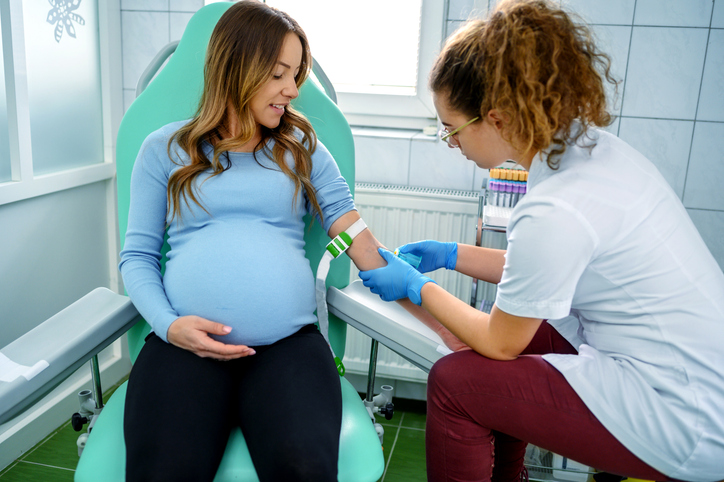
NIPT is considered noninvasive because it requires drawing blood only from the pregnant woman and does not pose any risk to the fetus. NIPT is a screening test, which means that it will not give a definitive answer about whether or not a fetus has a genetic condition. The test can only estimate whether the risk of having certain conditions is increased or decreased. In some cases, NIPT results indicate an increased risk for a genetic abnormality when the fetus is actually unaffected (false positive), or the results indicate a decreased risk for a genetic abnormality when the fetus is actually affected (false negative). Because NIPT analyzes both fetal and maternal cfDNA, the test may detect a genetic condition in the mother.
There must be enough fetal cfDNA in the mother’s bloodstream to be able to identify fetal chromosome abnormalities. The proportion of cfDNA in maternal blood that comes from the placenta is known as the fetal fraction. Generally, the fetal fraction must be above 4 percent, which typically occurs around the tenth week of pregnancy. Low fetal fractions can lead to an inability to perform the test or a false negative result. Reasons for low fetal fractions include testing too early in the pregnancy, sampling errors, maternal obesity, and fetal abnormality.
There are multiple NIPT methods to analyze fetal cfDNA. To determine chromosomal aneuploidy, the most common method is to count all cfDNA fragments (both fetal and maternal). If the percentage of cfDNA fragments from each chromosome is as expected, then the fetus has a decreased risk of having a chromosomal condition (negative test result). If the percentage of cfDNA fragments from a particular chromosome is more than expected, then the fetus has an increased likelihood of having a trisomy condition (positive test result). A positive screening result indicates that further testing (called diagnostic testing, because it is used to diagnose a disease) should be performed to confirm the result.
Related patient information and medicines

Patient information leaflet
Dépistage du syndrome de Down
There are two different types of tests that can be done to look for Down's syndrome during pregnancy - a screening test and a diagnostic test. If you are given a higher c... Alternatively, you may choose to have a second blood screening test called non-invasive prenatal screening (NIPT). You peuvent choose to have NIPT for Down's syndrome alone; just.
Patient information leaflet
Tests de dépistage pendant la grossesse
This leaflet discusses the routine pregnancy screening tests (antenatal checks) that should be offered to all pregnant women in the UK. If your combined test result shows that the chance of having a baby with Down's syndrome, Edwards' syndrome or Patau's syndrome is more than 1 in 150 this is called a hig... There is a second screening test called.

Patient information leaflet
Tests génétiques
Tests génétiques est a type of medical test that identifies changes in chromosomes, genes or proteins. Genes are short se... This type of test can be useful to provide information about a couple's risk of having a child with a genetic disorder. Prenatal testing Before birth (prenatal) testing is used to detect changes in an unborn baby's genes. This.
Patient information leaflet
Programme de dépistage du NHS
Screening involves tests on people without symptoms to check if they have a disease or condition before it causes symptoms. The reason for screening is the expectation that a problem can be discovered in the early stages and either prevented from progressing further or treated before they cause significant problems. A screening test is a check.

Patient information leaflet
Test de dépistage néonatal
Mothers of all newborn babies are offered testing for certain rare but serious health conditions by testing blood taken from the baby's heel. This is the blood spot screening programme and it is also known as the heel prick test. How is the blood test done. This is usually done by a health professional (usually a midwife or health visitor) during.

Patient information leaflet
Examens physiques pour nouveau-né
Many doctors will do this examination at the same time as your baby's first vaccina... These vaccinations start when your baby is 8 weeks old. The newborn and six-week examinations are screening tests that are done to check that your baby is healthy and to look for any possible problems that may need further tests or treatment in the future. What.
Lectures complémentaires et références
- What is noninvasive prenatal testing (NIPT) and what disorders can it screen for?; MedlinePlus, National Library of Medicine.
- Dungan JS, Klugman S, Darilek S, Malinowski J, Akkari YMN, Monaghan KG, Erwin A, Best RG; ACMG Board of Directors. Electronic address: documents@acmg.net. Noninvasive prenatal screening (NIPS) for fetal chromosome abnormalities in a general-risk population: An evidence-based clinical guideline of the American College of Medical Genetics and Genomics (ACMG). Genet Med. 2023 Feb;25(2):100336. doi: 10.1016/j.gim.2022.11.004. Epub 2022 Dec 16. Erratum in: Genet Med. 2023 Aug;25(8):100874. doi: 10.1016/j.gim.2023.100874. PMID: 36524989.
- Goldwaser T, Klugman S. Cell-free DNA for the detection of fetal aneuploidy. Fertil Steril. 2018 Feb;109(2):195-200. doi: 10.1016/j.fertnstert.2017.12.019. PubMed: 29447662.
- Guseh SH. Noninvasive prenatal testing: from aneuploidy to single genes. Hum Genet. 2020 Sep;139(9):1141-1148. doi: 10.1007/s00439-019-02061-1. Epub 2019 Sep 25. PMID: 31555907.
- Rose NC, Kaimal AJ, Dugoff L, Norton ME; American College of Obstetricians and Gynecologists’ Committee on Practice Bulletins—Obstetrics; Committee on Genetics; Society for Maternal-Fetal Medicine. Screening for Fetal Chromosomal Abnormalities: ACOG Practice Bulletin, Number 226. Obstet Gynecol. 2020 Oct;136(4):e48-e69. doi: 10.1097/AOG.0000000000004084. PubMed: 32804883.
Partagez vos pensées ou expériences avec les autres dans notre communautés de patients.
Accès simple à des traitements fiables et à des services de santé en ligne.
Common conditions
Get help with common conditions through the NHS, without a GP appointment.





Inscrivez-vous à la newsletter Patient
Votre dose hebdomadaire de conseils de santé clairs et fiables - rédigés pour vous aider à vous sentir informé, confiant et maître de la situation.
En vous abonnant, vous acceptez notre Politique de confidentialité. Vous pouvez vous désabonner à tout moment. Nous ne vendons jamais vos données.