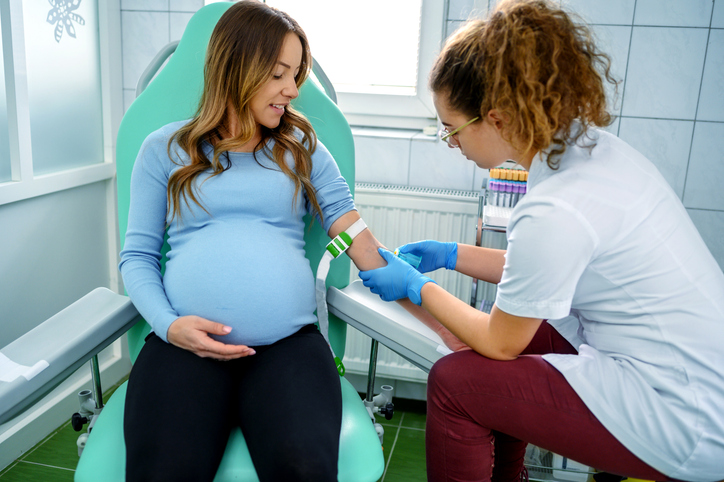
Tests de dépistage pendant la grossesse
Antenatal checks
Revu par Dr Colin Tidy, MRCGPDernière mise à jour par Dr Rosalyn Adleman, MRCGPDernière mise à jour 4 Mar 2023
Respecte les directives éditoriales
- TéléchargerTélécharger
- Partager
- Language
- Discussion
- Ask Patient
- Version audio
- Ajouter aux sources préférées sur Google
Dans cette série :Dépistage du syndrome de DownAmniocentèseBiopsie de villosités choriales
Cette brochure explique les tests de dépistage prénatal de routine (contrôles prénataux) qui doivent être proposés à toutes les femmes enceintes au Royaume-Uni. Il s'agit de tests de dépistage et de diagnostic effectués pour déterminer si votre bébé présente un problème de santé avant sa naissance. Des tests de dépistage du nouveau-né distincts sont proposés après la naissance de votre bébé.
En un coup d'œil
Les tests de dépistage pendant la grossesse visent à détecter les conditions tôt afin qu'un traitement puisse être proposé.
Vous devez accepter de passer ces tests ; ils ne sont pas obligatoires.
Les tests peuvent inclure des discussions sur votre santé, des examens physiques, et des échantillons d'urine ou de sang.
Des échographies sont régulièrement proposées pour vérifier la date prévue de l'accouchement et le développement du bébé.
Un test combiné dépiste des conditions telles que le syndrome de Down, le syndrome d'Edwards et le syndrome de Patau.
Un résultat indiquant une probabilité plus élevée lors d'un test de dépistage ne signifie pas que votre bébé a définitivement une condition.
Inscrivez-vous à notre cours gratuit de 8 semaines sur la grossesse en santé !
Chaque semaine, nous partagerons des informations utiles et des conseils essentiels sur des sujets tels que la nutrition, l'exercice, la santé mentale, les symptômes à surveiller et la préparation à l'accouchement, pour vous aider à naviguer dans votre parcours de grossesse, quel que soit le stade où vous en êtes.
En vous abonnant, vous acceptez notre Politique de confidentialité. Vous pouvez vous désabonner à tout moment. Nous ne vendons jamais vos données.
What are pregnancy screening tests?
A pregnancy screening test (also known as an antenatal check), aims to detect a disease or condition in the early stages before it causes significant problems, and where treatment can be offered. The potential benefits of any screening tests offered should outweigh any possible risks from the test.
Most pregnant women have normal test results. A small number of tests are abnormal. In these cases further assessment and/or treatment can be offered which may prevent serious problems. A midwife or doctor should discuss each test with you before it is done.
Are pregnancy screening tests compulsory?
No. You need to agree for the tests to be done. You can refuse to have a test if you do not want it.
What happens during a pregnancy screening test?
General history (talking to your doctor or midwife)
Early on in your pregnancy your doctor or midwife will ask various questions about your general health, family history and social history, and will ask about any previous pregnancies which you have had. Strictly speaking, this is not a test. However, it can raise issues which may need special attention during the pregnancy, which may prevent problems later in the pregnancy.
For example, if you have diabetes, or if you had pre-eclampsia in a previous pregnancy, you will need closer monitoring than usual during the pregnancy. If you have social or family problems such as domestic violence then you may need special help.
Physical examinations
Weight and height. Early on in the pregnancy your doctor or midwife will check your weight and height. This is to see if you are significantly underweight or overweight which may increase the risk of developing problems during pregnancy.
Assessing the growth of the baby. This is done by a midwife or doctor during routine antenatal checks. They use a tape to measure from the top of the growing womb (uterus) to the bone at the bottom of your tummy (pubic bone). If need be, une échographie can more accurately keep an eye on growth if it does not seem to be progressing normally.
Pression artérielle. This is measured regularly during routine antenatal checks. Together with a urine test to detect protein, this screens for a complication of pregnancy called pre-eclampsia. See the separate leaflet called Pre-eclampsia.
Examination of the baby's position. At about 36 weeks of pregnancy a doctor or midwife will examine your tummy (abdomen) to feel the baby to detect if the baby is lying bottom-down (breech). If so, treatment to turn the baby to a head-down position may be considered.
If you are otherwise healthy, other physical examinations are not routinely done. For example, routine vaginal or breast examinations used to be done in the past, but are not necessary. (They may be done if you have symptoms which warrant examination.)
Analyses d'urine
Urine is checked at antenatal checks using a simple dipstick test to detect:
Protéines. Protein in the urine may indicate early pre-eclampsia.
Sugar (glucose) as an initial check for diabetes.
Germs (bacteria). During pregnancy you can have an infection of the urine without symptoms (asymptomatic bacteriuria). This can increase the risk of problems later in pregnancy, such as early childbirth. It can be treated with antibiotic medication.
Analyses de sang
A sample of blood is taken early on in pregnancy and put into several tubes. These are sent to the laboratory to check for:
Anémie. The common reason for anaemia is lack of iron, which can usually be treated easily with iron tablets.
Blood group including rhesus D status and red cell antibodies. If you are rhesus D negative and your baby is rhesus positive then you may form anti-D antibodies in your bloodstream. These are not dangerous in the first pregnancy but can attack the blood cells of a baby who is rhesus D positive in any future pregnancy. To prevent this you will usually be offered anti-D injections later in your pregnancy.
Rubella status. This test checks for antibodies to German measles (the rubella virus). If antibodies are present it means that you are immune to this infection. If you are not immune, when you are pregnant you should keep away from anyone who may have rubella and consider being immunised.
Haemoglobin disorders. The blood test can detect if you're a carrier of sickle cell, thalassémie or another haemoglobin disorder.
Infections. Some uncommon but serious infections are checked for. These are:
VIH. You can be infected with HIV for years before it causes symptoms. The risk of passing this virus on to your baby can be greatly reduced with treatment during pregnancy, and delivery by caesarean section.
Hépatite B. Many people are carriers of the hepatitis B virus but have no symptoms. In some cases it can cause serious liver damage. If you have this virus, it may be prevented from affecting your baby if the baby is immunised at birth.
Syphilis. This is an uncommon sexually transmitted infection. Again, you can be infected with this germ (bacterium) without realising and pass it on to your baby. It can develop into a serious illness. It can be treated with antibiotics.
Diabète. If you have had a history of diabetes in a previous pregnancy (diabète gestationnel) then you will be tested for diabetes by a blood test in future pregnancies. In addition, you may be offered a test for diabetes if you have risk factors for diabetes; for example, if you:
Sont très en surpoids.
Have had a heavy baby in the past (≥4.5 kg).
Have a close family relative with diabetes.
Are from certain ethnic groups.
A repeat blood test at about 28 weeks is usually offered to check again for anaemia and red cell antibodies.
Les échographies
Une échographie is a safe and painless test which uses sound waves to create images of structures inside your body, such as an unborn baby. Two scans are normally offered:
An early pregnancy scan works out when your baby is due. The scan is usually done at around 10-13 weeks. This early scan confirms your baby's heart is beating and how many babies are growing inside your womb (uterus).
A fetal anomaly scan is offered later in your pregnancy. The scan is usually done at around 20 weeks. This looks for any developmental problems with your baby. There are variations across the UK as to exactly when and how fetal anomaly scanning is done.
Placenta prævia
Placenta praevia means that the placenta is covering the opening from the womb to the neck of the womb (cervix). This can cause serious problems during childbirth. If an earlier scan using sound waves (an ultrasound scan) indicates that you may have a placenta praevia, a repeat scan at 36 weeks of pregnancy may be advised. This is to clarify the position of your placenta before delivery.
Screening tests for the baby
The programme for checking for abnormalities in your baby differs across the UK. You can choose not to have some of the tests done if you prefer. The scan at around 20 weeks as described above checks for any problems with your baby's heart, kidneys, spine, etc and can check for conditions such as cleft lip/palate.
Combined Test
In England, Scotland and Wales, you will be offered a test to screen your baby for genetic abnormalities. Genetic means that the condition is passed on through special codes inside cells called genes.
The conditions which are checked for are:
Down's syndrome, also called trisomy 21.
Edwards' syndrome, also called trisomy 18.
Patau's syndrome, also called trisomy 13.
The test is called the combined test because it combines a blood test and an ultrasound scan. The ultrasound scan measures the fluid at the back of the baby's neck to determining the "nuchal translucency". The combined test can be done between 10 and 14 weeks at the same time as the blood tests and scan mentioned above. Your age and the results of these two tests are used to work out the chance of your baby having Down's syndrome, Edwards' syndrome or Patau's syndrome.
If you miss this time window, these conditions can also be screened for with a blood test between 14 and 20 weeks of pregnancy. This is called the quadruple test and only screens for Down's syndrome. It is less accurate than the combined test. In Northern Ireland some centres offer these tests in the same way, or you may be able to request them within the same time frames.
syndrome de Down
syndrome de Down is a genetic chromosomal problem that some people are born with. A person with Down's syndrome can usually be recognised by their typical features. It can also cause learning disability and certain medical problems. Someone with Down's syndrome has an extra copy of chromosome number 21 in the cells of their body.
Edwards' and Patau's syndrome
Babies with Edwards' syndrome and Patau's syndrome have an extra copy of chromosome number 18 or 13 respectively. Unfortunately, babies with Edwards' or Patau's syndromes have severe abnormalities and do not usually survive very long.
Pregnancy screening test results
The combined test results will provide you with information on the risk of your unborn baby having Down's syndrome, Edwards' syndrome or Patau's syndrome. It does not give you a definite diagnosis or a definite answer. The test tells you if your baby has a higher chance or lower chance of having one of these conditions.
A lower chance result does not mean there is no chance of your baby having Down's syndrome, Edwards' syndrome or Patau's syndrome. It means the chance is less than 1 in 150.
If your combined test result shows that the chance of having a baby with Down's syndrome, Edwards' syndrome or Patau's syndrome is more than 1 in 150 this is called a higher chance result. This does not mean your baby definitely does have one of these syndromes. You will then be offered further tests which you can choose whether to have or not.
There is a second screening test called non-invasive prenatal testing (NIPT). This can give you a more accurate screening result which might help you to decide whether to go on to have a diagnostic test or not.
Only diagnostic tests will give you a definite answer (these are amniocentesis et prélèvement de villosités choriales. These are not screening tests. They are, however, included here as they may be offered if a screening test is abnormal. Diagnostic tests are invasive prenatal tests and carry a small risk of miscarriage (approximately 1 in 200).
You do not have to have a screening test for Down's syndrome or other genetic conditions if you do not want one. If you have a screening test and it shows a higher chance of Down's syndrome, Edwards' syndrome or Patau's syndrome you do not have to a diagnostic test. Find out more about prenatal screening and diagnosis of Down's syndrome.
A final point
The above tests are the usual routine tests offered to all pregnant women. If you have symptoms or problems which suggest pregnancy complications, various other examinations and tests may be advised. See your midwife or doctor if you have any concerns about your pregnancy, or if you wish to discuss any tests in more detail.
Sélections des patients pour Tests de dépistage
Tests et investigations
Dépistage du cancer de l'intestin
Le cancer de l'intestin (colorectal) est courant. Le pronostic et les chances de guérison sont bien meilleurs si ce cancer est détecté à un stade précoce plutôt qu'à un stade avancé. Un programme de dépistage est en place au Royaume-Uni pour certains groupes d'âge. L'objectif est de proposer un test de dépistage simple pour détecter le cancer de l'intestin à un stade précoce, avant l'apparition des symptômes. Certaines personnes en dehors de l'âge normal de dépistage, qui présentent un risque élevé de développer un cancer de l'intestin, se voient proposer des tests de dépistage supplémentaires.
par Dr Hayley Willacy, FRCGP

Tests et investigations
Amniocentèse
La raison la plus courante pour laquelle une femme enceinte se voit proposer une amniocentèse est de vérifier si le bébé en développement présente un trouble chromosomique tel que le syndrome de Down.
par Dr Mary Harding, MRCGP
Questions fréquemment posées
Qu'est-ce que le test prénatal non invasif (NIPT) ?
Le NIPT est un test de dépistage qui peut fournir un résultat plus précis pour des conditions telles que le syndrome de Down, le syndrome d'Edwards et le syndrome de Patau par rapport au test combiné. Il peut vous aider à décider si vous souhaitez procéder à un test diagnostique.
Que se passe-t-il si je reçois un résultat de 'risque accru' d'un test de dépistage pour des conditions génétiques ?
Si votre test de dépistage montre un résultat de 'risque élevé' (ce qui signifie que le risque est supérieur à 1 sur 150) pour des conditions telles que le syndrome de Down, le syndrome d'Edwards ou le syndrome de Patau, cela ne signifie pas que votre bébé a définitivement l'un de ces syndromes. On vous proposera des tests supplémentaires, que vous pourrez choisir de faire ou non.
Y a-t-il des risques associés à des tests diagnostiques supplémentaires pour les conditions génétiques ?
Oui, les tests de diagnostic comme l'amniocentèse et le prélèvement de villosités choriales sont considérés comme invasifs. Ils comportent un petit risque de fausse couche, environ 1 sur 200.
Quelles conditions spécifiques l'échographie de dépistage des anomalies fœtales à 20 semaines peut-elle détecter ?
L'échographie de dépistage des anomalies fœtales à 20 semaines vérifie les problèmes de développement du cœur, des reins, de la colonne vertébrale de votre bébé, et peut également détecter des conditions telles que la fente labiale/palatine.
Quelle est la différence entre les tests de dépistage et les tests diagnostiques ?
Les tests de dépistage, comme le test combiné ou le NIPT, évaluent la probabilité ou la chance qu'une condition soit présente. Ils ne donnent pas de réponse définitive. Les tests diagnostiques, tels que l'amniocentèse ou le prélèvement de villosités choriales, fournissent une réponse définitive quant à la présence d'une condition, mais ils sont invasifs et comportent un petit risque.
Que se passe-t-il si l'échographie suggère que j'ai un placenta praevia en début de grossesse ?
Si une échographie antérieure indique que vous pourriez avoir un placenta praevia, une échographie de contrôle à 36 semaines de grossesse peut être recommandée. Cela permet de confirmer la position de votre placenta avant l'accouchement, car le placenta praevia peut causer des problèmes importants lors de l'accouchement.
Lectures complémentaires et références
- Amniocentèse et Prélèvement de Villosités Choriales; Collège Royal des Obstétriciens et Gynécologues (juin 2010 - mis à jour octobre 2021)
- Prophylaxie anti-D prénatale de routine pour les femmes qui sont rhésus D négatif; Orientation sur l'évaluation technologique du NICE, août 2008
- Programmes de dépistage de la population (Angleterre); GOV.UK
- Dépistage des anomalies fœtales : aperçu du programme; GOV.UK
- Ogilvie C, Akolekar R; Perte de grossesse après amniocentèse ou prélèvement de CVS - Il est temps de réévaluer le risque. J Clin Med. 2014 Jul 8;3(3):741-6. doi: 10.3390/jcm3030741.
- Zolotor AJ, Carlough MC; Mise à jour sur les soins prénatals. Am Fam Physician. 1er février 2014;89(3):199-208.
- Dépistage prénatal au Pays de Galles; Santé publique Pays de Galles
- Dépistage prénatal; Santé et Services Sociaux Irlande du Nord
- Soins prénatals; Recommandations NICE (août 2021)
- Antenatal screening programme Down's syndrome; GOV.UK
À propos de l'auteurVoir la biographie complète
Mis à jour par

Dr Rosalyn Adleman, MRCGP
MRCGP
Dr Rosalyn Adleman est médecin généraliste du NHS travaillant dans le nord de Londres.
À propos du critiqueVoir la biographie complète

Dr Colin Tidy, MRCGP
Médecin généraliste, Auteur médical
MBBS, MRCGP, MRCP (Paediatrics), DCH
Le Dr Colin Tidy est un médecin du NHS, basé dans l'Oxfordshire.
Historique de l'article
Article également disponible en Anglais, Allemand, Espagnol, Français, Italien, Portugais, Hindi, Hébreu, Arabe, and Suédois.
Prochaine révision prévue : 2 mars 2028
4 Mar 2023 | Dernière version
Partagez vos pensées ou expériences avec les autres dans notre communautés de patients.
Accès simple à des traitements fiables et à des services de santé en ligne.
Common conditions
Get help with common conditions through the NHS, without a GP appointment.





Inscrivez-vous à la newsletter Patient
Votre dose hebdomadaire de conseils de santé clairs et fiables - rédigés pour vous aider à vous sentir informé, confiant et maître de la situation.
En vous abonnant, vous acceptez notre Politique de confidentialité. Vous pouvez vous désabonner à tout moment. Nous ne vendons jamais vos données.