Doigt en maillet
Revu par Dr Colin Tidy, MRCGPDernière mise à jour par Dr Hayley Willacy, FRCGP Dernière mise à jour 15 sept. 2024
Respecte les directives éditoriales
- TéléchargerTélécharger
- Partager
- Language
- Discussion
- Version audio
- Ajouter aux sources préférées sur Google
A finger that bends down at the end joint and cannot be straightened is called a mallet finger. It is caused by an injury to the tendon that straightens (extends) the finger. A splint worn day and night for 6-8 weeks will cure the problem in most cases.
En un coup d'œil
A mallet finger is when the end of a finger bends towards the palm and cannot straighten.
It is caused by an injury that tears the tendon responsible for straightening the fingertip.
Symptoms include pain, swelling, and the inability to straighten the end of the finger.
Treatment usually involves wearing a splint continuously for 6-8 weeks.
Surgery may be needed if splinting does not work or if there is a cut to the finger.
What is a mallet finger?
A mallet finger describes a condition in which the end of a finger is bent (flexed) towards the palm and cannot straighten.
What causes a mallet finger?
The usual cause is an injury to the end of the finger. The injury tears the tendon that straightens (extends) the end of the finger.
It is sometimes called baseball finger, as it is a common injury when trying to catch a fast, hard ball. If the catch is missed slightly then the ball hits the straight finger. This may force the end of the finger to bend (flex) further than normal and tear the tendon. Without the use of this tendon, the finger stays bent (flexed).
Diagram of the hand showing mallet finger
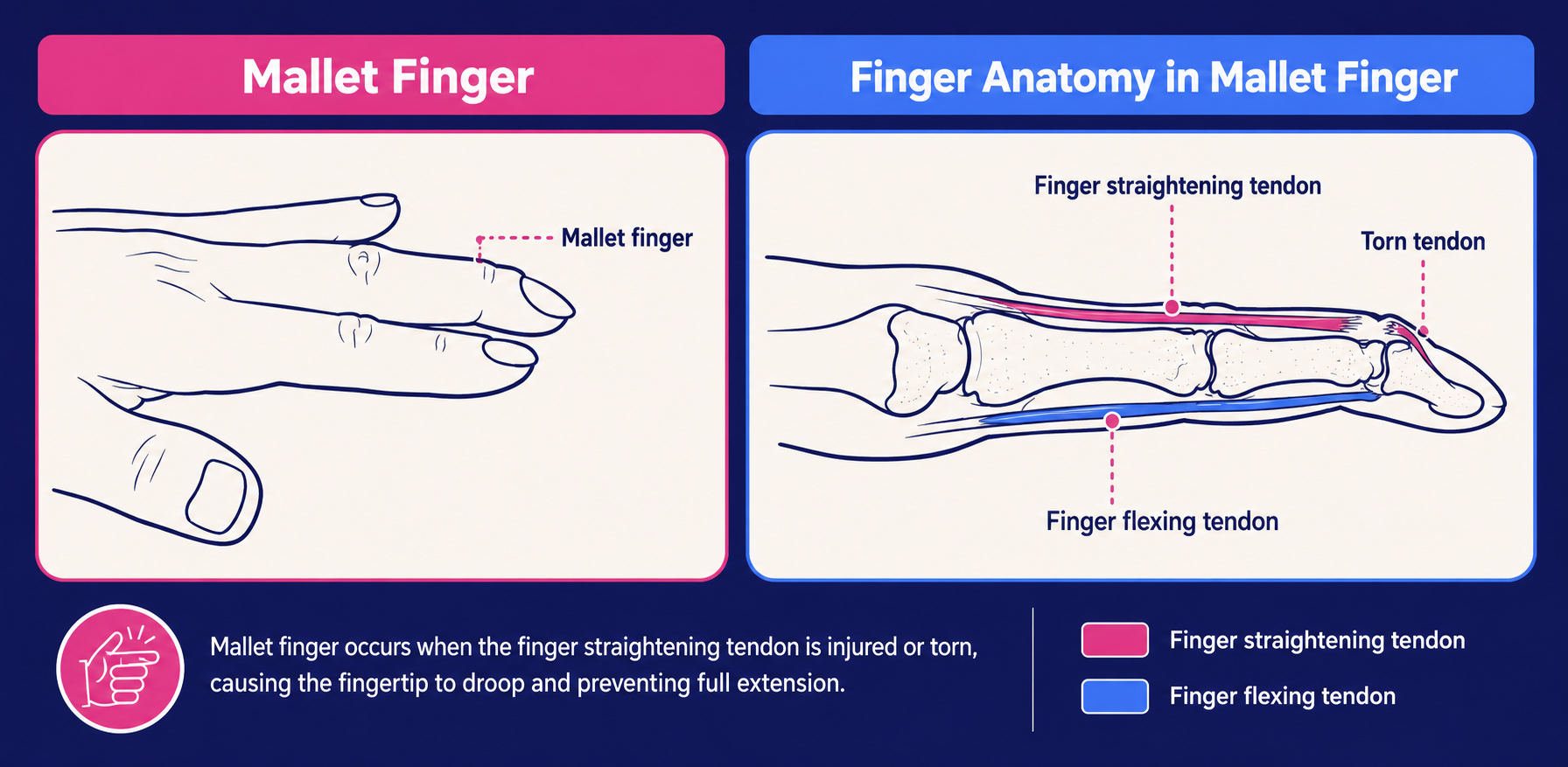
les blessures sportives are a common cause of mallet finger. However, any injury that forces the end joint of a finger to over-bend can cause it. (Sometimes the tendon does not tear but the injury causes a piece of bone to be pulled off the finger where the tendon is attached. This is called an avulsion fracture. The result is the same, as the tendon then cannot pull on the bone.)
What are the symptoms of a mallet finger?
After the injury, the end of your finger may:
Be painful and swollen.
Lie in a bent (flexed) position.
Not be able to straighten (extend) at the end.
Doigt en maillet
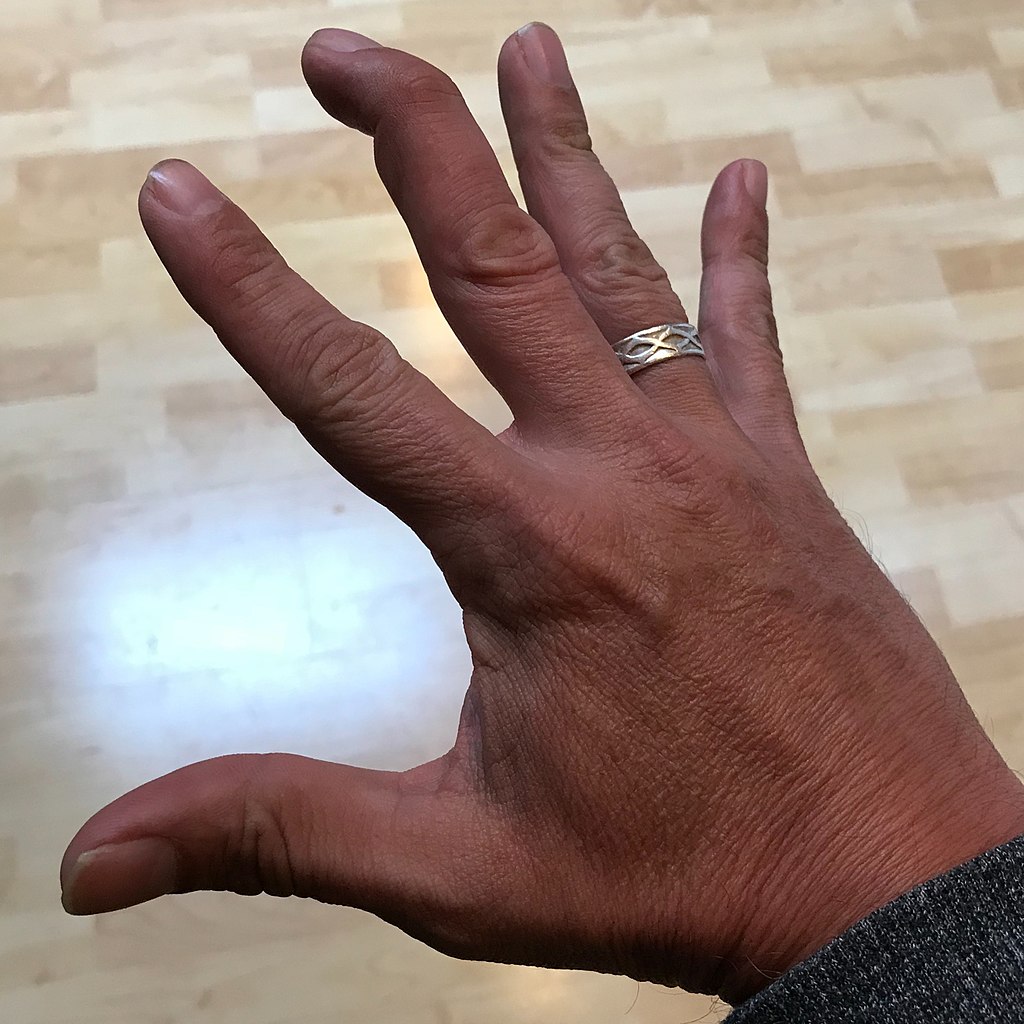
© Clappstar, CC BY-SA 4.0, via Wikimedia Commons
How is mallet finger diagnosed?
The clinician can usually diagnose a mallet finger from listening to how the injury occurred and how the finger looks and feels when examined. If there is any doubt they may request an x-ray.
What is the treatment for mallet finger?
Splint
A splint is worn for 6-8 weeks to keep the finger straight with the end joint bent backwards slightly (overextended). It must be worn all the time, day and night.
There are many different types of splints available. The type of splint given often depends on the size and shape of your finger. You must not take the splint off at any time during this treatment. If you have to take it off (for example, to wash) then you must keep that finger straight and not allow it to bend (flex).
Keeping the finger straight constantly allows the two ends of the torn tendon or bone to stay together and heal. About three in four cases heal well with this treatment.
Chirurgie
Surgery is needed to repair the torn tendon if the above fails. (Surgery may be advised straightaway if there is a cut to your finger; however, most injuries that cause mallet finger do not cut the skin.)
Recovering from mallet finger
It may take several months for your finger to fully recover its function. Any redness, swelling and tenderness of your skin over the end of your finger may persist for the first few months after the injury. These symptoms will usually improve eventually.
Can mallet finger be prevented?
As most mallet finger injuries occur during sports, taking care when playing with a hard ball is advisable but prevention may not always be possible. You can prevent the deformity returning by using the splint exactly as directed by your clinician.
Sélections des patients pour Douleur articulaire

Os, articulations et muscles
Épaule gelée
L'épaule gelée (en termes médicaux, capsulite adhésive de l'épaule) est une affection où l'épaule devient douloureuse et raide, souvent sans raison particulière. Les mouvements de l'épaule sont réduits, parfois complètement « gelés ». Elle ne touche généralement qu'une seule épaule, mais peut affecter les deux. On pense qu'elle est due à la formation de tissu cicatriciel dans la capsule de l'épaule. Sans traitement, les symptômes disparaissent généralement, mais cela peut prendre beaucoup de temps, jusqu'à trois ans dans certains cas. Divers traitements peuvent soulager la douleur et améliorer la mobilité de votre épaule.
par Dr Philippa Vincent, MRCGP

Os, articulations et muscles
Problèmes de hanche
Les problèmes de hanche sont assez courants. La cause peut être évidente, comme une blessure survenant soudainement lors de la pratique d'un sport. Parfois, la cause n'est pas aussi claire et vous devrez être examiné par un médecin ou un physiothérapeute.
par Dr Rachel Hudson, MRCGP
Questions fréquemment posées
What should I do immediately after getting a mallet finger injury?
The article suggests that after the injury, the end of your finger may be painful, swollen, and bent. While it doesn't give immediate first aid advice, generally for an injury that causes pain and swelling, it's advisable to avoid bending the affected finger and seek medical attention to confirm the diagnosis and receive appropriate treatment.
Are there different kinds of splints used for mallet finger?
Yes, there are many different types of splints available for mallet finger. The specific type you receive often depends on the size and shape of your finger.
How do I care for my skin if I'm wearing a splint for 6-8 weeks?
The article states that you must not take the splint off at any time during treatment, even to wash. However, if you absolutely have to remove it, you must keep the affected finger straight and not allow it to bend. This implies that cleaning around the splint or the finger itself would need to be done very carefully to ensure the finger remains straight.
What are the chances of my finger healing well with splint treatment?
About three in four cases of mallet finger heal well with splint treatment, provided it is worn exactly as directed.
When might surgery be considered as a first option for mallet finger?
Surgery may be advised straightaway if there is a cut to your finger. However, most injuries that cause mallet finger do not involve a cut through the skin.
After the splint is removed, can the mallet finger deformity come back?
Yes, the deformity can return. To prevent this, it's crucial to use the splint exactly as directed by your clinician throughout the entire treatment period.
Lectures complémentaires et références
- Yee J, Waseem M; Mallet Finger Injuries.
- Handoll HH, Vaghela MV; Interventions for treating mallet finger injuries. Cochrane Database Syst Rev. 2004;(3):CD004574.
- Salazar Botero S, Hidalgo Diaz JJ, Benaida A, et al; Review of Acute Traumatic Closed Mallet Finger Injuries in Adults. Arch Plast Surg. 2016 Mar;43(2):134-44. doi: 10.5999/aps.2016.43.2.134. Epub 2016 Mar 18.
À propos de l'auteurVoir la biographie complète

Dr Hayley Willacy, FRCGP
Médecin généraliste, Auteur médical
MBChB (1992), DRCOG, DFFP, MRCOG (Part 1) MRCGP (2007), DFSRH (2013), MSc - medical education (2020)
Le Dr Hayley Willacy était médecin généraliste au NHS travaillant dans le nord-ouest de l'Angleterre, qui a pris sa retraite de la pratique clinique en 2022 après 30 ans.
À propos du critiqueVoir la biographie complète

Dr Colin Tidy, MRCGP
Médecin généraliste, Auteur médical
MBBS, MRCGP, MRCP (Paediatrics), DCH
Le Dr Colin Tidy est un médecin du NHS, basé dans l'Oxfordshire.
Historique de l'article
Les informations sur cette page sont rédigées et examinées par des cliniciens qualifiés.
Article également disponible en Anglais, Allemand, Espagnol, Français, Italien, Portugais, Hindi, Hébreu, Arabe, and Suédois.
Prochaine révision prévue : 14 sept. 2027
15 sept. 2024 | Dernière version

Demandez, partagez, connectez-vous.
Parcourez les discussions, posez des questions et partagez vos expériences sur des centaines de sujets de santé.

Vous ne vous sentez pas bien ?
Évaluez vos symptômes en ligne gratuitement
Inscrivez-vous à la newsletter Patient
Votre dose hebdomadaire de conseils de santé clairs et fiables - rédigés pour vous aider à vous sentir informé, confiant et maître de la situation.
En vous abonnant, vous acceptez notre Politique de confidentialité. Vous pouvez vous désabonner à tout moment. Nous ne vendons jamais vos données.
Plus sur les os, les articulations et les muscles
- Anesthésie pour remplacement de la hanche ou du genou
- Arthrite
- Kyste de Baker
- Bisphosphonates
- Calcium pyrophosphate deposition
- Blessure aux ischio-jambiers
- Syndrome de vibration main-bras
- Remplacement du genou
- Douleur lombaire
- Les déchirures méniscales
- Ostéomyélite
- Maladie osseuse de Paget
- Polymyalgie rhumatismale
- Récupération après une fracture du bassin
- fracture du scaphoïde du poignet
- Anesthésie spinale
- Entorses et foulures
- Trouble de l'articulation temporo-mandibulaire (ATM)
- Tendinopathie et ténosynovite
- Carence en vitamine D