Acrochordons
Revu par Dr Colin Tidy, MRCGPDernière mise à jour par Dr Toni Hazell, FRCGPDernière mise à jour 15 déc 2022
Respecte les directives éditoriales
- TéléchargerTélécharger
- Partager
- Language
- Discussion
- Version audio
- Ajouter aux sources préférées sur Google
Professionnels de la santé
Les articles de référence professionnelle sont conçus pour être utilisés par les professionnels de la santé. Ils sont rédigés par des médecins britanniques et basés sur des preuves de recherche, des directives britanniques et européennes. Vous pouvez trouver le Traitement à l'azote liquide article plus utile, ou l'un de nos autres articles de santé.
Synonyms: acrochordon, soft fibromas, fibroepithelial polyps, fibroma pendulans
What are skin tags?
Skin tags are small, often pedunculated, skin-coloured or brown papules that occur most frequently where there are skin folds. Common sites are the neck, axillae, groin and eyelids. They are also known as acrochordons. They are usually 0.2 to 0.5 cm in diameter.
How common are skin tags? (Epidemiology)1
Skin tags are very common and may occur in up to half of the population.
They occur in men and in women and incidence increases with age.
They occur more commonly in pregnancy.
The most common sites for skin tags are the neck, the axillae and the groin.
They are more common in patients with type 2 diabetes and those with obesity and they appear to have an association with the metabolic syndrome.2
Skin tag causes (aetiology)3
It may be that skin tags are caused by irritation and chaffing as skin folds rub together.
They may be more common at sites where rubbing of clothing over skin occurs.
Insulin resistance may play a part.4
Human papillomavirus (HPV) may possibly play a role in pathogenesis.5
Diagnostic
Diagnosis is usually apparent from the typical appearance. Skin tags are usually pedunculated and have been described as looking as though they hang from the skin. They may also be sessile.
Skin tags on neck
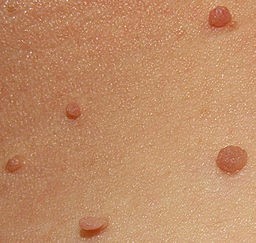
© Jmarchn, CC BY-SA 3.0, via Wikimedia Commons
Diagnostic différentiel
Filiform warts have fine finger-like projections on the surface and tend to be firmer on palpation.
Melanocytic naevi can also be pedunculated but have a broader base.
Molluscum contagiosum lesions tend to have broader bases, be dome-shaped, and have a dimpled centre.
Seborrhoeic keratoses have a broad base.
Multiple skin tags are seen in Birt-Hogg-Dubé (BHD) syndrome - a rare, autosomal dominant inherited dermatosis characterised by multiple skin lesions developing in adulthood, mainly on the face, neck and upper body. As well as skin tags, those affected have fibrofolliculomas and trichodiscomas - benign skin tumours forming around hair follicles.6
Primary care management
Skin tags do not have malignant potential but can be removed due to irritation or for cosmetic reasons, although this usually has to be done privately rather than by the NHS.
Small skin tags may be removed by snipping off with a pair of sharp scissors or by applying a ligature round the base. If the base is fine no anaesthetic is needed and little bleeding occurs. Cryotherapy is sometimes also used.
Larger ones will need local anaesthetic and can be removed by shave and cautery, or by cutting cautery alone.
Mises à jour exclusives pour les professionnels de la santé
Restez informé des dernières mises à jour cliniques, des perspectives professionnelles et des conseils fondés sur des preuves. La newsletter Patient Pro sélectionne des contenus essentiels pour les professionnels de santé—livrés directement dans votre boîte de réception.
En vous abonnant, vous acceptez notre Politique de confidentialité. Vous pouvez vous désabonner à tout moment. Nous ne vendons jamais vos données.
Lectures complémentaires et références
- Acrochordons; Société de Dermatologie en Soins Primaires (PCDS)
- Higgins JC, Maher MH, Douglas MS; Diagnostic des tumeurs cutanées bénignes courantes. Am Fam Physician. 1er octobre 2015;92(7):601-7.
- Wali V, Wali VV; Assessment of Various Biochemical Parameters and BMI in Patients with Skin Tags. J Clin Diagn Res. 2016 Jan;10(1):BC09-11. doi: 10.7860/JCDR/2016/15994.7062. Epub 2016 Jan 1.
- Skin Tags; DermNet NZ
- Barbato MT, Criado PR, Silva AK, et al; Association of acanthosis nigricans and skin tags with insulin resistance. An Bras Dermatol. 2012 Jan-Feb;87(1):97-104.
- Gupta S, Aggarwal R, Gupta S, et al; Human papillomavirus and skin tags: is there any association? Indian J Dermatol Venereol Leprol. 2008 May-Jun;74(3):222-5.
- Syndrome de Birt-Hogg-Dubé; DermNet NZ
À propos de l'auteurVoir la biographie complète

Dr Toni Hazell, FRCGP
MBBS, BSc, FRCGP, DFSRH, Dip GU med, DRCOG, DCH (London, UK, 2000)
Le Dr Toni Hazell a obtenu son diplôme de l'École de médecine de l'hôpital St. Mary et a effectué son VTS à l'hôpital Northwick Park.
À propos du critiqueVoir la biographie complète

Dr Colin Tidy, MRCGP
Médecin généraliste, Auteur médical
MBBS, MRCGP, MRCP (Paediatrics), DCH
Le Dr Colin Tidy est un médecin du NHS, basé dans l'Oxfordshire.
Historique de l'article
Les informations sur cette page sont rédigées et examinées par des cliniciens qualifiés.
Article également disponible en Anglais, Allemand, Espagnol, Français, Italien, Portugais, Hindi, Hébreu, Arabe, and Suédois.
Prochaine révision prévue : 14 déc. 2027
15 déc 2022 | Dernière version

Demandez, partagez, connectez-vous.
Parcourez les discussions, posez des questions et partagez vos expériences sur des centaines de sujets de santé.

Vous ne vous sentez pas bien ?
Évaluez vos symptômes en ligne gratuitement
Plus en dermatologie
- Verrues anogénitales
- Eczéma astéatosique
- Carcinome basocellulaire
- Eczéma discoïde (nummulaire)
- Folliculite
- Herpès génital pendant la grossesse
- Hyperhidrose
- Ichtyose hystrix
- Thrombocytopénie immune
- Cicatrices chéloïdes
- Sclérodermie localisée
- Milia
- Myosite - polymyosite et dermatomyosite
- Fasciite nécrosante
- Pemphigoïde gestationnelle
- Granulome pyogénique
- Scarlatine
- Nodules cutanés et sous-cutanés
- Corticostéroïdes topiques pour la peau