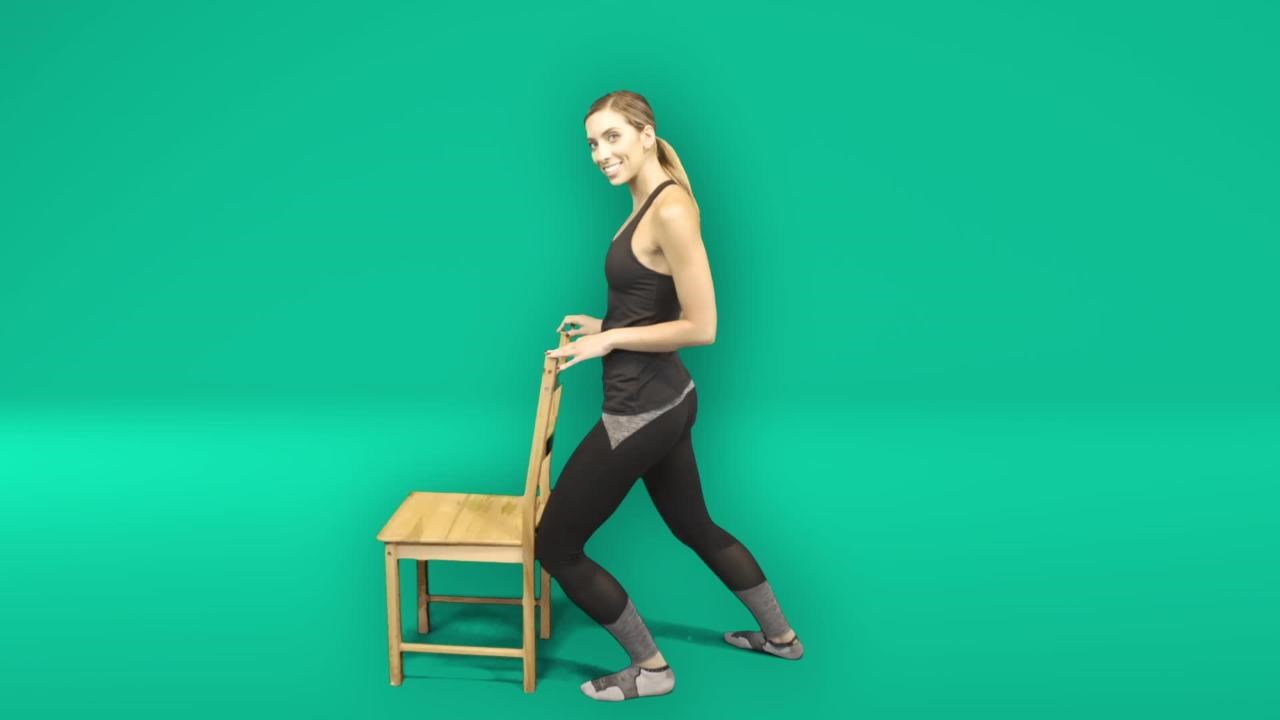
Vidéo : Exercices pour la douleur au pied
Revu par Dr Sarah JarvisRédigé par Lilly Sabri, MHPCPublié à l'origine 29 nov. 2017
Respecte les directives éditoriales
- TéléchargerTélécharger
- Partager
- Language
- Discussion
- Ask Patient
- Version audio
- Ajouter aux sources préférées sur Google
There are two main aims of physiotherapy for fasciite plantaire. The first is to control inflammation; the second is to stretch the muscles and connective tissue in the calf. Symptoms of plantar fasciitis are often brought on or made worse by tightening of these tissues. These exercises should take about 15 minutes a day. Once your symptoms are controlled it's worth getting into the habit of doing them once or twice a day to reduce the risk of symptoms coming back.
Sélections vidéo pour Problèmes de piedsBibliothèque vidéo
Liste de lecture : Foot Pain Exercises
2 vidéos
Foot Pain: Inflammation Control with Lilly Sabri | Patient Physio
Lilly Sabri, MHPC
Foot Pain: Inflammation Control with Lilly Sabri | Patient Physio
Lilly Sabri, MHPC

Foot Pain: Stretches with Lilly Sabri | Patient Physio
Lilly Sabri, MHPC
Inflammation control
Ice bag method
Fill a bag with ice (do not apply ice directly to the skin).
Press the ice bag under your foot for about 12-15 minutes.
Ice bottle method
Fill a round bottle with water and place in the freezer overnight.
Cover the bottle with a thin wet tea towel and roll your foot on the bottle, adding pressure through the foot. Do this for about one to two minutes for each foot (if both are affected).
Complete as many times daily as possible.
This method is most effective first thing in the morning, when symptoms tend to be at their worst.
Foot pain stretches
Fascia is a band of tough connective tissue that connects muscles and other organs together and provides stability. These exercises are aimed at stretching both the fascia and the many muscles in your calves, to help relieve symptoms of fasciite plantaire.
Gastrocnemius muscle stretch
Stand with both feet forward, facing towards a wall.
With your hands resting on the wall for support, step one foot back into a lunge position.
Feel a stretch in the big calf muscle in the back of the lower leg by increasing the bend in the front knee. Be sure to keep the back heel flat on the floor.
Hold the stretch for 20 seconds, repeat three times with each leg, 2-3 times daily.
Soleus muscle stretch
Stand with both feet forward, facing towards a wall.
Place the left foot just behind the right.
To stretch the right soleus, bend your right knee as much as possible without the right heel leaving the floor.
The aim is to feel the stretch in the lower part of your right calf.
Hold the stretch for 20 seconds; repeat three times with each leg, 2-3 times daily.
Achilles tendon and deep calf stretch
Stand on a step with your heel hanging off the end of the step.
Hold on to something for support.
Drop both heels downwards towards the floor, feeling a stretch in the calf muscles and the Achilles tendon.
Hold for 20 seconds; repeat three times, 2-3 times daily.
Fascia stretch
From a seated position, place an elasticated resistance band (or towel) underneath the foot, just below teh toes rather than the arch
Keeping pressure on the band, dig your heel into the floor and pull your toes up using the band
Keep your spine upright and breathe into the stretch.
To increase the stretch, bring yourself to the front of the chair and straighten your leg.
Hold for 20 seconds; repeat three times, 2-3 times daily.
Arch supports and heel pads
If you can have a biomechanics assessment with a podiatrist that can really help.
If you know you have a flat foot (decreased arch) you may require orthotics for your shoes to help support your arches. These come in three forms:
Over-the-counter: these can be found in most chemists. I would recommend three-quarter length so as to fit into all shoes and trainers.
Heat-molded orthotics: these can be purchased from most physiotherapy clinics. They are more tailored orthotics that are heated and molded to your foot, depending on your specific biomechanics and symptoms. They normally cost £30-£50.
Podiatrist assessment: this is the most expensive but by far the most specific orthotic provision. The process, including assessment and fitted orthotics, normally costs between £200-£500. These orthotics are tailor-made following extensive assessment. I would recommend this type of insoles for those with chronic symptoms.
Taping: kinesiology (K Tape) is the most popular and effective taping technique for plantar fasciitis. It can be completed by the patient themself, is waterproof and can last for up to three days.
Sélections des patients pour Problèmes de pieds
Soin des pieds
Fasciite plantaire : comment soulager la douleur et trouver le bon traitement
La fasciite plantaire est une cause fréquente de douleur au talon, due à une inflammation du tissu situé au bas de votre pied. La douleur est causée par de petites déchirures et une inflammation du fascia plantaire (le tissu qui soutient la voûte de votre pied). Mais comment pouvez-vous déterminer la cause de votre douleur au talon, y a-t-il quelque chose que vous pouvez faire pour soulager la condition à la maison et quand devriez-vous consulter un spécialiste ?
par Gillian Harvey

Soin des pieds
Signes indiquant que vous devez consulter un podologue
Nous avons tous déjà ressenti des douleurs aux pieds de temps en temps - peut-être à la fin d'une journée difficile. Et aucun d'entre nous n'est étranger à une ou deux ampoules. Mais qu'en est-il d'autres douleurs, gênes et problèmes apparaissant au niveau des pieds ? Nous examinons les signes et symptômes qui indiquent qu'il est nécessaire de consulter un podologue (spécialiste du pied).
par Gillian Harvey
À propos de l'auteurVoir la biographie complète
Rédigé par

Lilly Sabri, MHPC
Physiothérapeute, Entraîneur Personnel
BSc Physiotherapy, MCSP, MHPC, MAACP, MACSPM
Lilly Sabri est une kinésithérapeute agréée, instructrice de pilates APPI, influenceuse en fitness, santé et style de vie, et fondatrice de #LeanWithLilly.
À propos du critiqueVoir la biographie complète

Dr Sarah Jarvis
Consultant Clinique
MA (Cantab), BM, BCh (Oxon), DRCOG, FRCGP, MBE
Après avoir suivi une formation en médecine à Cambridge et Oxford, le Dr Sarah Jarvis MBE est devenue médecin généraliste.
Historique de l'article
Article également disponible en Anglais, Allemand, Espagnol, Français, Italien, Portugais, Hindi, Hébreu, Arabe, and Suédois.
29 nov. 2017 | Publié à l'origine
Écrit par :
Lilly Sabri, MHPCRevu par
Dr Sarah Jarvis
Partagez vos pensées ou expériences avec les autres dans notre communautés de patients.
Inscrivez-vous à la newsletter Patient
Votre dose hebdomadaire de conseils de santé clairs et fiables - rédigés pour vous aider à vous sentir informé, confiant et maître de la situation.
En vous abonnant, vous acceptez notre Politique de confidentialité. Vous pouvez vous désabonner à tout moment. Nous ne vendons jamais vos données.