
Que faire si vous avez un poil incarné infecté
Revu par Dr Krishna Vakharia, MRCGPAuthored by Matt BinnyPublié à l'origine 4 Apr 2023
Respecte les directives éditoriales
- TéléchargerTélécharger
- Partager
- Language
- Discussion
- Version audio
Les poils incarnés se produisent lorsque les poils poussent dans la peau plutôt qu'à l'extérieur comme ils le devraient. Ils apparaissent souvent sous forme de petites bosses rouges qui démangent parfois. Cependant, si un poil incarné s'infecte, cela peut être très douloureux et entraîner des problèmes plus graves s'il n'est pas traité. Alors, que devez-vous faire si vous avez un poil incarné infecté ?
Dans cet article:
Video picks for Hair and scalp
Why do we get ingrown hairs?
An ingrown hair happens when people shave or remove hair, and the new one grows and curls back into the skin. Instead of growing from the follicle through the skin, the hair grows inwards.
There are several reasons why this happens. Sometimes dead skin clogs a follicle and forces the hair inwards, or the end of a cut hair can pierce your skin and begin to grow the wrong way.
Ingrown hairs mainly happen on parts of the body where you shave - such as the face and neck, legs, pubic region and armpits. If you shave regularly, you're more likely to get ingrown and infected ingrown hairs1. This is because shaving and waxing sharpen hair that can then get trapped in the skin. People with coarse or curly hair are also more prone to ingrown hairs, as these hair types tend to curl back rather than outwards.
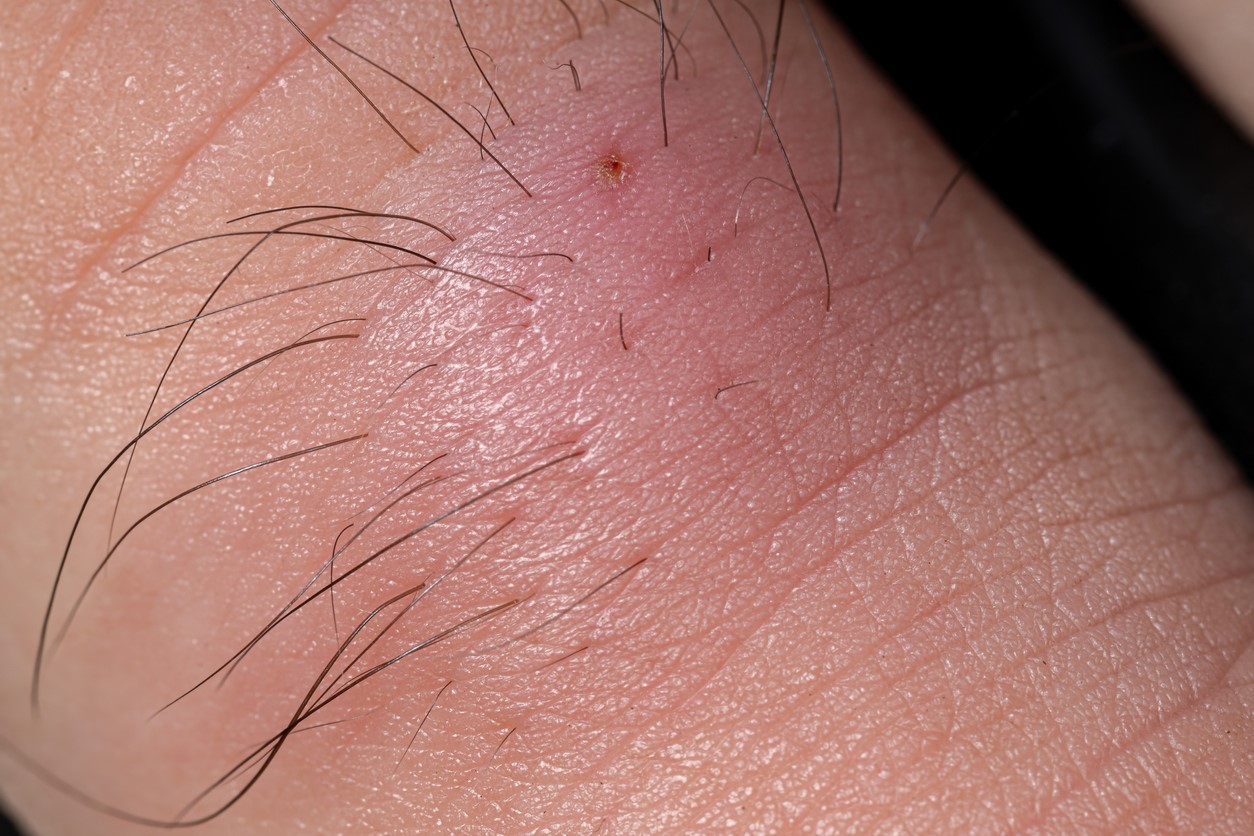
Ingrown hair swelling and redness
Continuez à lire ci-dessous
How to tell if your ingrown hair is infected?
An ingrown hair looks like an everyday spot or skin bump, varying in size and redness, and it may have swelling. Most ingrown hairs go away on their own if they're left alone and have time to heal. An infected ingrown hair looks similar, but there tends to be more swelling, redness and signs of pus.
Infected ingrown hairs can also be sore to touch. Mild infections are less noticeable and usually clear up without treatment. If you have a more serious infection that doesn't clear up in a few days or worsens, you should contact your doctor.
What's the difference between ingrown hairs and infected ingrown hairs?
Signs of ingrown hair
Small, round skin bumps.
Slightly itchy and sensitive.
Hair is sometimes visible underneath the skin.
Signs of an infectées ingrown hair:
Redness and swelling.
Pain and irritation.
The skin around the bump may feel warm or hot.
Bumps may have a pus-filled head.
How long does an ingrown hair infection last?
Retour au sommaireIngrown hairs tend to cure themselves in a few days but this can take longer if you pick, scratch, or interfere with the healing process in any other way.
Infected ingrown hairs take a bit longer to heal as your body is busy helping the ingrown hair exit the skin while fighting the infection. But you should see signs of improvement after a few days.
It’s important that you don’t miss any signs of a severe infection. Speak to your doctor if you have redness that is spreading, the swelling is increasing, your pain is getting worse, or you develop a fever, as these are all signs of a worsening infection.
Continuez à lire ci-dessous
Should you pop an infected ingrown hair?
Retour au sommaireYou should treat ingrown hairs with caution. Do not pop them - especially those with a pus-filled head as it can lead to infection and scarring. If you have an infected ingrown hair, picking at it risks spreading and worsening the infection.
Infected ingrown hair treatment
Retour au sommaireRegular ingrown hairs or mildly infected ingrown hairs can be left alone until the condition resolves. It also helps if you don't shave the area or try any other type of hair removal method. However, speak to your doctor if you experience any pain, swelling, heat or feverish symptoms around an ingrown hair.
Traitement médical
If an ingrown hair becomes infected, your doctor may treat it by:
Prescribing antibiotic medication or creams if you develop more severe ingrown hair issues such as cysts or folliculite.
Giving you a steroid cream if swelling or irritation occurs.
Removing the hair with a surgical blade or sterile needle.
Sending you to the emergency department in hospital if the infection is spreading or there is an abscess that needs lancing.
Remèdes maison
There are ways you can treat infected ingrown hairs at home to help heal and soothe the affected area.
Ceux-ci incluent :
Keeping the area clean by using small circular motions around the area and surrounding skin to prevent worse or prolonged infection.
Applying anti-bacterial ointment such as tea tree oil to help the infection and ensure it doesn't get worse.
Using over-the-counter products to relieve skin irritation and itching.
Continuez à lire ci-dessous
How to prevent ingrown hairs
Retour au sommaireKnowing how to treat and prevent ingrown hairs helps you avoid the hassle it causes and more severe concerns like an infection.
You can prevent ingrown hairs when shaving by:
Using warm water or shaving cream/gel to wet your skin when shaving.
Removing dead skin cells or moisturising if your skin is dry before shaving.
Not shaving too close to your skin.
Shaving in the direction your hair is growing.
Using a sharp razor and rinse after every stroke.
Using aftershave or lotion to soothe and clean the area.
Using alternative hair removal methods such as laser hair removal, chemical hair removal, or electric clippers.
You can't guarantee that these methods will prevent ingrown hairs, but they may reduce the likelihood of them developing and improve your skin's health overall.
Pour en savoir plus
Retour au sommairePatient picks for Hair and scalp
Santé de la peau, des ongles et des cheveux
À quelle fréquence devriez-vous vous laver les cheveux ?
Bien que vous ayez probablement une routine capillaire qui fonctionne pour vous et votre mode de vie, pouvez-vous être sûr de vous laver les cheveux au bon moment et d'utiliser les meilleurs produits pour votre type de cheveux ? Explorons à quelle fréquence vous devriez vous laver les cheveux (c'est probablement moins souvent que vous ne le pensez) et les méthodes simples que vous pouvez utiliser pour découvrir quel type de cheveux vous avez.
par Emily Jane Bashforth

Santé de la peau, des ongles et des cheveux
Causes courantes d'un cuir chevelu qui démange
Si vous dites à quelqu'un que vous vous grattez la tête, avec un peu de chance, il supposera que vous êtes plongé dans une réflexion sérieuse. Cependant, il est probablement plus probable que vous souffriez en réalité d'un cuir chevelu qui démange. Il existe de nombreuses raisons pour lesquelles notre cuir chevelu peut devenir irrité, mais voici quelques causes courantes et ce que vous pouvez faire à ce sujet.
par Dr Jessica Garner, MRCGP
Continuez à lire ci-dessous
Historique de l'article
Les informations sur cette page sont examinées par des cliniciens qualifiés.
Prochaine révision prévue : 2 mai 2027
4 Apr 2023 | Publié à l'origine
Écrit par :
Matt BinnyRevu par
Dr Krishna Vakharia, MRCGP

Demandez, partagez, connectez-vous.
Parcourez les discussions, posez des questions et partagez vos expériences sur des centaines de sujets de santé.

Vous ne vous sentez pas bien ?
Évaluez vos symptômes en ligne gratuitement
Inscrivez-vous à la newsletter Patient
Votre dose hebdomadaire de conseils de santé clairs et fiables - rédigés pour vous aider à vous sentir informé, confiant et maître de la situation.
By subscribing you accept our Politique de confidentialité. Vous pouvez vous désabonner à tout moment. Nous ne vendons jamais vos données.