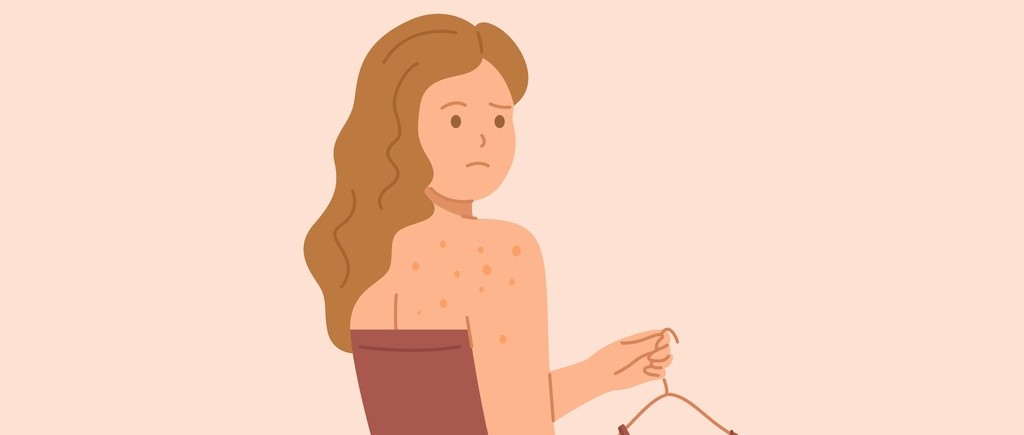
8 causes de l'acné du dos
Revu par Dr Krishna Vakharia, MRCGPRédigé par Amberley DavisPublié à l'origine 20 nov. 2023
Respecte les directives éditoriales
- TéléchargerTélécharger
- Partager
- Language
- Discussion
- Version audio
- Ajouter aux sources préférées sur Google
L'acné sur le dos peut être douloureuse. Elle peut également rendre de nombreuses personnes mal à l'aise et peu sûres d'elles dans leur propre peau. Cependant, développer de l'acné dorsale est souvent hors de votre contrôle, bien qu'il existe certaines habitudes qui peuvent la déclencher. Nous explorons les causes que vous pouvez et ne pouvez pas contrôler, ainsi que la manière de traiter l'acné dorsale afin que vous puissiez continuer à vivre votre vie.

What is back acne?
Back acne, or 'bacne' as it's sometimes called, is a common skin condition. Around half of all people with facial l'acné will also have acne on their back, shoulders, or chest1. Yet, because our backs are more covered than our faces, people with back acne often feel like they have an unusual and embarrassing problem. This simply isn't true.
We can all get spots on our back from time to time, but if you have back acne you may have red bumps, whiteheads, blackheads, and cysts forming in clusters or spread across your whole back. You may also experience acne scarring. Back acne is often sore and painful, but treatment can make a big difference.
What causes back acne?
Acne can occur when oil, bacteria, and dead skin cells clog your skin's pores. These are the tiny holes in your skin where hair follicles grow through and where sebum, your skin's natural oil, is produced. One of the main causes of acne is producing too much oil, which mixes with dead skin cells to form a plug that seals off the pore.
A whitehead - closed comedone - forms when the plugged follicle remains beneath the skin - if it breaks through to the skin's surface, a blackhead - open comedone - forms. Skin-residing bacteria can also thrive in clogged pores, triggering spots and bumps.
For the most part, back acne mirrors facial acne when it comes to its causes and triggers. Other than the face, the upper back has more oil glands than other body parts, making it easier for acne to develop.
However, there are some triggers that leave you more prone to back acne. With the help from dermatologist David Li, CEO and founder of Boston Derm Advocate, we explore the causes of back acne - starting from the factors out of your control to those that you can manage.
Hormones
According to Li, hormonal fluctuations are a prime cause of back acne: "changes in hormones often cause your oil glands to go into overdrive, producing excess sebum that can clog pores," says the dermatologist. "This is why back acne frequently affects teenagers and young adults going through puberty."
If you're an adult with back acne, this might also be influenced by hormones. Li says that back acne can continue into adulthood. Flare ups are particularly common pendant la grossesse and menstruation - times linked to significant hormonal changes.
Génétique
"Genetics play a role too. If your family members are prone to acne, you're more likely to experience it as well," says Li. It's also thought that this influences where your acne develops, with some families more genetically likely to develop acne on their backs2.
Médicaments
It's helpful to know that certain medicines could also be triggering your back acne or making it worse. These include contraceptives, steroid medicines, epilepsy medicines, and mood stabilising medicines like lithium. If you're concerned that acne might be a side effect of your medicine, keep taking it and speak to your doctor. It can be dangerous to stop taking medication without the guidance of a health professional.
Stress et anxiété
It might be that your mental health is triggering acne flare ups. There's evidence connecting stress and anxiety to acne outbreaks and other skin problems3. This is because stress and anxiety triggers your body's fight-or-flight response. This releases the stress hormones cortisol and androgens, which cause your oil glands to release more sebum.
Hygiene
If you're already prone to acne, Li says that poor hygiene can make the condition worse: "This means not showering after sweating. For back acne, this is especially a risk for people who are active at the gym. I often see patients who don't shower after weightlifting or cardio exercise. Sweat mixes with natural oils and dirt on the skin, creating a breeding ground for bacteria, leading to inflammation and breakouts."
Régime alimentaire
There's a possible link between what you eat and acne, but this hasn't yet been proven. Current research is exploring whether carbs and dairy, sugary, and fatty foods can trigger breakouts. According to Li, these are foods with high glycemic index values which may trigger inflammation that blocks your oil glands as well as increase hormone activity.
Study results are often mixed, which may be because people have different skin types - and only some types may be affected by foods in this way. If you suspect that what you eat is influencing your back acne, you might identify trigger foods by keeping a food diary.
Triggers specific to back acne
Friction under clothes
Friction, known medically as acne mechanica, is a trigger that's specific to non-facial acne. Li says: "friction happens when tight clothing and gear - like backpacks or sports equipment - rub against the skin. This is usually worse during physical activity. I see many patients who exercise who have back acne but no facial acne, because it's being caused by trapped sweat under tight gym clothes."
What you use or wear on your back
If you're experiencing back acne but your face is clear, think about what other things your back comes into contact with that your face doesn't. For example:
If your hair is unclean and hanging down your back this can transfer oils from your hair to the pores on your back.
If your bed sheets, towels, or clothing aren't clean, dirt, bacteria, and oils can rub into your back.
Some skincare products contain comedogenic ingredients, meaning they can clog your pores and trigger acne breakouts. This includes coconut oil, cocoa butter, argon oil, shea butter, and jojoba oil.
Who is more prone to back acne?
Anyone can develop acne, regardless of age, sex, or ethnicity. But it is more common in some groups: "You're more likely to develop acne if you have an oily skin type or are experiencing hormonal changes, including teenagers going through puberty, women during their menstrual cycle, or people undergoing hormonal therapy," says Li.
How to get rid of back acne
Back acne can be a mild nuisance or severely uncomfortable and disruptive. If it's having a big effect on your life, speak to your doctor or see a dermatologist. They can give advice on how to manage acne at home and may also recommend and prescribe les médicaments that you swallow or rub into your back if your acne is severe.
Some treatments are available from pharmacies. For example, cleansers, creams, and gels containing benzoyl peroxide can clear up back acne. There are also retinoid gels and acne stickers that releases salicylic acid into your acne spots.
There are also habits everyone can adopt at home to help manage the problem:
Don't pop or squeeze your acne spots - this can damage the skin, infect other spots, and may lead to acne scars, which can be severe and long-lasting.
Wash your back regularly - always shower and change clothes after exercise. Use an oil-free body wash that's noncomedogenic, meaning it won't clog your pores, and try not to scrub your skin with harsh cleansers.
Keep your bed sheets, towels, and clothes clean - this means washing clothes after every use and washing your sheets and towels at least once a week.
Consider your diet - new evidence is emerging around foods that may reduce acne flare ups. This includes eating fish and healthy oils rich in omega-3 fatty acids, as well as aliments probiotiques et suppléments. Although, research is in its early days4.
Wear looser fitness gear - staying physically active is essential for your health, and sweat is a natural part of this. Instead of limiting your fitness routine, wear looser clothing and wash immediately after training.
Pour en savoir plus
Sélections des patients pour Acné
Santé de la peau, des ongles et des cheveux
Bio-Oil aide-t-il à atténuer les cicatrices d'acné ?
Bio-Oil est une huile cosmétique que beaucoup prétendent pouvoir réduire l'apparence des cicatrices d'acné. Bio-Oil est à la fois le nom de l'huile et celui du fabricant du produit. C'est une huile cosmétique qui prétend réduire l'apparence des cicatrices et des vergetures, mais quelle est la précision de ces affirmations ?
par Emily Jane Bashforth

Santé de la peau, des ongles et des cheveux
Comment se débarrasser des cicatrices d'acné : votre guide ultime
Il peut s'agir de l'une des plaintes cutanées les plus courantes, mais les cicatrices physiques et mentales que l'acné laisse derrière elle peuvent être une grande source de stress. Heureusement, il existe une large gamme d'options de traitement pour s'adapter aux différents types et degrés de gravité des cicatrices d'acné.
par Amberley Davis
À propos de l'auteurVoir la biographie complète

Amberley Davis
Rédacteur senior
BA (Hons), CPD
Amberley est une rédactrice senior chez Patient et a écrit de manière approfondie sur une gamme de sujets liés à la santé et au bien-être.
À propos du critiqueVoir la biographie complète

Dr Krishna Vakharia, MRCGP
Médecin-chef pour la santé, Optum UK
MBChB, MRCGP(2013), BMedSci (hons), DFSRH, DRCOG, PGDipDerm (Distn)
Le Dr Krishna Vakharia est un médecin généraliste du NHS. Elle est également examinatrice régulière pour le diplôme de troisième cycle en dermatologie pratique à l'Université de Cardiff, ainsi que médecin-chef pour la santé chez Optum UK.
Historique de l'article
Les informations sur cette page sont examinées par des cliniciens qualifiés.
Article également disponible en Anglais, Allemand, Espagnol, Français, Italien, Portugais, Hindi, Hébreu, Arabe, and Suédois.
20 nov. 2023 | Publié à l'origine
Écrit par :
Amberley DavisRevu par
Dr Krishna Vakharia, MRCGP

Demandez, partagez, connectez-vous.
Parcourez les discussions, posez des questions et partagez vos expériences sur des centaines de sujets de santé.

Vous ne vous sentez pas bien ?
Évaluez vos symptômes en ligne gratuitement
Inscrivez-vous à la newsletter Patient
Votre dose hebdomadaire de conseils de santé clairs et fiables - rédigés pour vous aider à vous sentir informé, confiant et maître de la situation.
En vous abonnant, vous acceptez notre Politique de confidentialité. Vous pouvez vous désabonner à tout moment. Nous ne vendons jamais vos données.
Plus sur la santé de la peau, des ongles et des cheveux
- Peelings chimiques : avantages, coûts, risques et récupération
- Problèmes cutanés courants : comprendre le pityriasis versicolor
- Gérer la dépression et l'anxiété causées par l'acné adulte
- L'huile de romarin aide-t-elle réellement à faire pousser les cheveux ?
- Acide glycolique : bienfaits pour la peau, effets secondaires et plus encore
- Comment protéger vos enfants du soleil cet été
- Traitements de la rosacée : lequel vous convient ?
- Scarlatine : les conseils d'un médecin
- Vidéos sur les affections cutanées
- Mis à jourLes meilleurs aliments et nutriments à consommer pour une peau saine
- Vidéo : Comment les poux de tête se propagent-ils ?
- Options de traitement des verrues et verrues plantaires
- Quels sont les bienfaits du collagène et peut-il prévenir le vieillissement de la peau ?
- Qu'est-ce qui provoque l'apparition d'urticaire sur notre peau ?
- Qu'est-ce que la dermatite vulvaire ?
- Que faire si le psoriasis vous déprime
- Quand devrais-je m'inquiéter d'une piqûre d'insecte ?
- Pourquoi les hommes sont-ils moins enclins à porter de la crème solaire ?
- Pourquoi avons-nous des ongles ?
- Pourquoi mon eczéma facial est-il pire en été ?