Acute promyelocytic leukemia
Dernière mise à jour 8 Sept 2020
Respecte les directives éditoriales
- TéléchargerTélécharger
- Partager
- Language
- Discussion
- Version audio
- Ajouter aux sources préférées sur Google
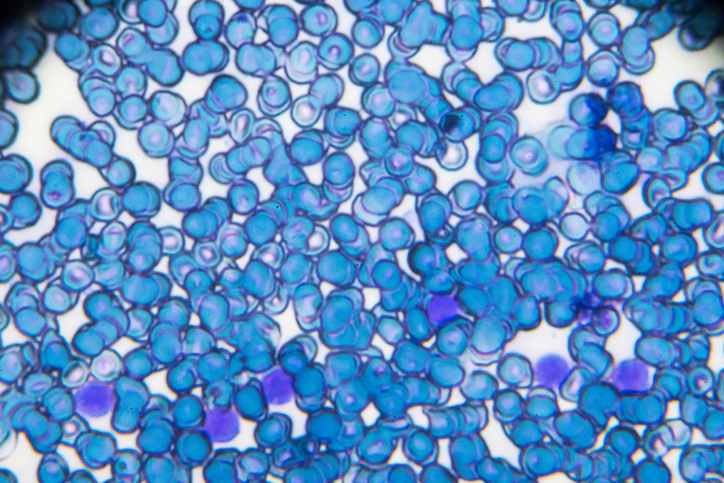
Acute promyelocytic leukemia is a form of acute myeloid leukemia, a cancer of the blood-forming tissue (bone marrow). In normal bone marrow, hematopoietic stem cells produce red blood cells (erythrocytes) that carry oxygen, white blood cells (leukocytes) that protect the body from infection, and platelets (thrombocytes) that are involved in blood clotting. In acute promyelocytic leukemia, immature white blood cells called promyelocytes accumulate in the bone marrow. The overgrowth of promyelocytes leads to a shortage of normal white and red blood cells and platelets in the body, which causes many of the signs and symptoms of the condition.
Description
Acute promyelocytic leukemia is a form of acute myeloid leukemia, a cancer of the blood-forming tissue (bone marrow). In normal bone marrow, hematopoietic stem cells produce red blood cells (erythrocytes) that carry oxygen, white blood cells (leukocytes) that protect the body from infection, and platelets (thrombocytes) that are involved in blood clotting. In acute promyelocytic leukemia, immature white blood cells called promyelocytes accumulate in the bone marrow. The overgrowth of promyelocytes leads to a shortage of normal white and red blood cells and platelets in the body, which causes many of the signs and symptoms of the condition.
People with acute promyelocytic leukemia are especially susceptible to developing bruises, small red dots under the skin (petechiae), nosebleeds, bleeding from the gums, blood in the urine (hematuria), or excessive menstrual bleeding. The abnormal bleeding and bruising occur in part because of the low number of platelets in the blood (thrombocytopenia) and also because the cancerous cells release substances that cause excessive bleeding.
The low number of red blood cells (anaemia) can cause people with acute promyelocytic leukemia to have pale skin (pallor) or excessive tiredness (fatigue). In addition, affected individuals may heal slowly from injuries or have frequent infections due to the loss of normal white blood cells that fight infection. Furthermore, the leukemic cells can spread to the bones and joints, which may cause pain in those areas. Other general signs and symptoms may occur as well, such as fever, loss of appetite, and weight loss.
Acute promyelocytic leukemia is most often diagnosed around age 40, although it can be diagnosed at any age.
Inheritance patterns
The source lists the following possible inheritance patterns: Not inherited. More than one pattern can apply in different cases.
Related genes
Other names
AML M3
APL
Leukemia, acute promyelocytic
M3 ANLL
Myeloid leukemia, acute, M3
Related patient information and medicines

Patient information leaflet
Leucémie myéloïde aiguë
Acute myeloid leukaemia is where the bone marrow makes large numbers of abnormal immature white blood cells which are derived from a myeloid stem cell. Acute myeloid leukaemia (AML) is a condition where the bone marrow makes large numbers of abnormal immature white blood cells which are derived from a myeloid stem cell. ...All-trans retinoic acid.
Patient information leaflet
Leucémie
Leucémie est a cancer of blood-forming cells. There are different types of leukaemia. If you develop leukaemia it is important to know what type it is. This is because the outlook (prognosis) and treatments vary for the different types. What is leukaemia. Leukaemia is a cancer of cells in the bone marrow (the cells which develop into white blood.

Patient information leaflet
Polycythémie rubra vera
Polycythaemia rubra vera (PRV) is a myeloproliferative disorder, which means the bone marrow makes trop many blood cells. It is also sometimes just called polycythaemia (PV). Blood cells, which can be seen under a microscope, make up about 40% of the blood's volume. For example, damage due to a viral infection or due to background radiation. PRV is.

Patient information leaflet
Infection thoracique
A chest infection is an infection cela affects votre lower large airways (bronchi) and your lungs. Pneumonia and bronchitis are the most common chest infections. People with an immune system that's weakened either by conditions such as some les cancers (y compris lymphome , le myélome et la leucémie ) or AIDS ; or by treatments such as high-dose steroids ,.

Patient information leaflet
scanner CT
Note : the information below is a general guide only. The arrangements, and the way tests are performed, may vary between different hospitals. Always follow the instructions given by your doctor or local hospital. What is a CT scan. A CT scan is a specialised X-ray test. It can give quite clear pictures of the inside of your body. In particular,.

Patient information leaflet
Types de cancer
Il y a more than 100 different types of cancer. Each type is classified by the type of cell the cancer originates from. For example, an osteosarcoma is a cancer of bone tissue. Leukaemias et lymphomas are cancers of cells in bone marrow and lymph glands. For example, leukaemia is a cancer of cells that make white blood cells. The five most.
Lectures complémentaires et références
- Acute promyelocytic leukemia; MedlinePlus, National Library of Medicine.
- Collins SJ. The role of retinoids and retinoic acid receptors in normal hematopoiesis. Leukemia. 2002 Oct;16(10):1896-905. doi: 10.1038/sj.leu.2402718.
- de The H, Chen Z. Acute promyelocytic leukaemia: novel insights into the mechanisms of cure. Nat Rev Cancer. 2010 Nov;10(11):775-83. doi: 10.1038/nrc2943. Epub 2010 Oct 22.
- de The H, Lavau C, Marchio A, Chomienne C, Degos L, Dejean A. The PML-RAR alpha fusion mRNA generated by the t(15;17) translocation in acute promyelocytic leukemia encodes a functionally altered RAR. Cell. 1991 Aug 23;66(4):675-84. doi: 10.1016/0092-8674(91)90113-d.
- Pandolfi PP. Oncogenes and tumor suppressors in the molecular pathogenesis of acute promyelocytic leukemia. Hum Mol Genet. 2001 Apr;10(7):769-75. doi: 10.1093/hmg/10.7.769.
- Parmar S, Tallman MS. Acute promyelocytic leukaemia:a review. Expert Opin Pharmacother. 2003 Aug;4(8):1379-92. doi: 10.1517/14656566.4.8.1379.
- Salomoni P, Pandolfi PP. The role of PML in tumor suppression. Cell. 2002 Jan 25;108(2):165-70. doi: 10.1016/s0092-8674(02)00626-8.
- Sanz MA, Montesinos P. Open issues on bleeding and thrombosis in acute promyelocytic leukemia. Thromb Res. 2010 Apr;125 Suppl 2:S51-4. doi: 10.1016/S0049-3848(10)70013-X.
- Yamamoto JF, Goodman MT. Patterns of leukemia incidence in the United States by subtype and demographic characteristics, 1997-2002. Cancer Causes Control. 2008 May;19(4):379-90. doi: 10.1007/s10552-007-9097-2. Epub 2007 Dec 7.
- Zelent A, Guidez F, Melnick A, Waxman S, Licht JD. Translocations of the RARalpha gene in acute promyelocytic leukemia. Oncogene. 2001 Oct 29;20(49):7186-203. doi: 10.1038/sj.onc.1204766.
Participez à la conversation
Partagez vos pensées ou expériences avec les autres dans notre communautés de patients.

Demandez, partagez, connectez-vous.
Parcourez les discussions, posez des questions et partagez vos expériences sur des centaines de sujets de santé.
Inscrivez-vous à la newsletter Patient
Votre dose hebdomadaire de conseils de santé clairs et fiables - rédigés pour vous aider à vous sentir informé, confiant et maître de la situation.
En vous abonnant, vous acceptez notre Politique de confidentialité. Vous pouvez vous désabonner à tout moment. Nous ne vendons jamais vos données.