
Infection thoracique
Revu par Dr Toni Hazell, FRCGPDernière mise à jour par Dr Colin Tidy, MRCGPDernière mise à jour 6 Oct 2024
Respecte les directives éditoriales
- TéléchargerTélécharger
- Partager
- Language
- Discussion
- Ask Patient
- Version audio
- Ajouter aux sources préférées sur Google
Dans cette série :Bronchite aiguëPneumoniePneumonie par aspirationInfection pulmonaire post-opératoireBronchoscopie
A chest infection is an infection that affects your lower large airways (bronchi) and your lungs. Pneumonia and bronchitis are the most common chest infections. Bronchite is usually caused by a viral infection, with between 1% and 10% of cases being caused by bacteria. Pneumonie is usually due to bacterial infection. Pneumonia may be serious and need hospital admission.
En un coup d'œil
Une infection pulmonaire provoque une toux grasse, des difficultés respiratoires, des douleurs thoraciques et une forte fièvre.
There are two main types: acute bronchitis and pneumonia.
Les infections pulmonaires sont généralement causées par des virus, donc les antibiotiques n'aident souvent pas.
Vous pouvez gérer les symptômes en vous reposant, en buvant des liquides et en prenant des analgésiques comme le paracétamol.
Consultez un médecin généraliste si vous êtes très malade, essoufflé, ou si les symptômes s'aggravent ou incluent des crachats de sang.
Chest infection symptoms
The main chest infection symptoms are:
A chesty cough.
Breathing difficulties (including shortness of breath and sifflements).
Douleur thoracique or tightness.
Muscle aches and pains.
Feeling very tired.
A rapid heartbeat.
A cold - often called an upper respiratory tract infection (URTI) - usually starts with a combination of blocked and/or runny nose and sneezing, sometimes with a mild high temperature (fever).
You will usually get a cough, which is often dry and harsh but it can also sound like you have a lot of phlegm (sputum), which you may bring up. You may also feel tired and achy, but with the help of over-the-counter medications you'll be able to keep going with everyday activities.
Chest infections can start with these symptoms too, but you don't need to see a doctor if these are the only symptoms you have. The only exceptions are people with long-term health conditions affecting the lungs, like maladie pulmonaire obstructive chronique (MPOC) et bronchectasie. People with these conditions are more likely to develop serious complications.
What causes a chest infection?
The vast majority of URTIs are caused by viral infections. Your immune system will fight these off without any help within a few days. Because URTIs are caused by viruses rather than bacteria, antibiotics won't help in any way. See the separate leaflet called Antibiotics.
Infections des voies respiratoires
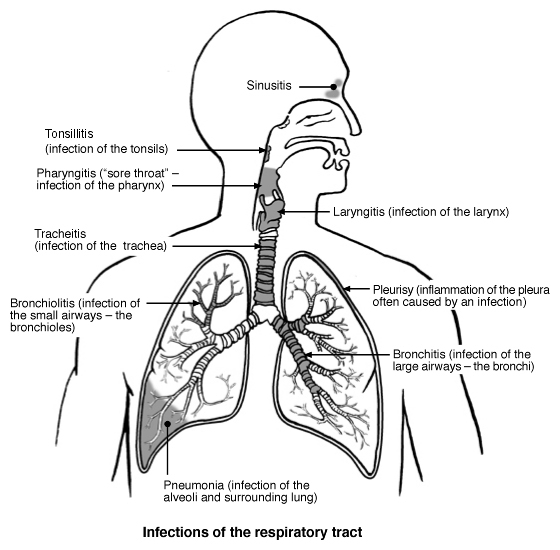
Lire à propos de sinusite, amygdalite, pharyngitis, laryngitis, tracheitis, pleurésie, bronchite et pneumonie.
Sometimes an infection in the upper airways can spread deeper, causing a chest infection. Sometimes germs (bacteria) already living in your lungs can multiply, with the same result.
Types of a chest infection
There are two main types of chest infection - acute bronchitis and pneumonia.
Bronchite aiguë
Bronchitis is inflammation due to infection of the bronchi. '-itis' is the medical term for inflammation. It can be acute or chronic. Acute means lasting a short time and chronic means lasting a long time.
Acute bronchitis is common and is often due to a viral infection. Infection with a germ (bacterium) is a less common cause. See the separate leaflet called Acute bronchitis for more details.
Pneumonie
This is usually a bacterial infection of the lung (bacterial chest infection) and may be serious. Treatment with antibiotics is usually needed. See the separate leaflet called Pneumonia for more details.
Chest infection recovery time
A bout of infection of the large airways (bronchi) in the lungs (acute bronchitis) usually gets better on its own within 7-10 days without any medicines. If you suspect that you have a severe infection of the lung (pneumonia), you should see a GP.
Are chest infections contagious?
You can pass a chest infection on to others through coughing and sneezing. So if you have a chest infection, it's important to cover your mouth when you cough or sneeze and to wash your hands regularly. You should throw away used tissues immediately.
Chest infection treatment
Although most chest infections are mild and improve on their own, some cases can be very serious, even life-threatening.
When to see a doctor?
Infection of the large airways (bronchi) in the lungs (acute bronchitis) usually gets better by itself, so there is often no need to see a GP. However, you should contact a GP if you feel very unwell, particularly if you are feeling breathless.
Si vous avez asthme ou BPCO you should take your doctor's advice.
They may have given you recommendations about increasing your inhaler medication or taking a 'rescue pack' of antibiotics and steroid tablets at the first sign of an infection (much more common for those with COPD than asthma).
If not, speak with them for advice if you develop chest infection symptoms.
You should also speak with a doctor or arrange a face-to-face consultation if you have a weakened immune system as it is more likely that you will need antibiotic treatment.
Warning signs of a chest infection
There are a number of chest infection symptoms that mean you should see a GP even if you do not have any other lung problems. If your symptoms get worse, you should look out for these warning signs. They include:
If a fever, wheezing or headache becomes worse or severe.
If you develop fast breathing, shortness of breath, or chest pains.
If you cough up blood or if your phlegm becomes dark or rusty-coloured.
If you become drowsy or confused.
If a cough lasts for longer than 3-4 weeks.
If you have repeated bouts of acute bronchitis.
Si un autre symptôme se développe et vous inquiète.
Antibiotics for a chest infection
Antibiotiques are medicines used for infections caused by germs (bacteria) and don't work on viruses. Unless you have a long-term condition affecting your chest, your doctor is unlikely to prescribe antibiotics unless your symptoms and examination suggest you may have pneumonia.
Chest infection treatment at home
If you have a chest infection, you should:
Have plenty of rest.
Drink lots to prevent your body becoming lacking in fluids (dehydrated) and to help loosen the mucus in your lungs and make it easier to cough up.
Inhale steam vapour, perhaps with added menthol. Breathe in steam from a bowl of hot water - this can help to clear the mucus from your chest. Never use a bowl of hot water for a child's cough, in case they get scalded by accident; however, you could run a very hot bath to make the bathroom steamy and sit in the room with the child, safely away from the hot water.
Sleeping with an extra pillow to avoid lying flat at night to help keep your chest clear of mucus and make it easier to breathe.
Prendre le paracétamol, l'ibuprofène ou aspirine to reduce high temperature and to ease any aches, pains and headaches. (Remarque: children aged less than 16 years should not take aspirin.)
You should try to cesser de fumer for good if you smoke. Bronchitis, chest infections and serious lung diseases are more common in smokers as well as the long-term consequences such as lung disease, heart disease and cancer.
If your throat is sore from coughing, you can relieve the discomfort with a warm drink of honey and lemon.
What about cold and cough medicines for a chest infection?
You can buy many cold and flu remedies and cough medicines at pharmacies. These will help to make you feel better and help you to carry on with normal activities, but won't make the infection go away more quickly.
How is a chest infection diagnosed?
Your doctor will be able to make a diagnosis of a chest infection by listening to your story and examining you.
Often no tests are needed if you have infection of the large airways (bronchi) in the lungs (acute bronchitis) and your symptoms are mild. If your chest infection symptoms are more severe and you need to go to hospital then you may need to have the following tests:
A radiographie thoracique may be taken to be sure of the diagnosis and to see how bad the infection is.
Analyses de sang and phlegm (sputum) tests may be taken to find which germ (bacterium) is causing the serious lung infection (pneumonia). This helps to decide which antibiotic medicine is best to use. Sometimes the germ (bacterium) that is causing the pneumonia is resistant to the first antibiotic. A switch to another antibiotic is sometimes needed.
Are chest infections common?
Chest infections are very common, especially during the autumn and winter. They often occur after a températures froides ou la grippe. Anyone can get a chest infection but they are more common in:
Young children and the elderly.
People who fument.
Femmes enceintes.
People with long-term chest problems such as asthme, BPCO, la fibrose kystique, maladies cardiaques, diabète, des reins ou maladie du foie.
People with an immune system that's weakened either by conditions such as some cancers (including lymphome, le myélome et la leucémie) ou SIDA; or by treatments such as high-dose stéroïdes, chimiothérapie or other medicines that can suppress your immune system.
How to prevent a chest infection
There are measures you can take to help prevent chest infections and to stop the spread of it to others. For instance, washing your hands regularly reduces the chance of germs getting into your system.
Quelle est la perspective ?
Infection of the large airways (bronchi) in the lungs (acute bronchitis) usually clears without any complications. Occasionally, the infection travels to the lung tissue to cause a serious lung infection (pneumonia).
If you have pneumonia and are well enough to be looked after at home, your outlook is very good. If you need to be looked after in hospital, the outlook is still usually good - but not quite as good. The outlook is also not as good for people who also have long-term illnesses such as lung disease, heart failure or diabetes.
Sélections des patients pour Infections pulmonaires

Poitrine et poumons
Tuberculose
La tuberculose (TB) est une infection causée par un germe (bactérie) appelé Mycobacterium tuberculosis. Si vous présentez des symptômes, ou si un médecin peut détecter des signes de l'infection en vous examinant, cela est connu sous le nom de tuberculose active. Si vous avez une infection à la TB sans aucun signe ou symptôme, cela est connu sous le nom de TB latente.
par Dr Colin Tidy, MRCGP

Poitrine et poumons
COVID long
La plupart des personnes infectées par la COVID-19 (infection par le SARS CoV-2) se sentent mieux en quelques jours ou semaines et se rétablissent complètement dans les 12 semaines suivant l'infection. Cependant, certaines personnes présentent des symptômes persistants qui durent des semaines, des mois, voire plus longtemps, ce qui est généralement appelé "COVID long". Pour certains, ces effets à long terme de la COVID-19 peuvent être débilitants. Ces effets peuvent être très différents d'une personne à l'autre, et il semble probable qu'il existe différents 'types' de COVID long, ou différents syndromes, qui pourraient se manifester de différentes manières.
par Dr Doug McKechnie, MRCGP
Questions fréquemment posées
Une infection thoracique peut-elle évoluer en quelque chose de plus grave ?
Oui, une infection des grandes voies respiratoires (bronchite aiguë) disparaît généralement sans complications. Cependant, parfois, l'infection peut se propager au tissu pulmonaire et causer une infection pulmonaire plus grave comme la pneumonie.
Comment puis-je prévenir la récurrence d'une infection thoracique ?
Se laver les mains régulièrement aide à réduire le risque que des germes pénètrent dans votre système et contribuent aux infections pulmonaires. Prendre des mesures générales pour rester en bonne santé peut également être bénéfique.
Que dois-je faire si ma toux persiste très longtemps ?
Si votre toux persiste pendant plus de 3-4 semaines, vous devriez contacter un médecin pour obtenir des conseils. C'est l'un des signes d'alerte qui suggère qu'un examen médical est nécessaire.
Certaines personnes sont-elles plus susceptibles de développer des infections pulmonaires graves nécessitant des soins hospitaliers ?
Oui, si vous avez une pneumonie et que vous êtes suffisamment malade pour nécessiter une hospitalisation, le pronostic est généralement bon mais pas aussi bon que de pouvoir se rétablir à domicile. Le pronostic est également moins favorable pour les personnes ayant des affections chroniques coexistantes telles que les maladies pulmonaires, l'insuffisance cardiaque ou le diabète.
Quels sont les remèdes naturels que je peux utiliser pour soulager les symptômes d'une infection thoracique à la maison ?
En plus de vous reposer et de boire beaucoup de liquides, vous pouvez essayer d'inhaler de la vapeur, éventuellement avec du menthol, pour aider à dégager le mucus. Dormir avec un oreiller supplémentaire peut également aider à garder votre poitrine dégagée. Une boisson chaude au miel et au citron peut apaiser un mal de gorge causé par la toux.
Comment savoir si j'ai la grippe ou une infection pulmonaire ?
Les infections pulmonaires surviennent souvent après un rhume ou la grippe. Alors qu'un rhume commence généralement par un nez qui coule ou bouché et des éternuements, avec une toux qui se développe plus tard, une infection pulmonaire peut débuter avec des symptômes similaires mais peut également inclure des difficultés respiratoires plus importantes, des douleurs thoraciques et une température plus élevée. Si vous présentez des symptômes tels qu'une respiration rapide, un essoufflement ou des douleurs thoraciques, vous devriez consulter un médecin, car cela peut indiquer une infection pulmonaire.
Lectures complémentaires et références
- Chest infections - adult; NICE CKS, mai 2024 (accès réservé au Royaume-Uni)
- Antibiotic awareness resources: key messages on antibiotic use; Public Health England (now UK Health Security Agency)
À propos de l'auteurVoir la biographie complète
Mis à jour par

Dr Colin Tidy, MRCGP
Médecin généraliste, Auteur médical
MBBS, MRCGP, MRCP (Paediatrics), DCH
Le Dr Colin Tidy est un médecin du NHS, basé dans l'Oxfordshire.
Rédigé par
Dr Colin Tidy, MRCGP
Médecin généraliste, Auteur médical
MBBS, MRCGP, MRCP (Paediatrics), DCH
Le Dr Colin Tidy est un médecin du NHS, basé dans l'Oxfordshire.
À propos du critiqueVoir la biographie complète

Dr Toni Hazell, FRCGP
MBBS, BSc, FRCGP, DFSRH, Dip GU med, DRCOG, DCH (London, UK, 2000)
Le Dr Toni Hazell a obtenu son diplôme de l'École de médecine de l'hôpital St. Mary et a effectué son VTS à l'hôpital Northwick Park.
Historique de l'article
Article également disponible en Anglais, Allemand, Espagnol, Français, Italien, Portugais, Hindi, Hébreu, Arabe, and Suédois.
Next review due: 5 Oct 2027
6 Oct 2024 | Dernière version
7 May 2013 | Publié à l'origine
Écrit par :
Dr Colin Tidy, MRCGP
Partagez vos pensées ou expériences avec les autres dans notre communautés de patients.
Accès simple à des traitements fiables et à des services de santé en ligne.
Common conditions
Get help with common conditions through the NHS, without a GP appointment.





Inscrivez-vous à la newsletter Patient
Votre dose hebdomadaire de conseils de santé clairs et fiables - rédigés pour vous aider à vous sentir informé, confiant et maître de la situation.
En vous abonnant, vous acceptez notre Politique de confidentialité. Vous pouvez vous désabonner à tout moment. Nous ne vendons jamais vos données.