Verrues et verrues plantaires
Revu par Dr Philippa Vincent, MRCGPDernière mise à jour par Dr Doug McKechnie, MRCGPDernière mise à jour 11 oct. 2024
Respecte les directives éditoriales
- TéléchargerTélécharger
- Partager
- Language
- Discussion
- Version audio
- Ajouter aux sources préférées sur Google
Dans cette série :Verrues séborrhéiques
Les verrues sont généralement inoffensives mais peuvent être disgracieuses. Les verrues sur les pieds sont appelées verrucas (ou verrucae) et sont parfois douloureuses. Les verrues et verrucas disparaissent généralement avec le temps sans traitement. Si nécessaire, elles peuvent souvent être éliminées plus rapidement avec un traitement. Le plus souvent, le traitement consiste à appliquer de l'acide salicylique ou à les geler avec de l'azote liquide ou un spray froid.
En un coup d'œil
Les verrues sont de petites bosses rugueuses sur la peau causées par un virus appelé papillomavirus humain.
Les verrues plantaires sont des verrues qui apparaissent sur la plante des pieds.
La plupart des verrues sont inoffensives et disparaissent souvent d'elles-mêmes en deux ans.
Vous pouvez transmettre des verrues à d'autres par contact étroit peau à peau.
Pour éviter la propagation, évitez de partager les serviettes et couvrez les verrues avec un pansement imperméable pour la natation.
Les traitements courants incluent l'acide salicylique et la congélation (cryothérapie).
Consultez un médecin pour les verrues si elles sont douloureuses, inesthétiques ou persistantes.
What are warts and verrucas?
Warts are small rough lumps on the skin. Verrucas are warts on the feet. They are caused by a virus (human papillomavirus) which causes a reaction in the skin. Warts can occur anywhere on the body but occur most commonly on hands and feet.
They range in size from 1 mm to over 1 cm. Sometimes only one or two warts develop. Sometimes several occur in the same area of skin. The shape and size of warts vary and they are sometimes classed by how they look.
Verucca
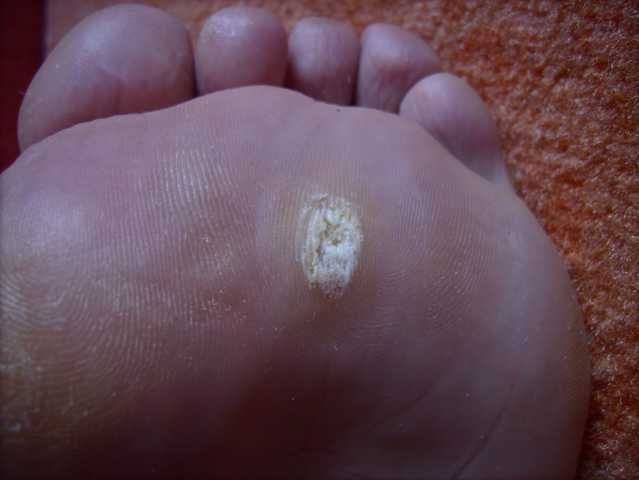
© Marionnette, CC BY-SA 3.0, via Wikimedia Commons
Hand wart
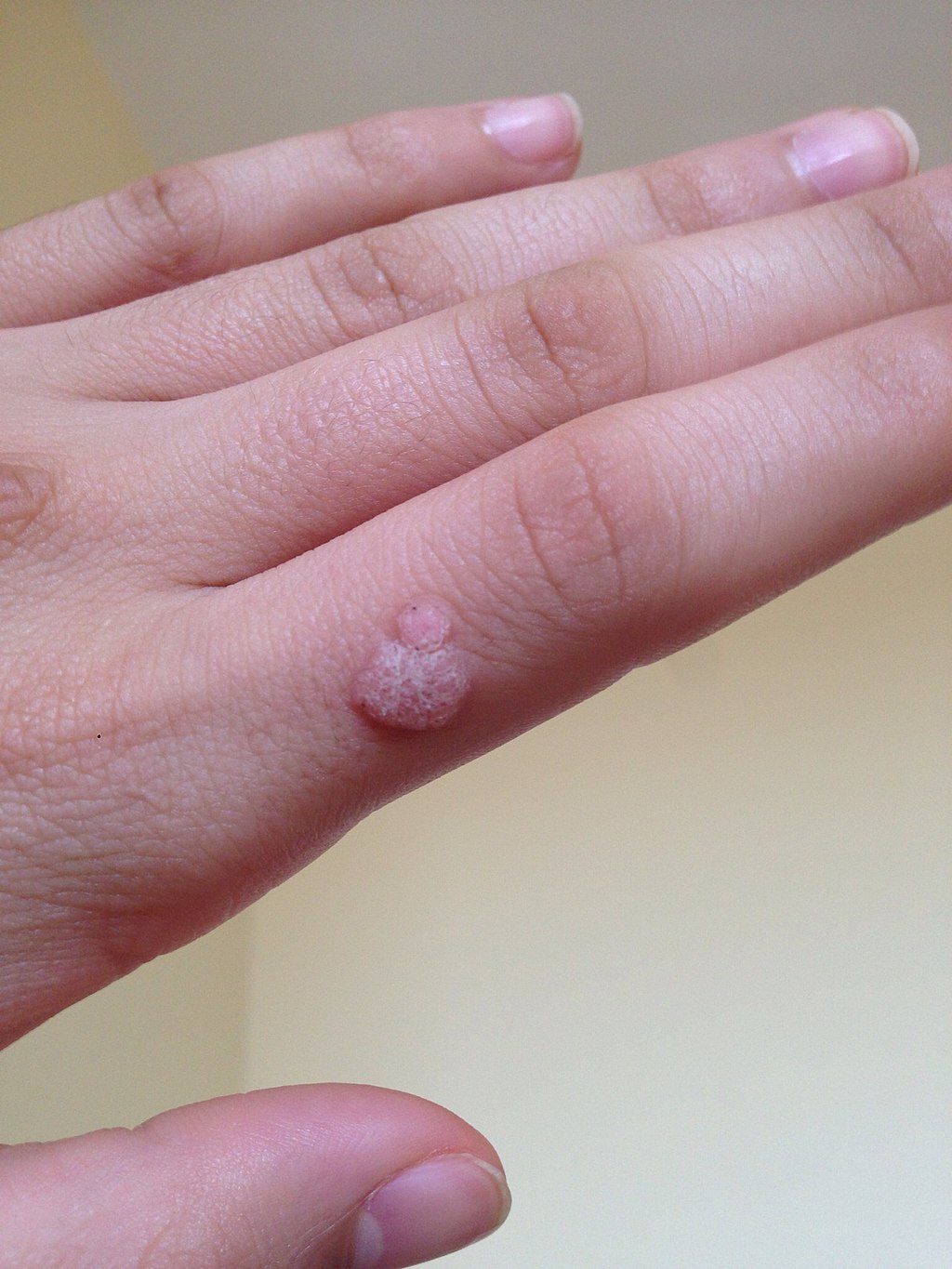
© Mohamed boujil, CC BY-SA 4.0, via Wikimedia Commons
Types of warts and verrucas
Examples are:
Common warts.
Plane (flat) warts.
Filiform (finger-like) warts.
Mosaic warts - when several warts join together.
Verrucas are warts on the soles of the feet. They are the same as warts on any other part of the body. However, they may look flatter, as they tend to get trodden in.
Remarque: anal and genital warts are different. See the separate leaflet called Genital warts for more detail.
How common are warts and verrucas?
Most people develop one or more warts at some time in their lives, usually before the age of 20. About 1 in 10 people in the UK have warts at any one time. Almost as many as 1 in 3 children or young people may have warts.
Are warts and verrucas harmful?
They are not usually harmful. Sometimes verrucas are painful if they press on a sensitive part of the foot. Some people find their warts unsightly. Warts at the end of fingers may interfere with fine tasks.
Are warts and verrucas contagious?
Yes - however, the risk of passing them on to others is low. When something is called 'contagious', it means it can be passed on by touching. You need close skin-to-skin contact to pass the virus on directly. You are more at risk of being infected if your skin is damaged, or if it is wet and macerated, and in contact with roughened surfaces. For example, in swimming pools and communal washing areas.
You can also spread the wart virus to other areas of your body. For example, warts may spread round the nails, lips and surrounding skin if you bite warts on your fingers, or nearby nails, or if you suck fingers with warts on.
If you have a poor immune system you may develop lots of warts which are difficult to clear. (For example, if you have AIDS, if you are on chemotherapy, etc.)
How to stop warts and verrucas spreading
To reduce the chance of passing on warts to others:
Don't share towels.
When swimming, cover any wart or verruca with a waterproof plaster.
If you have a verruca, wear flip-flops in communal shower rooms and don't share shoes or socks.
To reduce the chance of warts spreading to other areas of your body:
Don't scratch warts or pick them.
Don't bite nails or suck fingers that have warts.
If you have a verruca, change your socks or tights daily.
What is the treatment for warts and verrucas?
Warts are generally harmless, and usually disappear on their own, although this can take some time. About two-thirds of warts go away without treatment within two years.
So, treatment for warts and verrucas isn't always necessary, although some people choose to get treatment if they are unsightly, or causing pain, discomfort, or other problems.
The most commonly used treatments are:
Acide salicylique.
Freezing treatment.
Each of these is now discussed further.
Acide salicylique
There are various lotions, paints and special plasters that contain salicylic acid. This acid burns off the top layer of the wart. You can buy salicylic acid at pharmacies, or your doctor may prescribe one. If these don't work, a podiatrist can offer treatment with stronger acid.
Salicylic acid usually comes as a paint or a gel. Read the instructions in the packet on how to use the brand you buy or are prescribed, or ask your pharmacist for advice. Usually:
You need to apply it each day for up to three months. Persevere - if you give up too soon, it will not work.
Before applying the salicylic acid, rub off the dead tissue from the top of the wart, with an emery file (or similar).
It is best if you soak the wart in water for 5-10 minutes before applying salicylic acid.
You should not apply salicylic acid to the face because of the risk of skin irritation which may cause scarring.
If you have diabetes or poor circulation, you should use salicylic acid only on the advice of a doctor.
If you put the acid on correctly each day you have a reasonable chance of clearing the warts within three months.
Tips for success include:
Try not to get the acid on the skin next to the wart, as it may become irritated. You can protect the nearby skin by putting some Vaseline® on the normal skin beforehand, or by putting on a plaster with a hole in it which just exposes the wart for treatment.
If the surrounding skin does become sore, stop the treatment for a few days until it settles. Then re-start treatment. There is also a small risk that you may get a skin allergy to the treatment. If this occurs, the surrounding skin becomes red and itchy.
It may take two weeks or more before you notice any improvement. It can take up to three months of daily applications for warts to go completely.
Acid lotions and paints are flammable. Keep them away from open fires and flames.
Freezing treatment (cryotherapy)
Freezing warts may also be effective. Many GPs and practice nurses are skilled at this. You can also get private treatment with cryotherapy from podiatrists. Liquid nitrogen is commonly used.
The nitrogen is sprayed on or applied to the wart. Liquid nitrogen is very cold and the freezing and thawing destroys the wart tissue. To clear the wart fully it can need up to 4-6 treatment sessions, sometimes more. Each treatment session is a couple of weeks or so apart.
Freezing treatment can be painful. Sometimes a small blister develops for a day or so on the nearby skin after treatment. Also, there is a slight risk of scarring the nearby skin or nail or damaging underlying tissues such as tendons or nerves. It is not suitable for younger children or for people with poor circulation.
There are freezing treatments available over the counter, which you can apply yourself. However, these cannot provide such a cold freeze as liquid nitrogen. They are probably less effective, although again the results of studies are not totally clear.
Combined treatment
Another option is treatment with salicylic acid plus cryotherapy. In between the freezing sessions, you apply salicylic acid daily to your wart. You should not use the salicylic acid until any blistering, scabs or soreness from the cryotherapy have settled.
Autres options de traitement
Verruca needling
Most treatments for verrucas work by destroying the verruca itself with acid or freezing treatment. Verruca needling works by stimulating your own body's immune response to fight off the virus. It involves puncturing the verruca with a small needle to cause bleeding.
Verruca needling is done under local anaesthetic so the procedure doesn't hurt. Most people don't experience much pain afterwards. It is important to avoid anti-inflammatory painkillers for at least 48 hours following treatment, as there is a small chance they can reduce your immune system's ability to fight off the virus.
Verruca needling can be very effective for stubborn verrucas, curing 7 in 10 long-standing verrucas after a single treatment. It is not available on the NHS but can be accessed as a private (paid for) treatment from podiatrists.
Swift microwave therapy
This is a new treatment developed in the UK which uses precise doses of microwave energy delivered directly through a probe. This allows the energy to be targeted very precisely, heating and destroying the verruca. It only takes a few seconds and does not need local anaesthetic.
It causes minimal tissue inflammation and has a high success rate. In studies, Swift successfully cleared more than 3 out of 4 long-lasting, stubborn warts which hadn't responded to previous treatment. You may only need one treatment, but up to 70% of verrucas respond in 1-3 treatments.
This service is not available on the NHS. It is offered as a private (paid for) service by some podiatrists.
Specialist treatments
There are some other treatments used by specialists if other treatments have failed. Treatment is not usually available on the NHS to treat warts and verrucas unless there are complications or they are very severe. It is available as a private (paid for) service from many podiatrists.
Some of the treatments used on warts and verrucas which don't go away are:
Surgery to cut out the wart or verruca.
Light therapy (photodynamic therapy).
Laser therapy.
Creams to try to kill the virus (virucidal creams).
Creams which stop the skin cells multiplying.
Certain creams which are normally used for skin cancers.
Tape
Duct tape may help warts to disappear sooner, although there is only limited research on it, and we don't know for certain if it works or not. However, it's a safe and easy treatment, and may be worth trying, especially in children.
To try this method:
Cover the wart with duct tape for six days. If the tape falls off during this time, put a fresh piece of tape on.
After six days, remove the tape and soak the wart in warm water for five minutes. After drying, gently rub the wart with emery board or pumice stone to get rid of dead tissue from the top of the wart.
Leave the wart uncovered overnight, and put duct tape on again the next day.
This can be continued for up to two months.
There have been no concerns about harm using this method. Some experts advise that you should not use duct tape on the face, as in some people it can irritate the skin.
Can you swim with warts and verrucas?
A child with warts or verrucas should go swimming as normal. Swimming is a vital skill, which can save your life. Warts can be covered with waterproof plasters. A verruca can also be covered with a waterproof plaster.
Some people prefer to wear a special sock which you can buy from pharmacies. However, this makes it very obvious that you have a verruca, may be embarrassing and has not been proved to make a difference. British swimming organisations do not advise wearing the waterproof sock. The plaster should be enough. It is also a good idea to wear flip-flops when using communal showers, as this may reduce the chance of catching or passing on virus particles from verrucas.
Sélections des patients pour Infections cutanées
Infections
Éruptions virales
De nombreuses infections virales peuvent provoquer une éruption cutanée en plus d'autres symptômes. Les éruptions cutanées sont très courantes avec les infections virales, surtout chez les jeunes enfants. Il est très important de s'assurer que l'éruption cutanée ne fait pas partie d'une infection grave - par exemple, une infection à méningocoques qui est une infection bactérienne et peut être associée à une méningite.
par Dr Toni Hazell, FRCGP

Infections
syndrome de la joue giflée
Le syndrome de la joue slapée est généralement une maladie bénigne et courte. Cependant, l'éruption peut sembler assez spectaculaire. Aucun traitement n'est généralement nécessaire. Cependant, il peut nuire à un bébé à naître, donc les femmes enceintes qui entrent en contact avec des personnes atteintes de cette maladie doivent consulter un médecin.
par Dr Hayley Willacy, FRCGP
Questions fréquemment posées
Les verrues saignent-elles ?
Oui, le needling des verrues, un traitement pour les verrues tenaces, fonctionne en perforant la verrue avec une petite aiguille pour provoquer un saignement. Cette méthode stimule la réponse immunitaire de votre corps pour combattre le virus.
Les verrues peuvent-elles apparaître sur les doigts ?
Les verrues peuvent apparaître n'importe où sur le corps, bien qu'elles soient plus courantes sur les mains et les pieds. Les verrues plantaires se réfèrent spécifiquement aux verrues situées sur les pieds, ce qui implique que les verrues sur les doigts seraient généralement appelées verrues communes plutôt que verrues plantaires.
Comment l'acide salicylique élimine-t-il les verrues ?
L'acide salicylique agit en brûlant la couche supérieure de la verrue. Il se présente sous forme de lotions, de peintures et de pansements spéciaux qui doivent être appliqués quotidiennement, généralement pendant trois mois, pour éliminer efficacement la verrue.
Pourquoi les verrues démangent-elles ?
L'article ne mentionne pas spécifiquement les démangeaisons comme un symptôme courant des verrues plantaires. Cependant, les verrues peuvent parfois être douloureuses si elles appuient sur une partie sensible du pied, et la peau environnante peut devenir irritée si des traitements comme l'acide salicylique ne sont pas appliqués avec soin.
Quelle est la différence entre une verrue plantaire et une verrue ?
Les verrues plantaires sont un type de verrue qui se développe spécifiquement sur la plante des pieds. Elles sont essentiellement identiques aux verrues présentes sur d'autres parties du corps, mais elles peuvent sembler plus plates en raison de la pression exercée par la marche.
Comment puis-je identifier une verrue plantaire ?
Les verrues plantaires sont des verrues sur la plante des pieds. Elles sont généralement de petites bosses rugueuses et peuvent sembler plus plates que d'autres verrues car elles sont souvent piétinées. Elles sont causées par le papillomavirus humain.
Existe-t-il des traitements spécifiques pour les verrues tenaces ?
Oui, pour les verrues qui n'ont pas répondu aux traitements standard comme l'acide salicylique ou la cryothérapie, des options avancées comme le perçage de verrues et la thérapie par micro-ondes Swift sont disponibles. Le perçage de verrues stimule la réponse immunitaire du corps, tandis que la thérapie par micro-ondes Swift utilise l'énergie des micro-ondes pour détruire le tissu de la verrue. Ces traitements sont généralement proposés en privé par des podologues.
Lectures complémentaires et références
- Kwok CS, Gibbs S, Bennett C, et al; Traitements topiques pour les verrues cutanées. Cochrane Database Syst Rev. 2012 Sep 12;9:CD001781. doi: 10.1002/14651858.CD001781.pub3.
- Directives de l'Association Britannique de Dermatologie pour la gestion des verrues cutanées; Journal Britannique de Dermatologie (2014)
- Lynch MD, Cliffe J, Morris-Jones R; Management of cutaneous viral warts. BMJ. 2014 May 27;348:g3339. doi: 10.1136/bmj.g3339.
- Verrues virales; DermNet NZ
- Bruggink SC, Eekhof JA, Egberts PF, et al; Évolution naturelle des verrues cutanées chez les écoliers : une étude de cohorte prospective. Ann Fam Med. 2013 Sep-Oct;11(5):437-41. doi: 10.1370/afm.1508.
- Comprendre les verrues plantaires; Natation Britannique
- Longhurst B, Bristow I; The Treatment of Verrucae Pedis Using Falknor's Needling Method: A Review of 46 Cases. J Clin Med. 2013 Apr 2;2(2):13-21. doi: 10.3390/jcm2020013.
- Bristow, I., Lim, W.C., Lee, A. et al.; Microwave therapy for cutaneous human papilloma virus infection. Eur J Dermatol (2017) 27: 511. https://doi.org/10.1684/ejd.2017.3086
- Verrues et verrues plantaires; NICE CKS, octobre 2024 (accès réservé au Royaume-Uni)
À propos de l'auteurVoir la biographie complète

Dr Doug McKechnie, MRCGP
Rédacteur Médical
MA, MBBS, MSc, DRCOG, MRCP(UK), MRCGP(2021), FHEA
Le Dr Doug McKechnie est un médecin généraliste du NHS travaillant à Londres. Il travaille à plein temps en clinique et est également le chef adjoint du module de Pratique Clinique et Professionnelle à l'École de Médecine de l'University College London.
À propos du critiqueVoir la biographie complète

Dr Philippa Vincent, MRCGP
Médecin généraliste, Auteur médical
MB BS, Bsc, MRCGP (2000), DCH, DFSRH, DRCOG
Dr Philippa Vincent est un médecin généraliste du NHS travaillant dans le nord de Londres.
Historique de l'article
Les informations sur cette page sont rédigées et examinées par des cliniciens qualifiés.
Article également disponible en Anglais, Allemand, Espagnol, Français, Italien, Portugais, Hindi, Hébreu, Arabe, and Suédois.
Prochaine révision prévue : 10 oct. 2027
11 oct. 2024 | Dernière version

Demandez, partagez, connectez-vous.
Parcourez les discussions, posez des questions et partagez vos expériences sur des centaines de sujets de santé.

Vous ne vous sentez pas bien ?
Évaluez vos symptômes en ligne gratuitement
Inscrivez-vous à la newsletter Patient
Votre dose hebdomadaire de conseils de santé clairs et fiables - rédigés pour vous aider à vous sentir informé, confiant et maître de la situation.
En vous abonnant, vous acceptez notre Politique de confidentialité. Vous pouvez vous désabonner à tout moment. Nous ne vendons jamais vos données.
Plus sur les infections
- Punaises de lit
- Cystite chez les femmes
- Fièvre chez les enfants
- Infection fongique de l'oreille
- Herpès génital
- Verrues génitales
- fièvre glandulaire
- Impetigo
- Laryngite
- COVID long
- maladie de Lyme
- Virus Mpox
- Mycoplasma genitalium
- Norovirus
- Rhumatisme articulaire aigu
- Angine
- Infection urinaire chez les personnes âgées
- Infections urinaires
- Médicaments contre les vers