Drains chirurgicaux
Évalué par des pairs Dr Hayley Willacy, FRCGP Dernière mise à jour par Dr Rachel Hudson, MRCGPDernière mise à jour 11 févr. 2023
Respecte les directives éditoriales
- TéléchargerTélécharger
- Partager
- Language
- Discussion
- Version audio
- Ajouter aux sources préférées sur Google
Un drain chirurgical est un petit tube en plastique qui est parfois utilisé après une opération. Il est placé à l'intérieur de vous pendant la chirurgie par le médecin et restera à l'extérieur de votre corps jusqu'à ce qu'il soit retiré, généralement quelques jours plus tard. Il est relié à un petit sac en plastique qui recueille tout liquide ou air qui s'est écoulé de l'endroit où vous avez été opéré. Toutes les opérations ne nécessitent pas un drain : votre chirurgien vous conseillera si cela est nécessaire.
En un coup d'œil
Un drain chirurgical est un petit tube pour aider à évacuer le liquide ou l'air après une opération.
Ce sont généralement de petits tubes en plastique flexibles placés lors de la chirurgie.
Les drains peuvent aider à prévenir l'accumulation de liquide, la douleur, l'infection et les problèmes de cicatrisation.
Ils ne sont généralement pas douloureux mais peuvent limiter le mouvement.
Les drains restent généralement en place pendant quelques jours jusqu'à ce que la production de liquide diminue.
What is a surgical drain?
Surgeons use small plastic tubes to help drain away fluid after an operation: without them the fluid might gather up and cause infection. Or, in the case of an operation on the lungs or chest, air might gather up and squash the lungs.
They are usually special small, flexible plastic tubes which the surgeon places during the operation and then leaves poking out your skin, attached to a small bag.
This is an example of a drain coming out of someone's leg:
Surgical drain
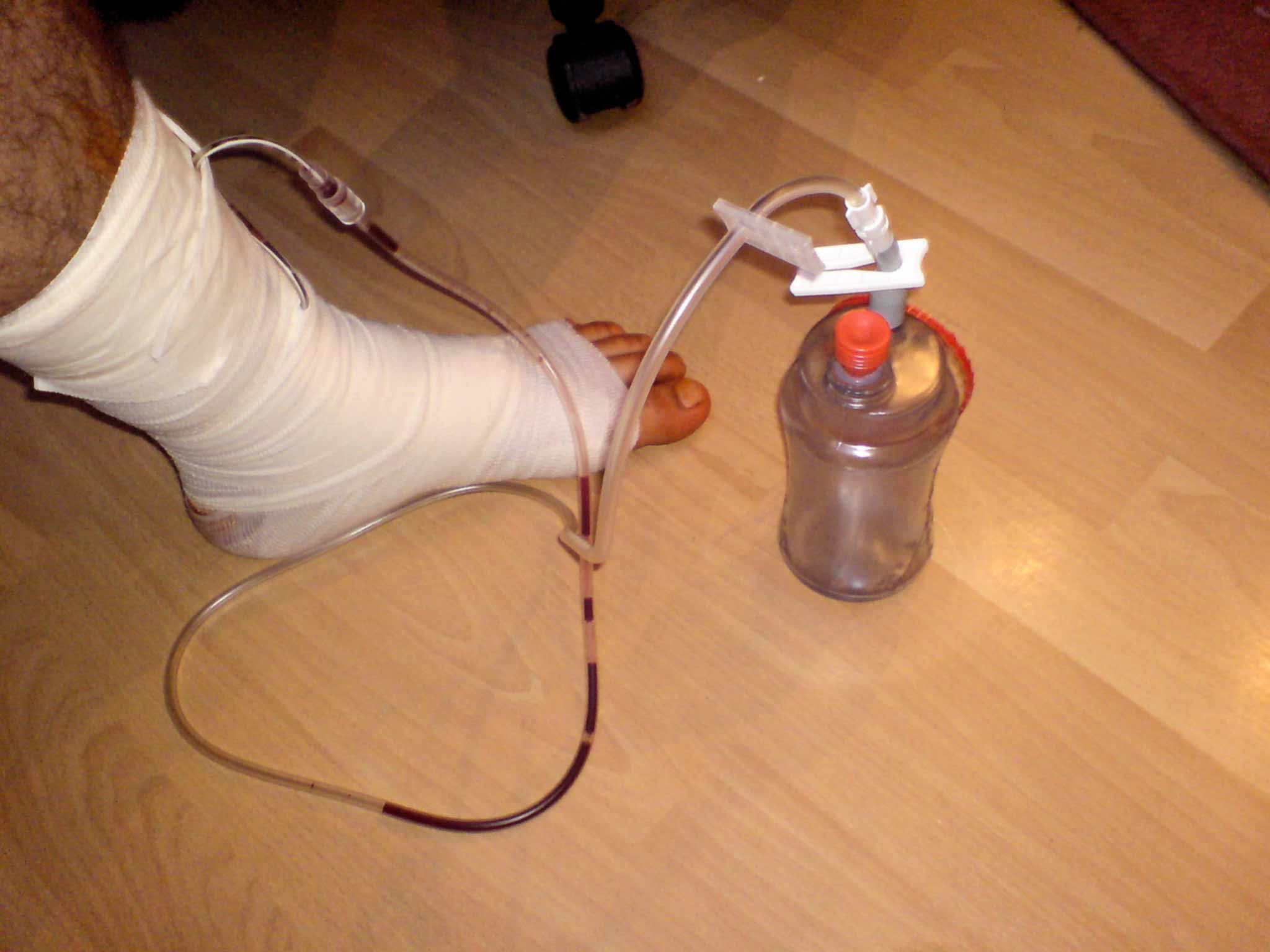
© ChristianKazur, Public domain, via Wikimedia Commons
Although they look a bit gruesome, they aren't usually painful.
Here's an example of a surgical drain after hand surgery:
Hand surgical drain
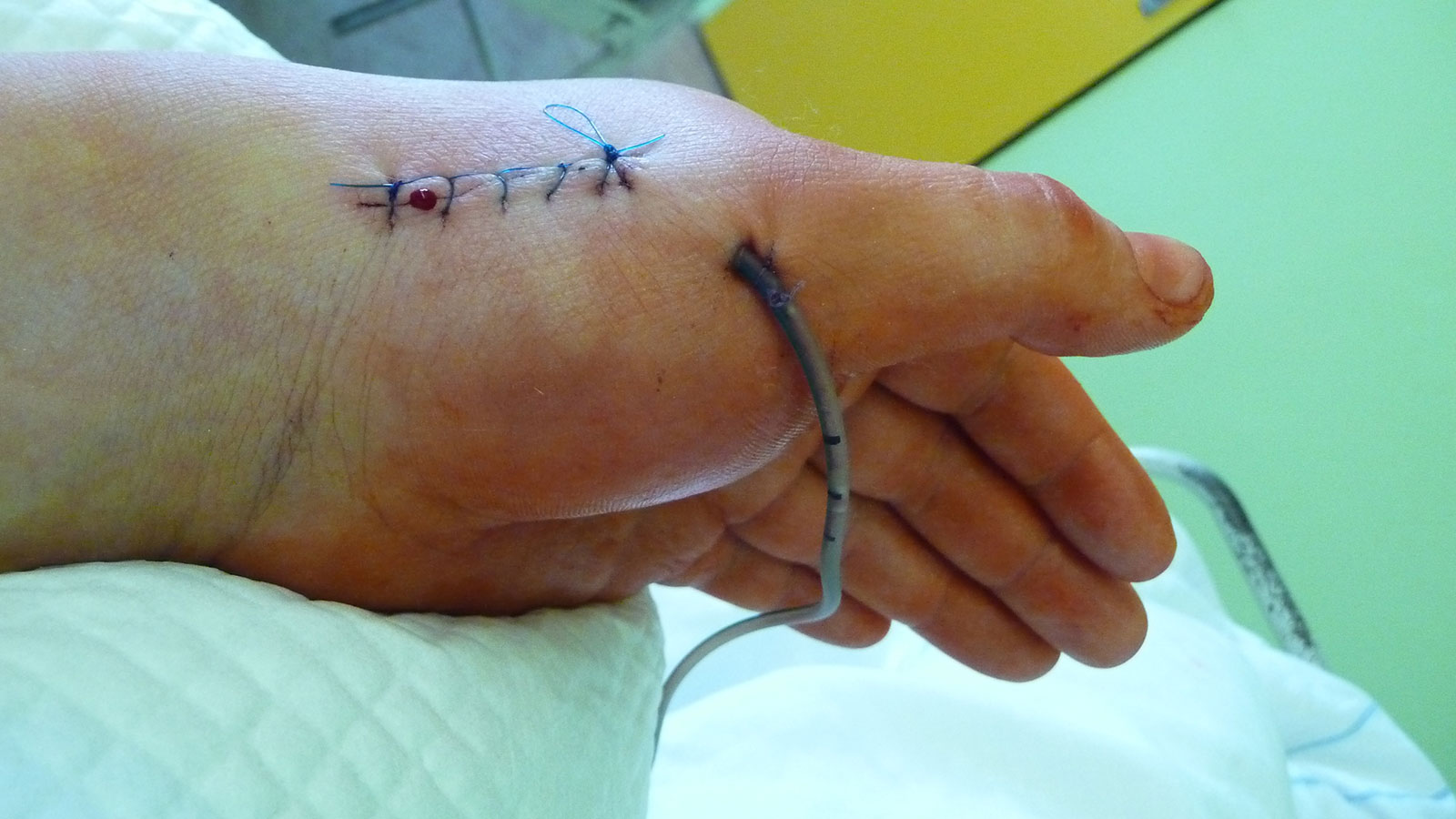
© Pavel Ševela, CC BY-SA 3.0,viaWikimedia Commons
How useful are surgical drains?
Some operations involve quite 'juicy' parts of the body: areas where the body usually makes lots of fluid or juices. An example would be surgery on someone's armpit (axilla): this is often done as part of breast cancer surgery. The armpit makes a lot of fluid after being operated on. Without a drain, the fluid might gather up in a large pool and be painful.
The pressure of the fluid inside might stop the wound healing properly. So the surgical drain allows extra fluid to drain off harmlessly.
If you have had to have an emergency operation - for example, for a burst digestive tract (what doctors would call a perforated bowel) - then there can be infected juices left behind inside you. A surgical drain allows those juices to drain away and hopefully reduce the chances of getting an infection after the operation.
How long do surgical drains stay in for?
Surgical drains usually stay in the body for a few days after an operation. When the fluid production has faded away, the drain can be removed painlessly.
Are there any drawbacks to surgical drains?
There are differences of opinion between surgeons as to whether surgical drains are always needed. Some studies have shown that they don't necessarily allow things to heal any faster. Other drawbacks include:
They can cause problems like infection around where the drain comes out; or they can interfere with things healing inside your body.
They can keep you in hospital longer.
Sometimes they can stop you moving around as much as you'd like, particularly if you have a drain from your chest area.
If they are left in for too long accidentally, they can be difficult to pull out and may leave a small tract which will take a while to heal up.
Which operations require a surgical drain to be fitted?
Operations around the neck, including on the thyroid gland.
Operations on the armpit (axilla).
Operations done in an emergency for something which has ruptured inside you.
Some types of brain surgery.
Operations on the stomach (the drain often then comes out your nose and is called a 'nasogastric tube').
Operations on the bladder (the drain then usually comes out the urine tube and is called a 'urinary catheter').
Your surgeon will discuss with you before the operation whether you will need a surgical drain and where it will be.
Sélections des patients pour Chirurgie générale et procédures

Chirurgie et procédures
Stérilisation féminine
La stérilisation féminine est une méthode de contraception. C'est une procédure réalisée pour empêcher les ovules d'atteindre les spermatozoïdes.
par Dr Toni Hazell, FRCGP

Chirurgie et procédures
Remplacement du genou
Une prothèse du genou est une opération visant à remplacer les parties endommagées de l'articulation du genou. Elle peut être soit une prothèse totale du genou (PTG), soit une prothèse partielle (uni-compartimentale) du genou. La nouvelle partie de l'articulation est appelée une prothèse.
par Dr Philippa Vincent, MRCGP
Questions fréquemment posées
Les drains chirurgicaux fonctionnent-ils toujours efficacement pour prévenir les complications ?
Il existe différentes opinions parmi les chirurgiens concernant la nécessité constante des drains chirurgicaux. Certaines recherches indiquent qu'ils n'accélèrent pas nécessairement le processus de guérison. Bien qu'ils soient conçus pour prévenir l'accumulation de liquide et l'infection, leur efficacité peut varier.
Les drains chirurgicaux peuvent-ils limiter mes mouvements après une opération ?
Oui, les drains chirurgicaux peuvent parfois restreindre vos mouvements, surtout si le drain est situé dans votre région thoracique. Cela pourrait vous empêcher de vous déplacer aussi librement que vous le souhaiteriez pendant votre période de récupération.
Que se passe-t-il si un drain chirurgical est laissé en place trop longtemps ?
Si un drain chirurgical est accidentellement laissé en place pendant une période excessive, il peut devenir difficile à retirer. De plus, il pourrait laisser derrière lui un petit trajet ou tunnel dans la peau qui prendra un certain temps à guérir complètement après le retrait du drain.
Le fait d'avoir un drain chirurgical signifie-t-il que je devrai rester plus longtemps à l'hôpital ?
Un des inconvénients potentiels d'avoir un drain chirurgical est qu'il peut entraîner un séjour prolongé à l'hôpital. Le drain reste généralement en place jusqu'à ce que la production de liquide diminue de manière significative, ce qui peut prolonger le temps de récupération nécessaire avant la sortie.
Existe-t-il différents types de drains chirurgicaux, comme ceux qui sortent du nez ou du tube urinaire ?
Oui, bien que de nombreux drains chirurgicaux soient de petits tubes en plastique sortant de la peau, il en existe d'autres types. Pour les opérations de l'estomac, un drain peut sortir de votre nez et est appelé une 'sonde nasogastrique'. Pour les opérations de la vessie, un drain sort généralement par le tube urinaire et est connu sous le nom de 'cathéter urinaire'.
Lectures complémentaires et références
- Makama JG, Ameh EA; Drains chirurgicaux : ce que le résident doit savoir. Niger J Med. 2008 Jul-Aug;17(3):244-50.
À propos de l'auteurVoir la biographie complète

Dr Oliver Starr, MRCGP
MBChB, BMedSc, MRCS, MRCGP, DRCOG
Dr Oliver Starr is a general practitioner in Hertfordshire and an undergraduate tutor at University College Medical School.
À propos du critiqueVoir la biographie complète

Dr Hayley Willacy, FRCGP
Médecin généraliste, Auteur médical
MBChB (1992), DRCOG, DFFP, MRCOG (Part 1) MRCGP (2007), DFSRH (2013), MSc - medical education (2020)
Le Dr Hayley Willacy était médecin généraliste au NHS travaillant dans le nord-ouest de l'Angleterre, qui a pris sa retraite de la pratique clinique en 2022 après 30 ans.
Historique de l'article
Les informations sur cette page sont rédigées et examinées par des cliniciens qualifiés.
Article également disponible en Anglais, Allemand, Espagnol, Français, Italien, Portugais, Hindi, Hébreu, Arabe, and Suédois.
Prochaine révision prévue : 10 fév. 2028
11 févr. 2023 | Dernière version
18 oct. 2017 | Publié à l'origine
Écrit par :
Dr Oliver Starr, MRCGP

Demandez, partagez, connectez-vous.
Parcourez les discussions, posez des questions et partagez vos expériences sur des centaines de sujets de santé.

Vous ne vous sentez pas bien ?
Évaluez vos symptômes en ligne gratuitement
Inscrivez-vous à la newsletter Patient
Votre dose hebdomadaire de conseils de santé clairs et fiables - rédigés pour vous aider à vous sentir informé, confiant et maître de la situation.
En vous abonnant, vous acceptez notre Politique de confidentialité. Vous pouvez vous désabonner à tout moment. Nous ne vendons jamais vos données.
Plus en chirurgie et procédures
- Botox
- Bronchoscopie
- Complications postopératoires courantes
- Pontage aortocoronarien
- Cystoscopie
- CPRE
- Lifting du visage
- Gastroscopie
- remplacement de la hanche
- Hystéroscopie
- Biopsie rénale
- Transplantation rénale
- Remplacement du genou
- Épilation au laser
- Anesthésie locale pour votre opération des yeux
- Chirurgie de réduction du nez (rhinoplastie)
- Sigmoïdoscopie
- Stérilisation
- Vasectomie
- Chirurgie thoracoscopique assistée par vidéo