Nerve conduction studies
Peer reviewed by Dr Rachel Hudson, MRCGPLast updated by Dr Caroline Wiggins, MRCGP Last updated 13 Jul 2023
Meets Patient’s editorial guidelines
- DownloadDownload
- Share
- Language
- Discussion
- Audio Version
- Add to preferred sources on Google
Nerve conduction studies help to test how well and how fast nerves conduct electrical signals.
Note: the information below is a general guide only. The arrangements, and the way tests are performed, may vary between different hospitals. Always follow the instructions given by your doctor or local hospital.
At a glance
Nerve conduction studies check how well nerves send electrical signals.
The test can help diagnose nerve damage or trapped nerves like carpal tunnel syndrome.
Small electrical pulses are used to stimulate nerves, and electrodes measure their speed and strength.
The test can be uncomfortable or cause a tapping sensation but is usually well-tolerated.
Prepare by keeping warm, avoiding lotions, and wearing loose clothing.
What are nerve conduction studies?
Nerve conduction studies give doctors information about how well and how fast the nerves in your body send waves of electricity (electrical impulses). This test can be used to check for various different types of problems with the peripheral nervous system. The peripheral nervous system includes all the nerves in your body apart from those in your brain and within the spinal cord itself. Nerves in the brain and spinal cord make up the central nervous system.
Why are nerve conduction studies done?
Nerve conduction studies are used for a wide variety of reasons including:
To assess nerve damage following an injury.
To check for damage to nerves caused by certain conditions (peripheral neuropathy).
To check for 'trapped' nerves - conditions such as carpal tunnel syndrome.
To monitor changes to a known damaged nerve's function over time.
How do nerve conduction studies work?
Very small electrical shocks made by a machine are used to mimic the electrical pulses made by nerves. By attaching a small device that is able to detect electricity or supply electricity (an electrode) to the skin, the nerve can be stimulated with a very small electrical pulse. If the nerve is attached to a muscle, the muscle will contract in response to the electrical signal.
To test sensory nerves, the electrodes are usually attached to the fingers or toes with another electrode either at the ankle or wrist. When the electrical pulse is applied to the fingers or toes the sensory nerve carries the electrical signal. The electrode at the wrist or ankle detects the electrical impulse when it reaches that point.
Nerve conduction velocity
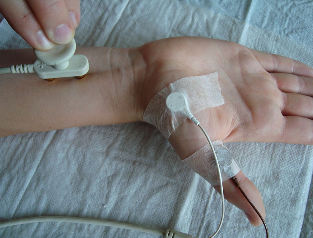
© Private individual, CC BY-SA 3.0, via Wikimedia Commons
The electrodes are connected to a machine which generates the impulses and detects them. It can measure the time taken for the impulse to travel in the nerve from the first electrode to the second. This information, plus the distance between the two electrodes, can be used to work out the speed at which the impulse is travelling along the nerve. This is referred to as the conduction velocity. It is quite fast - usually, 50-60 metres per second.
Nerve conduction studies can also be used to measure whether the size of the electrical impulses decreases as they travel along the nerve.
Are nerve conduction studies accurate?
There are many sources of potential error. This is because of the way the test is performed and the difficulty interpreting the test results. Studies show that the accuracy is also affected depending on which nerves are being tested.
How are nerve conduction studies done?
In this test, several electrodes are attached to your skin with tape or a special paste. The electrodes can be stick-on or made of small felt pads soaked in salt water solution. Felt electrodes are usually mounted in a plastic holder and kept in place with a strip of Velcro®.
A pulse-emitting electrode is placed directly over the nerve to be tested. If the nerve controls a muscle, a recording electrode is placed over the muscles under control of that nerve. Several quick electrical pulses are given to the nerve. The electrical pulses are very brief and feel like a sharp tapping sensation on the skin. Many people find this unpleasant with a slight numbness or tingling sensation but fortunately it does not last very long.
The time it takes for the muscle to contract in response to the electrical pulse is recorded. The speed of the response is called the conduction velocity.
If the nerve being tested is a sensory nerve, the recording electrode is placed in a position that will record the impulses going back towards the brain. Other nerves of the body may be studied for comparison.
How long does a nerve conduction study take?
Nerve conduction tests may take from 15 minutes to 1 hour or more, depending on how many nerves and muscles are studied.
What should I do to prepare for a nerve conduction study?
Usually very little. Your local hospital should give you specific information about any preparation necessary.
If you take certain types of medication, such as muscle relaxants or other medicines called 'anticholinergics', your doctor may ask you to stop taking them a few days before the test.
You should let the person testing you know if you have a pacemaker or defibrillator for your heart. If you have had a recent heart attack, nerve conduction study tests may be postponed.
It is also helpful if your hands and feet are as warm as possible. If they are cold this may slow down the waves of electricity (electrical impulses).
You may be asked to avoid hand lotions or creams.
Loose-fitting clothing that can be rolled up to above the elbows and knees is very helpful.
Bracelets, rings and watches will usually be removed for tests on the hands, and socks or tights removed for investigation on the feet.
Nerve conduction study side-effects
While it may sound alarming to have an electrical impulse applied to your skin, the amount of electricity that passes through you is very small.
Most people tolerate the test very well and have no side-effects after the test. Some people may have some mild discomfort or tingling which may last for a few hours after the test.
How do nerves work?
Nerves act a bit like electrical cables. They use electrical impulses to allow communication between the brain and all the other parts of the body. The brain can send signals, in the form of electrical impulses via the spinal cord to the peripheral nervous system.
Peripheral nerves can be 'motor' nerves, which means they are attached to muscles and cause the muscles to contract. They can be 'sensory' nerves, which means they are attached to special body sensors which detect things like heat, pressure, touch, etc. Or they can be mixed nerves, which means they have both a motor and a sensory part. Motor nerves use electrical signals to make muscles move. Sensory nerves send information about the environment back to the brain in the form of electrical impulses.
To work well, most nerves need to be surrounded by a special substance called myelin. Myelin provides a form of insulation for nerves, helping to keep the electrical impulses within the nerve fibre. If nerves are damaged the electrical signal often moves slower through the nerve fibre. The speed of the nerve impulse is one of the things that can be detected by nerve conduction studies.
Patient picks for General tests and investigations

Tests and investigations
Genetic testing
Genetic testing is a type of medical test that identifies changes in chromosomes, genes or proteins. Genetic tests examine a person's DNA in a variety of ways to assess a person's genetic health. They are all designed to identify a particular gene that may cause a genetic disorder. We all have 46 chromosomes in our cells. Chromosomes are made from DNA (deoxyribonucleic acid). Genes are short sections of DNA and each chromosome contains hundreds to thousands of genes. Genes contain the information our bodies need to make chemicals called proteins. Proteins form the structure of our bodies and play an important role in the processes that keep us alive. It is the differences in our genes that makes us all individuals. Sometimes a gene may change (this is called a mutation) and either cause or increase the risk of a disease or disorder. Note: the information below is a general guide only. The arrangements, and the way tests are performed, may vary between different hospitals. Always follow the instructions given by your doctor or local hospital.
by Dr Colin Tidy, MRCGP

Tests and investigations
Lumbar puncture
A lumbar puncture is used to diagnose meningitis and some other brain and spinal cord disorders.
by Dr Toni Hazell, FRCGP
Frequently asked questions
Are nerve conduction studies painful?
The electrical pulses used during the test are very brief and are often described as a sharp, tapping sensation on the skin. While many people find this sensation unpleasant, some experiencing a slight numbness or tingling, it does not last for long. Most people tolerate the test well and have no long-lasting side-effects, though some might feel mild discomfort or tingling for a few hours afterwards.
What parts of the body can be tested during a nerve conduction study?
Nerve conduction studies can investigate nerves in the peripheral nervous system, which includes all nerves outside of your brain and spinal cord. Depending on the specific nerve being tested, electrodes might be attached to fingers, toes, wrists, or ankles. If a motor nerve is being examined, a recording electrode might be placed on the muscle that nerve controls.
What information does a nerve conduction study provide to doctors?
These studies provide information on how effectively and quickly your body's nerves transmit electrical signals. The test can measure the speed at which an electrical impulse travels along a nerve (conduction velocity) and whether the strength of these impulses diminishes en route. This helps doctors assess nerve function and identify potential issues.
Does having cold hands or feet affect the outcome of the test?
Yes, if your hands and feet are cold, it can slow down the electrical impulses in your nerves. It is helpful to ensure they are as warm as possible before the test to get accurate results.
Do I need to stop taking any medications before the test?
Usually, specific instructions regarding medication will be given by your local hospital. However, if you are currently taking muscle relaxants or certain 'anticholinergic' medications, your doctor might advise you to stop them a few days prior to the test.
Should I inform the clinic if I have a pacemaker or a history of heart problems?
Yes, it is important to let the person conducting the test know if you have a pacemaker or a defibrillator. Additionally, if you have recently experienced a heart attack, the nerve conduction study might need to be postponed.
Further reading and references
- Bourke HE, Read J, Kampa R, et al; Clinic-based nerve conduction studies reduce time to surgery and are cost effective: a comparison with formal electrophysiological testing. Ann R Coll Surg Engl. 2011 Apr;93(3):236-40. doi: 10.1308/147870811X566385.
- Dyck PJ, Overland CJ, Low PA, et al; Signs and symptoms versus nerve conduction studies to diagnose diabetic sensorimotor polyneuropathy: Cl vs. NPhys trial. Muscle Nerve. 2010 Aug;42(2):157-64. doi: 10.1002/mus.21661.
- Mallik A, Weir AI; Nerve conduction studies: essentials and pitfalls in practice. J Neurol Neurosurg Psychiatry. 2005 Jun;76 Suppl 2(Suppl 2):ii23-31. doi: 10.1136/jnnp.2005.069138.
- Werner RA, Andary M; Electrodiagnostic evaluation of carpal tunnel syndrome. Muscle Nerve. 2011 Oct;44(4):597-607. doi: 10.1002/mus.22208.
About the authorView full bio

Dr Caroline Wiggins, MRCGP
General Practitioner, Medical Author
MBBS Honours (with Distinction), MRCGP (2016), MSc.SEM (with Distinction), BSc (Hons)
Dr Caroline Wiggins is a GP locum currently in the South-West of England.
About the reviewerView full bio

Dr Rachel Hudson, MRCGP
General Practitioner and Medical Author
MBChB, MRCGP (2008), BSc (Medical Science), DFSRH, DRCOG, DCH
Dr Rachel Hudson, is an NHS GP working in the North West of England.
Article history
The information on this page is written and peer reviewed by qualified clinicians.
Article also available in English, German, Spanish, French, Italian, Portuguese, Hindi, Hebrew, Arabic, and Swedish.
Next review due: 11 Jul 2028
13 Jul 2023 | Latest version
Join the conversation
Share your thoughts or experiences with others in our patient communities.

Ask, share, connect.
Browse discussions, ask questions, and share experiences across hundreds of health topics.

Feeling unwell?
Assess your symptoms online for free
Sign up to the Patient newsletter
Your weekly dose of clear, trustworthy health advice - written to help you feel informed, confident and in control.
By subscribing you accept our Privacy Policy. You can unsubscribe at any time. We never sell your data.
More in tests and investigations
- Arterial blood gases
- Blood tests to detect inflammation
- Cervical screening
- Coombs test
- DEXA scan
- Endobronchial ultrasound-guided transbronchial needle aspiration
- Exercise Tolerance Testing
- Faecal immunochemical test
- Full blood count and blood film
- Intravenous urography
- Kidney biopsy
- MRCP scan
- Newborn physical examinations
- Routine kidney function blood test
- Sickle cell trait
- Thalassaemia
- Thyroid function tests
- Ultrasound scan
- Urodynamic testing
- Voiding cystourethrogram