Électroencéphalographe
EEG
Revu par Dr John Cox, MRCGPDernière mise à jour par Dr Colin Tidy, MRCGPDernière mise à jour 24 May 2018
Respecte les directives éditoriales
- TéléchargerTélécharger
- Partager
- Language
- Discussion
- Version audio
- Ajouter aux sources préférées sur Google
Dans cette série :ÉpilepsieTypes de crisesCrises tonico-cloniquesCrises focalesAbsences épileptiquesMédicaments contre l'épilepsie et effets secondaires
Cette page a été archivée.
Il n'a pas été révisé récemment et n'est pas à jour. Les liens externes et les références peuvent ne plus fonctionner.
An electroencephalograph is a useful test to help diagnose epilepsy. It records the electrical activity of the brain. However, a normal result does not rule out epilepsy.
Remarque: les informations ci-dessous ne sont qu'un guide général. Les dispositions et la manière dont les tests sont effectués peuvent varier d'un hôpital à l'autre. Suivez toujours les instructions données par votre médecin ou votre hôpital local.
En un coup d'œil
An electroencephalograph (EEG) detects and records the electrical signals of your brain.
It is a painless and harmless test.
Small patches called electrodes are attached to your scalp and connected to a machine.
An EEG may be used to help diagnose conditions like epilepsy.
A normal EEG result does not rule out epilepsy.
An abnormal EEG result does not necessarily mean you have epilepsy.
There are special types of EEG tests, such as sleep EEG and ambulatory EEG, for specific situations.
What is an electroencephalograph?
The brain normally produces tiny electrical signals that come from the brain cells and nerves which send messages to each other. These electrical signals can be detected and recorded by the electroencephalograph (EEG) machine. The EEG test is painless and harmless. (The EEG machine records electrical signals coming de your brain - it does not put any electricity into your brain or body.)
You may be advised to have an EEG if you have had symptoms which may be due to a seizure. (Old words for seizure are convulsion or 'fit'.) An EEG test is useful in diagnosing conditions such as epilepsy. See the separate leaflet called Types of Epilepsy and Seizures.
How is the test done?
When you have the test, the operator will attach several small patches (electrodes) to your scalp. Wires from the electrodes are connected to the EEG machine. The machine detects and amplifies the electrical signals and records them on to a paper or computer. The test takes about 20-30 minutes. The electrodes are removed at the end of the test.
EEG machine
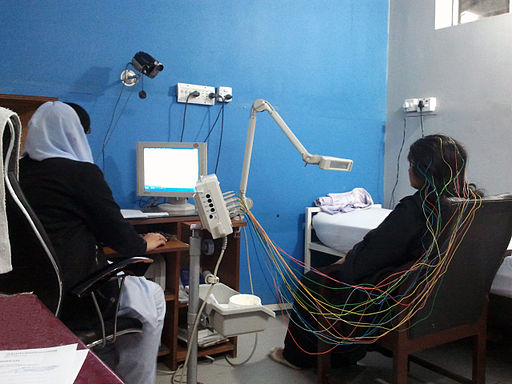
© By Baitaal (Own work), via Wikimedia Commons
For the duration of the test you may be asked to sit in a chair or lie on a couch. At some point you may be asked to blink lots of times, or to breathe deeply. These can sometimes trigger patterns of electrical activity in the brain which are associated with certain types of epilepsy.
What can the test show?
A normal ('negative') result
This shows a typical pattern of electrical activity from the brain. Most people without epilepsy, and many people with epilepsy, have a normal result. This is because an EEG only shows the electrical activity of the brain when the test is done. With many types of epilepsy, you only have abnormal electrical activity during a seizure. For the rest of the time, the pattern is normal.
An abnormal ('positive') result
This shows abnormal patterns of electrical activity. Some people with certain types of epilepsy have abnormal patterns all the time, not just when they have seizures. (Although, during a seizure the activity is even more abnormal.) For example, children with typical 'absence seizures' often have a characteristic EEG pattern which helps to confirm this type of epilepsy.
However, a small number of people who never have seizures and who don't have epilepsy, have some abnormal patterns of electrical activity in the brain.
Therefore, if you have symptoms which are thought to be seizures, an abnormal EEG means that the diagnosis is likely to be epilepsy. However, a normal result does not rule out epilepsy, and an abnormal result does not necessarily mean that you have epilepsy.
Children and electroencephalography
The interpretation of a child's EEG recording is more difficult. This is because the EEG changes during childhood. An adult pattern is usually developed by the age of 15 years. As the EEG pattern in infants and children can vary considerably, careful interpretation of the test is necessary.
Some specialised types of electroencephalograph test
Strobe lighting
In some cases, a strobe light may be used during an EEG test. This aims to detect if this alters the electrical pattern in the brain. (Usually it does not. However, a small number of people have seizures triggered by flickering or strobe lights and so this may help to identify these people.)
Sleep EEG
In this test, an EEG is performed while you are sleeping. This is usually carried out when you are in hospital. You may need to have one of these if your seizures happen when you are asleep or when you are tired.
Sleep-deprived EEG
There may be a better chance of detecting abnormal brain activity after a period of time when you are deprived of sleep. Therefore, sometimes the EEG test is done after you have stayed awake for all or most of the night. It is done in the same way as the normal test but with you asleep - after the period of 'sleep deprivation'.
Ambulatory EEG
This may be advised in cases where the diagnosis is not clear. It uses a portable EEG machine which records the brain's electrical activity when you are going about your normal activities. The electrodes can usually be hidden under your hair. The wires are connected to a small machine which you wear on a belt (a bit like wearing an mp3 player).
You may be asked to keep a diary when you have meals, go to sleep, and have any symptoms which may be a seizure. The patterns on the EEG can be analysed to see if they change when symptoms occur. It may help to confirm whether certain symptoms are due to seizures.
Video-telemetry
Where there is doubt about a diagnosis of epilepsy, or where the type of seizures someone experiences is unclear, video-telemetry can be helpful. This is a test that uses a video camera linked to an EEG machine.
The camera will visually record your movements and, at the same time, the EEG machine will record your brainwave pattern. Both the video and EEG are stored on to a computer so that they can be reviewed once the test is finished.
The doctor will be able to see any seizures that you may have had, as well as any changes in your EEG at that time. The test is often carried out over a number of days in order to increase the chances of recording one of your seizures.
What should I do to prepare for an electroencephalograph?
Your doctor should give you instructions about what you need to do to prepare for an EEG. Commonly there is no preparation necessary. You should not stop any medication you take for seizures unless advised to by your doctor.
Sélections des patients pour Tests et investigations générales

Tests et investigations
Tests auditifs
Il existe différentes manières de tester l'audition, selon l'âge de la personne concernée et le type de perte auditive. Le terme médical pour les tests auditifs est audiométrie. Remarque : les informations ci-dessous ne sont qu'un guide général. Les dispositions et la manière dont les tests sont effectués peuvent varier d'un hôpital à l'autre. Suivez toujours les instructions données par votre professionnel de santé ou votre hôpital local.
par Dr Hayley Willacy, FRCGP

Tests et investigations
Aspiration à l'aiguille fine
L'aspiration à l'aiguille fine utilise une aiguille fine et creuse pour prélever un échantillon de cellules d'un organe ou d'une masse sous la peau. Les cellules sont ensuite analysées au microscope. Remarque : les informations ci-dessous sont uniquement un guide général. L'organisation et la manière dont les tests sont effectués peuvent varier d'un hôpital à l'autre. Suivez toujours les instructions données par votre médecin ou votre hôpital local.
par le Dr Roger Henderson, MBBS
Questions fréquemment posées
What is the primary reason for having an EEG test?
An EEG test is primarily used to help diagnose conditions like epilepsy. It's often recommended if you've experienced symptoms that might be seizures, such as convulsions or 'fits'.
How long does an EEG test usually take?
A standard EEG test typically takes about 20-30 minutes to complete. Some specialised types of EEG, like ambulatory EEG or video-telemetry, might last longer or be conducted over several days.
Does having a 'normal' EEG result mean I definitely don't have epilepsy?
Not necessarily. A normal ('negative') EEG result means the electrical activity in your brain appeared typical during the test. For many people with epilepsy, abnormal electrical activity only occurs during a seizure. Therefore, a normal result during an EEG does not rule out epilepsy.
Does an 'abnormal' EEG result always mean I have epilepsy?
No. An abnormal ('positive') EEG result indicates unusual patterns of electrical activity, which can suggest epilepsy, especially if you have symptoms of seizures. However, a small number of people who do not have epilepsy and never experience seizures can also show some abnormal patterns. So, an abnormal result doesn't automatically confirm epilepsy.
Is it safe for children to have an EEG?
Yes, it is safe for children to have an EEG. The test is painless and harmless; it only records electrical signals and does not put electricity into the body. However, interpreting a child's EEG is more complex because brain electrical patterns change significantly during childhood, reaching an adult pattern around 15 years of age.
What is the purpose of flashing a strobe light during an EEG?
In some cases, a strobe light is used during an EEG to see if it triggers changes in the brain's electrical patterns. This is particularly useful for identifying individuals whose seizures are triggered by flickering or strobe lights, though usually, it doesn't alter the electrical pattern.
Lectures complémentaires et références
- Épilepsies : diagnostic et prise en charge; Ligne directrice clinique NICE (janvier 2012)
- Diagnostic et gestion de l'épilepsie chez les adultes; Réseau Écossais de Directives Intercollégiales - SIGN (2015 - mis à jour 2018)
- Épilepsie; NICE CKS, mars 2018 (accès réservé au Royaume-Uni)
À propos de l'auteurVoir la biographie complète

Dr Colin Tidy, MRCGP
Médecin généraliste, Auteur médical
MBBS, MRCGP, MRCP (Paediatrics), DCH
Le Dr Colin Tidy est un médecin du NHS, basé dans l'Oxfordshire.
À propos du critiqueVoir la biographie complète
Dr John Cox, MRCGP
MA, MB, B Chir, DCH, DRCOG, MRCP (UK), MRCGP
Le Dr John Cox a travaillé comme registraire médical au Royaume-Uni et en Nouvelle-Zélande et comme médecin intérimaire en Nouvelle-Zélande.
Historique de l'article
Les informations sur cette page sont rédigées et examinées par des cliniciens qualifiés.
Article également disponible en Anglais, Allemand, Espagnol, Français, Italien, Portugais, Hindi, Hébreu, Arabe, and Suédois.
24 May 2018 | Dernière version

Demandez, partagez, connectez-vous.
Parcourez les discussions, posez des questions et partagez vos expériences sur des centaines de sujets de santé.

Vous ne vous sentez pas bien ?
Évaluez vos symptômes en ligne gratuitement
Inscrivez-vous à la newsletter Patient
Votre dose hebdomadaire de conseils de santé clairs et fiables - rédigés pour vous aider à vous sentir informé, confiant et maître de la situation.
En vous abonnant, vous acceptez notre Politique de confidentialité. Vous pouvez vous désabonner à tout moment. Nous ne vendons jamais vos données.
Plus dans les tests et enquêtes
- Électrocardiogramme ambulatoire
- Lavement baryté
- Tests au baryum
- Analyses de sang
- Angiographie cérébrale
- Scan DEXA
- Taux de filtration glomérulaire estimé
- Gastroscopie
- Biopsie hépatique
- Tests de fonction hépatique
- Scintigraphie de perfusion myocardique
- Test de dépistage néonatal
- Test auditif néonatal
- Programme de dépistage du NHS
- Scintigraphie
- Trait drépanocytaire
- Test cutané par piqûre pour allergies
- Vérificateur de symptômes
- Test Synacthène
- Tests de la fonction thyroïdienne