Syndrome du canal carpien
Revu par Dr Hayley Willacy, FRCGP Dernière mise à jour par Dr Colin Tidy, MRCGPDernière mise à jour 14 oct. 2022
Respecte les directives éditoriales
- TéléchargerTélécharger
- Partager
- Language
- Discussion
- Version audio
- Ajouter aux sources préférées sur Google
Le syndrome du canal carpien est un ensemble de symptômes que l'on pense être causés par l'écrasement (compression) du nerf médian dans le canal carpien.
En un coup d'œil
Le syndrome du canal carpien est causé par une pression sur un nerf de votre poignet.
Les symptômes incluent des picotements, de la douleur et un engourdissement dans vos doigts ou votre main.
Les symptômes apparaissent souvent du jour au lendemain, ou lorsque vous utilisez votre main.
Les facteurs de risque incluent l'obésité, la grossesse, les antécédents familiaux et les mouvements répétitifs de la main.
Les traitements incluent des attelles de poignet, des injections de stéroïdes ou une chirurgie dans les cas graves.
Consultez votre médecin si vous ressentez un engourdissement constant ou une faiblesse musculaire du pouce.
Carpal tunnel syndrome diagram
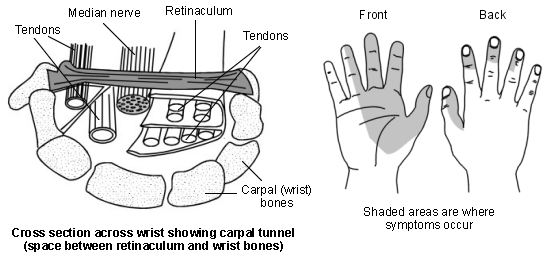
What is carpal tunnel syndrome?
This syndrome is a set of symptoms thought to be caused by squashing (compression) of the median nerve in the carpal tunnel. In terms of age, carpal tunnel syndrome is more common in:
People in their late 50s, particularly women.
People in their late 70s, when men and women are equally affected.
Carpal tunnel syndrome is more common in people who are obese and it often runs in families. It is more common in women who are pregnant.
What causes carpal tunnel syndrome?
In most cases it is not clear why it occurs. An increase in pressure going through the carpal tunnel is thought to squash (compress) and restrict the blood supply to the median nerve. As a result, the function of the median nerve is affected causing the symptoms.
Potential risk factors for carpal tunnel syndrome include:
There seems to be some inherited (genetic) factor. You have an increased risk of carpal tunnel syndrome if a close family member (father, mother, brother, sister) also has or had the condition.
Activities with repetitive hand/wrist movement, such as:
Gardening, assembly line work, and occupations requiring forceful or repetitive hand grip/exertion.
Use of vibrating hand tools.
There may be a link between carpal tunnel syndrome and using a computer, but the evidence for this is uncertain.
Grossesse.
Arthrose of the joint at the base of the thumb (metacarpophalangeal joint). This is due to compression of the median nerve by bony lumps (osteophytes).
Inflammatory joint disease, such as polyarthrite rhumatoïde.
Ganglion cysts, tumour, scar tissue.
What are the symptoms of carpal tunnel syndrome?
Fourmillements. This is numbness and tingling in part or all of the shaded area (see diagram above). This is typically the first symptom to develop. The index and middle fingers are usually first to be affected.
Douleur in the same fingers may then develop. The pain may travel up the forearm and even to the shoulder.
Engourdissement of the same finger(s), or in part of the palm, may develop if the condition becomes worse.
Dryness of the skin may develop in the same fingers.
Faiblesse of some muscles in the fingers and/or thumb occurs in severe cases. This may cause poor grip and eventually lead to muscle wasting at the base of the thumb.
Symptoms tend to come and go at first, often after you use the hand. Typically, symptoms are worse at night and may wake you up.
The symptoms may be eased for a while by raising the hand up or hanging it down. Flicking the hand and wrist may also give relief. Symptoms persist all the time if the condition becomes severe.
Carpal tunnel syndrome is a collection of symptoms - with pain as the main problem - that result from squashing of the median nerve as it runs through the carpal tunnel.
What is carpal tunnel syndrome?
What is the carpal tunnel?
There are eight small bones called carpal bones in the wrist. A ligament (also called retinaculum) lies across the front of the wrist. Between this ligament and the carpal bones is a space called the carpal tunnel. The tendons that attach the forearm muscles to the fingers pass through the carpal tunnel. A main nerve (median nerve) to the hand also goes through this tunnel before dividing into smaller branches in the palm.
The median nerve gives feeling to the thumb, index and middle fingers, and half of the ring finger. It also controls the movement of the small muscles at the base of the thumb.
Do I need any tests for carpal tunnel syndrome?
Often the symptoms are so typical that no tests are needed to confirm the diagnosis.
If the diagnosis is not clear then a test to measure the speed of the nerve impulse through the carpal tunnel (nerve conduction test) may be advised. A slow speed of impulse down the median nerve will usually confirm the diagnosis. Some people may also be referred for an ultrasound scan or a magnetic resonance imaging (MRI) scan to look at their wrist in more detail.
How do you treat carpal tunnel syndrome?
In up to 1 in 3 cases the symptoms go without treatment within six months or so. Symptoms are most likely to go in younger people.
Mesures générales
Try not to over-use your wrist by excessive squeezing, gripping, wringing, etc. If you are overweight, losing some weight may help. Painkillers may be prescribed to ease the pain. If the condition is part of a more general medical condition (such as arthritis) then treatment of that condition may help.
Not treating may be an option
In about 2 in 3 cases that develop during pregnancy, the symptoms go after the baby is born. So, not treating is an option, particularly if symptoms are mild. The situation can be reviewed if symptoms become worse.
A wrist splint
A removable wrist splint (brace) is often advised as a first active treatment. The aim of the splint is to keep the wrist at a neutral angle without applying any force over the carpal tunnel so as to rest the nerve. This may cure the problem if used for a few weeks. However, it is common to wear a splint just at night, which is often sufficient to ease symptoms.
Une injection de stéroïdes
An injection of steroid into, or near to, the carpal tunnel is an option. One research trial found that a single steroid injection eased symptoms in about 3 in 4 cases. In this trial the symptoms returned in some people over the following year. Other studies report variable success rates with steroid injections.
Surgery for carpal tunnel syndrome
Surgery is recommended for severe cases but the jury is still out as to whether it is better than injections for moderate symptoms. A large trial is being conducted to answer this question.
A small operation can cut the ligament over the front of the wrist and ease the pressure in the carpal tunnel to give your nerve more space. This usually cures the problem. It is usually done under local anaesthetic. There are two main types of surgery - open and keyhole. Your surgeon will discuss which technique is appropriate for you.
You will not be able to use your hand for work for a few weeks after the operation. A small scar on the front of the wrist will remain. There is a small risk factor of complications from surgery. For example, following surgery there is a very small risk of infection and damage to the nerve or blood vessels. Sometimes, the nerve can get caught up in the scar and become stretched when the wrist is moved: this is known as tethering.
Autres traitements
Over the years, a wide range of other treatments has been tried. For example, controlled cold therapy, ice therapy, laser therapy and exercises. None of these treatments has good research evidence to support its use and so they are not commonly advised. However, they can work for some people. There is some evidence that acupuncture may relieve symptoms in some people.
Steroid tablets may ease symptoms in some cases. However, there is a risk of serious side-effects from taking a long course of steroid tablets. Also, a local injection of a steroid (described above) probably works better. Therefore, steroid tablets are not usually advised.
Which is the best treatment for me?
A non-surgical option may be advised if your symptoms are mild - for example, if your symptoms come and go and mainly consist of tingling, pins and needles or mild discomfort. A wrist splint (brace) may work but a steroid injection is probably the most effective non-surgical treatment.
If you try a non-surgical treatment and it does not work, do return to your doctor. In particular, see your doctor if you have constant numbness in any part of your hand, or if you have any weakness of the muscles next to the thumb. These symptoms mean that the nerve is not working well and is at risk of permanent damage.
Surgery gives the best chance of long-term cure. It is quite a common operation. It is done if symptoms continue (persist) despite other treatments, or if symptoms are severe and the nerve is in danger of permanent damage.
Treatment for severe symptoms
If you have severe symptoms - in particular wasting of the muscles at the base of the thumb - then you will probably need surgery. This is to relieve pressure on (decompress) the trapped nerve quickly, which aims to prevent any permanent long-term nerve damage.
Carpal tunnel syndrome during pregnancy
Symptoms commonly go after the baby is born. Therefore, a non-surgical treatment, such as a splint, is usually advised at first. Surgery is an option if symptoms persist.
Sélections des patients pour Troubles nerveux

Cerveau et nerfs
Douleur neuropathique
La douleur neuropathique (néuralgie) est une douleur causée par des problèmes avec les signaux nerveux. Il existe différentes causes. Elle diffère du type de douleur courant due à une blessure, une brûlure, une pression, etc. Les analgésiques traditionnels tels que le paracétamol, les anti-inflammatoires et la codéine n'aident généralement pas beaucoup. Cependant, la douleur neuropathique est souvent soulagée par des médicaments antidépresseurs ou anti-épileptiques - par une action distincte de leur effet sur la dépression et l'épilepsie. D'autres médicaments et techniques analgésiques sont également parfois utilisés.
par Dr Surangi Mendis, MRCGP

Cerveau et nerfs
Trouble neurologique fonctionnel
Le terme de trouble neurologique fonctionnel englobe une large gamme de symptômes qui sont souvent très invalidants. Les médecins ont tendance à catégoriser ces symptômes selon leur cadre médical de référence, mais échouent souvent. Les troubles neurologiques fonctionnels n'ont pas de méthode officielle de diagnostic par les médecins. Ils peuvent cependant être traités.
par Dr Hayley Willacy, FRCGP
Questions fréquemment posées
Quelle est la probabilité de récidive du syndrome du canal carpien après une chirurgie ?
L'article indique que la chirurgie guérit généralement le problème. Il ne fournit pas de statistiques spécifiques sur les taux de récidive après une opération réussie, mais le but de la chirurgie est une guérison à long terme en soulageant la pression sur le nerf.
Existe-t-il des exercices spécifiques qui peuvent aider à soulager les symptômes du syndrome du canal carpien ?
L'article mentionne qu'une large gamme de traitements a été essayée au fil des ans, y compris des exercices. Cependant, il indique qu'aucun de ces traitements ne dispose de preuves de recherche solides pour soutenir leur utilisation et ne sont donc pas couramment conseillés. Bien qu'ils puissent fonctionner pour certaines personnes, il n'y a pas de soutien scientifique pour leur recommandation générale.
Combien de temps dure généralement la période de récupération après une chirurgie du syndrome du canal carpien ?
Après la chirurgie, vous ne pourrez pas utiliser votre main pour le travail pendant quelques semaines. La durée exacte de la récupération peut varier selon l'individu et le type de chirurgie effectuée, mais quelques semaines est le délai général indiqué.
Si je ressens des symptômes légers, devrais-je attendre pour voir s'ils s'améliorent d'eux-mêmes avant de consulter un traitement ?
Si les symptômes sont légers et vont et viennent, consistant particulièrement en des picotements, des fourmillements ou un léger inconfort, une option non chirurgicale peut être conseillée. L'article note également que dans jusqu'à 1 cas sur 3, les symptômes disparaissent sans traitement en six mois, surtout chez les jeunes. Pour les femmes enceintes, les symptômes disparaissent souvent après l'accouchement, ce qui fait de 'ne pas traiter' une option viable pour les symptômes légers.
Quels sont les effets négatifs potentiels d'une injection de stéroïdes pour le syndrome du canal carpien ?
L'article mentionne qu'une seule injection de stéroïdes peut soulager les symptômes, mais il note également que les symptômes sont revenus chez certaines personnes au cours de l'année suivante dans un essai de recherche. Il ne détaille pas d'effets négatifs spécifiques ou de risques associés à l'injection elle-même, au-delà du potentiel de soulagement temporaire plutôt qu'une guérison permanente.
Lectures complémentaires et références
- Vasiliadis HS, Georgoulas P, Shrier I, et al; Endoscopic release for carpal tunnel syndrome. Cochrane Database Syst Rev. 2014 Jan 31;1:CD008265. doi: 10.1002/14651858.CD008265.pub2.
- Syndrome du canal carpien; NICE CKS, août 2022 (accès réservé au Royaume-Uni)
- Wipperman J, Goerl K; Carpal Tunnel Syndrome: Diagnosis and Management. Am Fam Physician. 2016 Dec 15;94(12):993-999.
- Wright AR, Atkinson RE; Carpal Tunnel Syndrome: An Update for the Primary Care Physician. Hawaii J Health Soc Welf. 2019 Nov;78(11 Suppl 2):6-10.
- Petrover D, Richette P; Treatment of carpal tunnel syndrome : from ultrasonography to ultrasound guided carpal tunnel release. Joint Bone Spine. 2018 Oct;85(5):545-552. doi: 10.1016/j.jbspin.2017.11.003. Epub 2017 Nov 16.
- Burton C, Chesterton LS, Davenport G; Diagnosing and managing carpal tunnel syndrome in primary care. Br J Gen Pract. 2014 May;64(622):262-3. doi: 10.3399/bjgp14X679903.
À propos de l'auteurVoir la biographie complète

Dr Colin Tidy, MRCGP
Médecin généraliste, Auteur médical
MBBS, MRCGP, MRCP (Paediatrics), DCH
Le Dr Colin Tidy est un médecin du NHS, basé dans l'Oxfordshire.
À propos du critiqueVoir la biographie complète

Dr Hayley Willacy, FRCGP
Médecin généraliste, Auteur médical
MBChB (1992), DRCOG, DFFP, MRCOG (Part 1) MRCGP (2007), DFSRH (2013), MSc - medical education (2020)
Le Dr Hayley Willacy était médecin généraliste au NHS travaillant dans le nord-ouest de l'Angleterre, qui a pris sa retraite de la pratique clinique en 2022 après 30 ans.
Historique de l'article
Les informations sur cette page sont rédigées et examinées par des cliniciens qualifiés.
Article également disponible en Anglais, Allemand, Espagnol, Français, Italien, Portugais, Hindi, Hébreu, Arabe, and Suédois.
Next review due: 13 Oct 2027
14 oct. 2022 | Dernière version

Demandez, partagez, connectez-vous.
Parcourez les discussions, posez des questions et partagez vos expériences sur des centaines de sujets de santé.

Vous ne vous sentez pas bien ?
Évaluez vos symptômes en ligne gratuitement
Inscrivez-vous à la newsletter Patient
Votre dose hebdomadaire de conseils de santé clairs et fiables - rédigés pour vous aider à vous sentir informé, confiant et maître de la situation.
En vous abonnant, vous acceptez notre Politique de confidentialité. Vous pouvez vous désabonner à tout moment. Nous ne vendons jamais vos données.
Plus sur le cerveau et les nerfs
- TDAH chez les enfants
- Outil d'auto-évaluation du TDAH
- Causes de la perte de mémoire et de la démence
- Dyspraxie
- Épilepsie et contraception
- Tremblement essentiel
- Traumatismes crâniens
- Maladie de Huntington
- Vivre avec l'épilepsie
- Médicaments et traitements pour la démence
- Céphalée due à l'abus de médicaments
- Perte de mémoire et démence
- la maladie de Parkinson
- Fourmillements
- Mutisme sélectif
- Zona
- AVC
- Mort subite inattendue en épilepsie
- Lésions du lobe temporal
- Céphalée de tension