Infection fongique de l'aine
Tinea cruris
Évalué par des pairs Dr Toni Hazell, FRCGPDernière mise à jour par Dr Philippa Vincent, MRCGPDernière mise à jour 9 janv. 2025
Respecte les directives éditoriales
- TéléchargerTélécharger
- Partager
- Language
- Discussion
- Version audio
- Ajouter aux sources préférées sur Google
Dans cette série :Infections fongiquesMédicament antifongiqueMuguet chez les hommesPied d'athlèteInfection à levuresTeigne
Infection fongique de l'aine (tinea cruris) est une infection de la peau de l'aine causée par un champignon. C'est un problème courant, en particulier chez les athlètes et les personnes âgées. Le traitement avec une crème antifongique fonctionne généralement bien. Les conseils ci-dessous peuvent aider à prévenir les récidives.
En un coup d'œil
Tinea cruris is a fungal skin infection in the groin area.
Symptoms include itchiness, redness, and a scaly rash with a definite border.
It is sometimes called "jock itch" and is common in athletes.
Self-care includes keeping the area dry and wearing loose clothing.
Antifungal creams are often used for treatment.
See a doctor if the rash is painful, causes a fever, or does not improve after a week of treatment.
What is tinea cruris?
Tinea cruris is a fungal skin infection of the groin. Some types of fungal germs (fungi) are commonly found on human skin. These fungi usually cause no problems. However, under certain circumstances, they can multiply and cause an infection. The most common fungus causing a fungal groin infection is trichophyton rubrum.
The conditions that fungi like best are warm, moist and airless areas of skin. This includes the groin, the armpits and the area under the breasts.
Fungal skin infection is also known as intertrigo. This is a word that means "between" and "rubbing". The fungal infection is more likely to take hold because there is so much skin-to-skin contact in these areas - in the groin this is where the scrotum rubs on the skin of the thighs or the thighs rub together.
Tinea cruris in the groin is sometimes called "jock itch" because it is common in athletes. This is because the groin tends to become warm and moist during sports activities.
What does tinea cruris look like?
Fungal groin infection (tinea cruris)
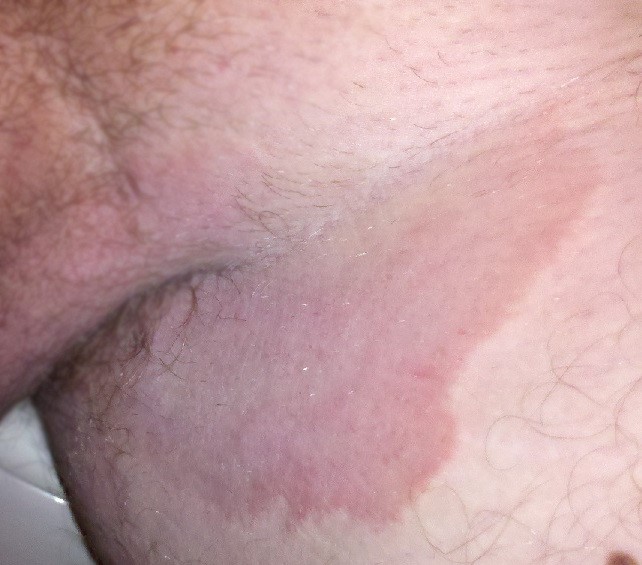
© ByRobertgascoin,via Wikimedia Commons
Jock itch
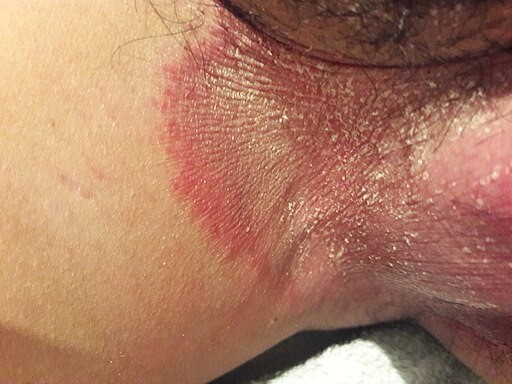
© Gerardolagunes, CC BY-SA 3.0, via Wikimedia Commons
Tinea cruris symptoms
Symptoms of tinea cruris include:
Itchiness. The groin becomes itchy and can be sore, mainly in the crease between the top of the leg and the genitals.
Scrotum. In men the scrotum may also be itchy or sore.
Redness. The skin in the groin area becomes red and slightly scaly. There is usually a definite edge or border. Both sides are commonly affected.
Spreading away from the groin. The rash often spreads a short way down the inside of both thighs.
Odeur. Sometimes a musty yeasty smell is noticeable.
Sometimes the infection spreads to the skin on other parts of the body (or may have first started in another area, such as pied d'athlète (tinea pedis)). Fungal infections usually remain on the skin and do not usually go deeper into the body; they are not usually serious.
Fungal groin infections are more common in men than women.
When to see a doctor about tinea cruris
Medical advice should be sought if:
The rash is painful or a fever develops.
The rash has not improved after a week or two of using a topical antifungal medicine as recommended by a pharmacist.
The rash hasn't cleared up fully after three weeks of treatment.
People with a weakened body defence (immune system), eg, diabetes or having chemotherapy, may need more treatment so should seek medical advice sooner if the rash is not improving.
Risk factors for fungal groin infection
Diabète.
Obésité.
A weakened immune system.
Tinea cruris diagnosis
Appearance. The diagnosis can usually be made by the features of the rash which is usually obvious.
Skin scrapings. Occasionally, if there is doubt about the diagnosis, skin scrapings can be sent to the laboratory to identify features that would indicate a fungal infection.
Biopsie cutanée. If there is any concern about the diagnosis then a specialist (dermatologist) referral may be made. This would be unusual. Occasionally a skin biopsy may be required.
Tinea cruris treatment
Self-care.
Wear loose-fitting clothes made of cotton or material designed to keep moisture away from the skin.
Avoid tight-fitting clothes such as leggings.
Maintain good hygiene by washing the affected skin areas daily.
Dry thoroughly after washing, especially in the skin folds.
Avoid scratching which may spread the infection to other sites.
Do not share towels, and wash them frequently, to reduce the risk of passing on the infection to someone else.
Wash clothes and bed linen frequently to get rid of any fungal spores.
If a child is affected, it is not necessary to exclude them from school or nursery.
Topical antifungal creams. A topical antifungal cream can be used if there is mild, non-extensive disease. Options include:
Treatment with a topical antifungal cream may be repeated in the future if there are recurrent episodes of mild, non-extensive disease. An antifungal powder can be used (eg, miconazole) but creams are recommended as being more effective.
Steroid cream. A mildly-potent topical corticosteroid can be used in addition to a topical antifungal cream if there is associated marked inflammation, eg, hydrocortisone 1% cream, applied once daily for a maximum of 7 days. A topical corticosteroid preparation should not be used alone as it can make the fungal infection worse.
Oral antifungal treatment. For severe or extensive disease, adults can be prescribed oral antifungal treatment, such as:
Oral itraconazole ou oral griseofulvin can be used if terbinafine cannot be used or causes any side effects.
A child with severe or extensive disease would be referred to a specialist (paediatric dermatologist).
Tinea cruris outcome
Tinea cruris usually clears up in 1 to 3 weeks with treatment, including antifungal creams. However, for people who are particularly susceptible, such as athletes and those who sweat a lot, recurrences are common and the problem may become long term (chronic).
Preventing recurrent tinea cruris
To prevent any recurring tinea cruris (fungal groin infection) self-care should be used, as outlined in the treatment above:
Wash the groin daily; then dry thoroughly. Drying is the most important part of this. It is very important to delay putting on underwear until the groin is fully dry. The damp groin is then an ideal site for fungi to multiply. A hairdryer is very useful to dry the area if the groin is more hairy or difficult to dry. However, ensure that the hairdryer is not too hot.
Change underwear daily. Fungi may multiply in flakes of skin in unwashed underwear.
Check for pied d'athlète (tinea pedis) and treat it if present. Athlete's foot is a common fungal infection of the toes. In a typical case of athlete's foot, the skin between the toes is itchy and flaky - especially between the outer two toes. The fungi from athlete's foot may spread to the groin. The same creams are used to treat athlete's foot and tinea cruris.
Do not share towels with people in communal changing rooms. Wash towels frequently.
Do not share towels if suffering from tinea cruris.
Sélections des patients pour Infections fongiques

Infections
Infections fongiques des poumons
Un champignon est un type de germe minuscule qui ne cause généralement pas de problèmes. Ils sont tout autour de nous : vous ne pouvez les voir qu'avec un microscope. Mais dans certaines situations, en particulier si vous avez d'autres maladies graves, les champignons (le pluriel de champignon) peuvent infecter vos poumons. Cela peut être très sérieux et nécessite des soins spécialisés.
par Dr Colin Tidy, MRCGP

Infections
Muguet chez les hommes
Le muguet est une infection courante, causée par un champignon appelé Candida. Candida vit normalement sur notre peau en petites quantités sans causer de problèmes. Parfois, cependant, il peut provoquer des infections. Les infections à Candida peuvent affecter de nombreux systèmes corporels, mais causent le plus souvent des problèmes dans la région génitale, dans la bouche (muguet buccal) ou sur la peau. Le muguet chez les hommes est assez courant, bien que les femmes soient plus susceptibles de contracter le muguet que les hommes. Le muguet est généralement une infection bénigne qui disparaît rapidement avec un traitement.
par Dr Hayley Willacy, FRCGP
Questions fréquemment posées
Can I use hydrocortisone cream alone to treat tinea cruris?
No, a topical corticosteroid preparation like hydrocortisone 1% cream should not be used alone to treat tinea cruris, as it can worsen the fungal infection. It should only be used in addition to a topical antifungal cream, and for a maximum of 7 days, if there is significant inflammation.
How long does it typically take for tinea cruris to clear up with treatment?
With appropriate treatment, including antifungal creams, tinea cruris usually clears up within 1 to 3 weeks. However, for individuals who are particularly prone to it, such as athletes or those who sweat a lot, recurrences are common.
Is tinea cruris more common in men or women?
Fungal groin infections, or tinea cruris, are more common in men than in women.
What should I do if the infection keeps coming back?
If you experience recurrent tinea cruris, it's important to consistently follow self-care measures. This includes washing the groin daily and drying thoroughly, changing underwear daily, checking for and treating athlete's foot, and avoiding sharing towels. If recurrences are persistent, medical advice may be helpful.
Should children with tinea cruris be kept home from school or nursery?
No, if a child is affected by tinea cruris, it is not necessary to exclude them from school or nursery.
Lectures complémentaires et références
- Infections fongiques de la peau; DermNet NZ
- Infection fongique de la peau - corps et aine; NICE CKS, juillet 2023 (accès réservé au Royaume-Uni)
- Tinea corporis (body), cruris (groin) and incognito (steroid exacerbated); Société de Dermatologie de Soins Primaires.
À propos de l'auteurVoir la biographie complète

Dr Philippa Vincent, MRCGP
Médecin généraliste, Auteur médical
MB BS, Bsc, MRCGP (2000), DCH, DFSRH, DRCOG
Dr Philippa Vincent est un médecin généraliste du NHS travaillant dans le nord de Londres.
À propos du critiqueVoir la biographie complète

Dr Toni Hazell, FRCGP
MBBS, BSc, FRCGP, DFSRH, Dip GU med, DRCOG, DCH (London, UK, 2000)
Le Dr Toni Hazell a obtenu son diplôme de l'École de médecine de l'hôpital St. Mary et a effectué son VTS à l'hôpital Northwick Park.
Historique de l'article
Les informations sur cette page sont rédigées et examinées par des cliniciens qualifiés.
Article également disponible en Anglais, Allemand, Espagnol, Français, Italien, Portugais, Hindi, Hébreu, Arabe, and Suédois.
Prochaine révision prévue : 8 janv. 2028
9 janv. 2025 | Dernière version

Demandez, partagez, connectez-vous.
Parcourez les discussions, posez des questions et partagez vos expériences sur des centaines de sujets de santé.

Vous ne vous sentez pas bien ?
Évaluez vos symptômes en ligne gratuitement
Inscrivez-vous à la newsletter Patient
Votre dose hebdomadaire de conseils de santé clairs et fiables - rédigés pour vous aider à vous sentir informé, confiant et maître de la situation.
En vous abonnant, vous acceptez notre Politique de confidentialité. Vous pouvez vous désabonner à tout moment. Nous ne vendons jamais vos données.