Sinus pilonidal
Revu par des pairs par Dr Surangi Mendis, MRCGPDernière mise à jour par Dr Philippa Vincent, MRCGPDernière mise à jour 10 août 2023
Respecte les directives éditoriales
- TéléchargerTélécharger
- Partager
- Language
- Discussion
- Version audio
- Ajouter aux sources préférées sur Google
Un sinus pilonidal est un conduit infecté sous la peau entre les fesses. Le traitement implique généralement une opération. Après l'opération, il est conseillé de garder la zone exempte de poils en croissance par un rasage régulier ou d'autres moyens d'épilation.
En un coup d'œil
A pilonidal sinus is a narrow tunnel under the skin, often containing hairs.
They commonly occur between the buttocks, above the back passage.
Symptoms can include pain, swelling, and pus discharge.
Factors like sitting for long periods, being overweight, or very hairy can increase risk.
Treatment for active symptoms usually involves antibiotics or an operation.
If you have no symptoms, good hygiene and hair removal in the area may be advised.
What is a pilonidal sinus?
Diagram detailing the natal cleft
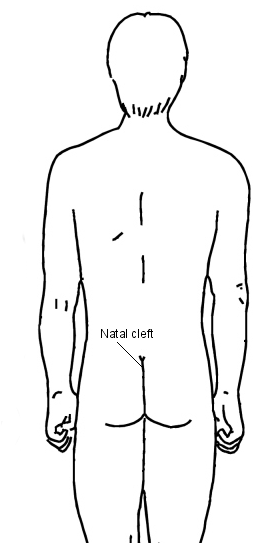
Pilonidal means a 'nest of hairs'.
A sinus tract is a narrow tunnel (a small abnormal channel) in your body. A sinus tract typically goes between a focus of infection in deeper tissues to the skin surface. This means that the tract may discharge pus from time to time on to the skin.
A pilonidal sinus is a sinus tract which commonly contains hairs. It occurs under the skin between the buttocks (the natal cleft) a short distance above the back passage (anus). The sinus tract goes in a vertical direction between the buttocks. Rarely, a pilonidal sinus occurs in other sites of the body.
The pilonidal sinus usually starts as a pilonidal cyst. This is the lump before the sinus develops. However in practice the terms tend to be used interchangeably.
What causes a pilonidal sinus?
The exact cause is not clear. There are various theories including:
Birth abnormality
One theory is that the problem may develop from a minor abnormality in the skin between the buttocks that was present at birth. This may explain why the condition tends to run in some families. Part of the abnormality in this part of the skin may be that the hairs grow into the skin rather than outwards.
Skin dimples
Another theory is that skin dimples (skin pits) may develop in the skin between the buttocks as a result of local pressure or friction causing damage to the small structures below the skin, responsible for making hairs (the hair follicles). Because of local pressure, hair growing in the natal cleft may become pushed into the skin pits.
Whatever the cause, once hair fragments become 'stuck' in the skin they irritate it and cause inflammation. Inflamed skin quickly becomes infected and so a repeated (recurrent) or persistent infection tends to develop in the affected area. The infection causes the sinus (which often contains broken pieces of hair) to develop .
(A similar condition can occur between the fingers of hairdressers which is caused by customers' hairs entering moist, damaged skin.)
How common is pilonidal sinus?
This condition affects around 26 in 100,000 people each year in the UK. It is rare in children and in people over the age of 40. It is four times more common in men than in women (as men tend to have more body hair than women).
Certain factors increase the risk of developing the condition and include:
Having a job involving a lot of sitting (a sedentary occupation).
Being overweight or obese.
Having a previous persistent irritation or injury to the affected area.
Having a hairy, deep natal cleft.
Having a family history of the condition.
This condition used to be called 'jeep seat' as it was common in army jeep drivers. This was probably a result of many hours of driving and 'bouncing' on a hard seat, which caused irritation, minor injury and pressure around the natal cleft.
It used to be thought that excessive sweating was one of the causes but recent studies have not shown this.
Pilonidal sinus symptoms
A pilonidal sinus may not cause any symptoms at first. Some people notice a painless lump at first in the affected area when washing. However, in most cases, symptoms develop at some stage and can be 'acute' or 'chronic'.
Rapid-onset (acute) symptoms
Pain and swelling may develop over a number of days as a ball of pus with surrounding skin infection (an infected abscess) develops in and around the sinus. This can become very painful and tender.
Persistent (chronic) symptoms
Around 4 in 10 people have a repeated (recurrent) pilonidal sinus. Some pain may develop which is less intense than the acute symptoms. Usually the sinus discharges some pus which releases the pressure and so the pain tends to ease off and not become severe. However, the infection does not clear completely. This can mean that the symptoms of pain and discharge can last long-term, or flare up from time to time, until the sinus is treated by an operation.
Is pilonidal sinus dangerous?
Pilonidal sinuses are not dangerous in themselves. Recurrent infections can be painful and require multiple courses of antibiotics. There is some evidence that untreated, recurrently infected pilonidal sinuses can develop into a squamous cell carcinoma of the skin. This is a very rare complication.
Pilonidal sinus treatment
If you have no symptoms
If there are no symptoms then keeping the affected area clear of hairs (by shaving, etc) and keeping the area clean with good personal hygiene may be all that is required.
If you have rapid-onset (acute) symptoms
If there is an infection then antibiotiques will usually be prescribed. Painkillers (such as paracétamol et/ou ibuprofène) may be very helpful to improve the pain. An emergency operation is sometimes required. This procedure punctures (incises) and drains the ball of pus with the surrounding skin infection (abscess).
If you have persistent (chronic) symptoms
In most cases, an operation will be advised. There are various operations which are done to cure this problem. A surgeon will be able to give the details and the pros and cons of each operation. The options include the following:
Wide excision and healing by secondary intention.
This operation involves cutting out (excision of) the sinus but also cutting out a wide margin of skin which surrounds the sinus. The wound is not closed but just left open to heal by natural healing processes (healing by 'secondary intention'). This usually requires several weeks of regular dressing changes until it heals fully. The advantage of this method is that all inflamed tissue is removed and the chance of the condition coming back (a recurrence) is low.
Excision and primary closure.
This means taking out the section of skin which contains the sinus. This is done by cutting out an oval-shaped (ellipse) flap of skin either side of the sinus, which takes out the sinus. The two sides of the ellipse are then stitched together.
The advantage for this is that, if successful, the wound heals quite quickly. The risk of a recurrence or of developing a wound infection after the operation is higher than with the above procedure. This risk may be reduced by using a wound technique in which the line of stitches is moved away from between the buttocks.
A plastic surgery technique
In some cases, where the sinus recurs or is extensive, plastic surgery may be advised to remove the sinus and refashion the nearby skin.
There are variations on the above procedures, depending on the circumstances, the size and extent of the sinus, and whether it is a first or recurrent problem. A surgeon will be able to discuss the most suitable type of operation.
New techniques are being researched to try to improve the recovery after having an operation.
After your operation
The surgeon will usually advise that the wound should be kept clean and any hair growing near it be shaved or removed by other means. Some surgeons recommend that, even when the wound is healed, the area should be kept free of hair growing by shaving the area every few weeks, or by other methods to remove the hair. This reduces the chance of the problem coming back (recurring).
Sélections des patients pour Autres infections

Infections
maladie de Lyme
La maladie de Lyme est une infection causée par la morsure d'une tique infectée. Le premier et le plus courant des symptômes est une éruption cutanée qui s'étend à partir du site de la morsure de la tique. Si elle n'est pas traitée, les germes (bactéries) peuvent se propager à d'autres parties du corps. Dans certains cas, cela peut provoquer des symptômes graves - souvent des mois après la morsure initiale de la tique. Un traitement antibiotique permet généralement de guérir l'infection.
par Dr Philippa Vincent, MRCGP

Infections
Rhumatisme articulaire aigu
La fièvre rhumatismale est une maladie causée par un type particulier de bactérie appelée streptocoque bêta-hémolytique. C'est le même germe qui peut provoquer un mal de gorge. Elle peut affecter votre cœur, ainsi que vos articulations, votre peau et votre système nerveux.
par Dr Hayley Willacy, FRCGP
Questions fréquemment posées
What is the natal cleft?
The natal cleft is the groove or fold between the buttocks. A pilonidal sinus commonly occurs under the skin in this area, a short distance above the back passage.
Does a pilonidal sinus always contain hair?
A pilonidal sinus is a sinus tract that commonly contains hairs. The term 'pilonidal' itself means a 'nest of hairs', and the presence of hair fragments becoming stuck in the skin is believed to irritate and cause inflammation, leading to infection and the development of the sinus.
Can excessive sweating cause a pilonidal sinus?
It was once thought that excessive sweating was a cause of pilonidal sinus; however, recent studies have not shown this to be the case.
If I have a pilonidal sinus, do I always need surgery?
Not necessarily. If you have no symptoms at all, keeping the affected area clean and free of hairs may be sufficient. If you have persistent or chronic symptoms, an operation is usually advised. For acute symptoms, antibiotics and painkillers may be prescribed, and sometimes an emergency operation to drain a pus collection is performed.
What is the difference between a pilonidal cyst and a pilonidal sinus?
A pilonidal sinus usually starts as a pilonidal cyst. The cyst is the initial lump that forms before the sinus, which is a narrow tunnel or channel, develops. In practice, however, these terms are often used interchangeably.
Lectures complémentaires et références
- de Parades V, Bouchard D, Janier M, et al; Pilonidal sinus disease. J Visc Surg. 2013 Sep;150(4):237-47. doi: 10.1016/j.jviscsurg.2013.05.006. Epub 2013 Aug 1.
- Garg P, Menon GR, Gupta V; Laying open (deroofing) and curettage of sinus as treatment of pilonidal disease: a systematic review and meta-analysis. ANZ J Surg. 2016 Jan;86(1-2):27-33. doi: 10.1111/ans.13377. Epub 2015 Nov 27.
- Mahmood F, Hussain A, Akingboye A; Pilonidal sinus disease: Review of current practice and prospects for endoscopic treatment. Ann Med Surg (Lond). 2020 Aug 1;57:212-217. doi: 10.1016/j.amsu.2020.07.050. eCollection 2020 Sep.
- Rethinking the causes of pilonidal sinus disease; Doll et al
- Pandey MK, Gupta P, Khanna AK; Squamous cell carcinoma arising from pilonidal sinus. Int Wound J. 2014 Aug;11(4):354-6. doi: 10.1111/j.1742-481X.2012.01096.x. Epub 2012 Oct 11.
À propos de l'auteurVoir la biographie complète

Dr Philippa Vincent, MRCGP
Médecin généraliste, Auteur médical
MB BS, Bsc, MRCGP (2000), DCH, DFSRH, DRCOG
Dr Philippa Vincent est un médecin généraliste du NHS travaillant dans le nord de Londres.
À propos du critiqueVoir la biographie complète

Dr Surangi Mendis, MRCGP
Consultant et Auteur Médical
MBBS, BSc (1st), MRCGP (2014), DFSRH, PGcert otology and audiology
Surangi Mendis est consultante en médecine audiovestibulaire et neuro-otologie aux hôpitaux Royal National ENT et Eastman Dental, UCLH.
Historique de l'article
Les informations sur cette page sont rédigées et examinées par des cliniciens qualifiés.
Article également disponible en Anglais, Allemand, Espagnol, Français, Italien, Portugais, Hindi, Hébreu, Arabe, and Suédois.
Prochaine révision prévue : 8 août 2028
10 août 2023 | Dernière version

Demandez, partagez, connectez-vous.
Parcourez les discussions, posez des questions et partagez vos expériences sur des centaines de sujets de santé.

Vous ne vous sentez pas bien ?
Évaluez vos symptômes en ligne gratuitement
Inscrivez-vous à la newsletter Patient
Votre dose hebdomadaire de conseils de santé clairs et fiables - rédigés pour vous aider à vous sentir informé, confiant et maître de la situation.
En vous abonnant, vous acceptez notre Politique de confidentialité. Vous pouvez vous désabonner à tout moment. Nous ne vendons jamais vos données.
Plus sur les infections
- Amibiase
- Antibiotiques
- Campylobacter
- Toux et rhumes chez les enfants
- Leptospirose et maladie de Weil
- Listériose
- Infection de l'oreille moyenne (otite moyenne)
- Infection pulmonaire post-opératoire
- Poux du pubis et poux du corps
- Rage et vaccin contre la rage
- Teigne
- Sexe sécurisé
- Salmonella
- Schistosomiase
- Infections sexuellement transmissibles
- syndrome de la joue giflée
- Syphilis
- Coqueluche