Obstruction du canal lacrymal chez les bébés
Revu par Dr Toni Hazell, FRCGPDernière mise à jour par Dr Doug McKechnie, MRCGPDernière mise à jour 11 août 2025
Respecte les directives éditoriales
- TéléchargerTélécharger
- Partager
- Language
- Discussion
- Version audio
- Ajouter aux sources préférées sur Google
L'obstruction du canal lacrymal signifie qu'il y a un blocage des petits canaux (conduits) qui drainent les larmes du coin interne de l'œil vers le côté du nez. De nombreux bébés naissent avec des canaux lacrymaux bloqués. Ils s'ouvrent généralement sans aucun traitement avant l'âge d'un an.
En un coup d'œil
Un canal lacrymal bloqué est courant chez les bébés, affectant jusqu'à 1 nouveau-né sur 5.
Cela se produit lorsque les canaux lacrymaux ne se sont pas encore complètement développés ou ouverts.
Les symptômes incluent des yeux larmoyants ou un écoulement collant.
La plupart des canaux lacrymaux obstrués s'ouvrent d'eux-mêmes avant que le bébé n'ait un an.
Masser doucement le canal lacrymal peut aider à drainer les larmes.
Consultez un médecin si l'œil de votre bébé est très rouge, enflammé, ou s'il y a un gonflement.
What causes tear duct blockage in babies?
Many babies are born with a blocked tear duct. This happens when the tear ducts haven't fully developed and opened up yet. This can be due to:
A membrane (web of tissue) that hasn't yet broken down, and is blocking the tear duct.
A tear duct that is too narrow.
We don't know why this affects some babies and not others, although it's thought that some babies might inherit genetic variations that mean their tear ducts take a bit longer to fully develop.
It's also more likely to happen in babies who were born prematurely, and in babies with conditions that affect the shape of their face, such as syndrome de Down. But most babies with a blocked tear duct don't have any other health conditions.
Blocked tear ducts usually open after a bit more time for them to develop fully. For 9 out of 10 children, the tear duct opens up on its own by the time they are one year old.
Blocked tear ducts are common in babies and usually don't cause any serious problems. There are some rare complications to be aware of. See "When should you take your baby to see a doctor?" below for more.
In most babies, a blocked tear duct will simply get better with time, without causing any problems.
What are tear ducts for?
The surface of the eye is kept moist by watery fluid (tears). This is really important to prevent any damage to the sensitive surface of the eye. The tears help to remove any dust or dirt from the surface of the eye. The tears are made in glands called the lacrimal glands, which are just above the outside corner of the eye, below the eyebrow.
Close-up view
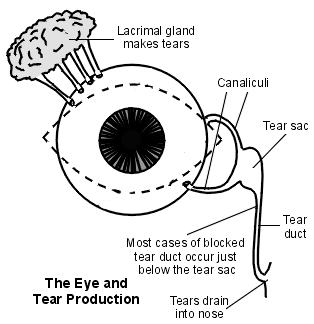
The lacrimal glands constantly make a small amount of tears which drains on to the eye.
When we blink, the eyelid spreads the tears all over the surface of the eye. Any excess tears drain out of the eye by passing through the small channels of the tear duct (nasolacrimal duct) and into the nose. (This is why your nose starts running if you are crying - the extra tears produced are going into your nose.)
There are also tiny glands (called meibomian glands) in the eyelids, which make a small amount of oily liquid. This oily liquid also helps to protect the surface of the eyes.
In babies with tear duct blockage, these tears don't drain into the nose properly. This means their tears back up in their eyes, and the can become more watery. The tears can also form a sticky discharge on, and around, the eyes.
How common is tear duct blockage in babies?
Blockage of the tear duct is common in babies, occurring in up to 1 in 5 newborns. It is usually because the tear duct has not completely developed by the time of the birth. The blockage of the tear duct can affect just one eye or both eyes.
Abnormalities of the eye or the eyelids can also cause a blockage of the tears in babies but this is very rare.
What are the symptoms of a blocked tear duct?
Tear duct blockage in babies can cause:
Yeux larmoyants.
'Sticky eyes' - a white or yellowish discharge on the corner of the eyes, which might cause the eyelids to stick together.
Slight redness of the eyelids or eyes, if your child has been rubbing their eyes. (If the eye has become very red, it could be a sign of infection - see 'When should you take your baby to see a doctor?' below).
It may take until a week or two after birth before the tear glands (lacrimal glands) start to make tears. So, you may not notice your baby having watery eyes until they are a week or two old.
The symptoms are usually worse if your child has a cold, and can also be worse in cold weather.
You might notice that their eyes have a sticky discharge, particularly first thing in the morning. If their eye isn't red, this isn't due to an infection, but is just dried tear residue. It can be cleared away using clean water and cotton wool.
Complications of a blocked tear duct in babies
Most babies with tear duct blockages don't get any other problems.
Rarely, it can cause other issues. These include:
The duct not opening up on its own. For most babies, the tear ducts simply open up as they grow, and should have opened in most babies by the time they are one year old. If they haven't opened by the time they are one, a small procedure to open up the tear ducts may be required.
Infection of the outer part of the eye (infective conjunctivitis). This causes the eye to look inflamed and red, and may also cause a sticky discharge. This is not usually serious and can be easily treated.
Infection of the tear sac (dacryocystitis). This is rare. This causes redness and swelling between the inner corner of the eye and the nose. It is often treated with antibiotics.
Infection of the skin and soft tissues around the eye (preseptal cellulitis). This causes the skin around the eye to become swollen, red, and inflamed. It's rare, and usually a mild infection, but can occasionally lead to a more serious infection (orbital cellulitis), so usually needs antibiotic treatment.
A collection of fluid in the tear duct (a dacryocoele). This causes a swelling, usually blueish, between the nose and the corner of the eye. This can go away on its own, but often needs a small procedure to get rid of it.
When should you take your baby to see a doctor?
If your baby has a watery or sticky eye, you can usually treat it at home without seeing a doctor.
You should take your baby to see a doctor if:
Your baby's eye is inflamed, angry or red.
Your baby does not seem to want to open his or her eye, or light seems to hurt your baby's eye.
Your baby has swelling or redness between the inner corner of their eye and their nose.
Your baby has red or swollen skin around their eyes.
Your baby still has symptoms of a blocked tear duct when they are one year old, or older.
You are concerned or worried about your baby.
What treatment is there for a tear duct blockage?
In most babies, their tear duct opens up fully as they grow. It often happens in the first few months but can take up to a year.
So, for most babies, no treatment is needed, because the problem will go away on its own with time.
Simple massage of the tear duct of your baby can help drain the tears. Use gentle pressure with your finger on the outside of your baby's nose and then stroke downwards towards the point of the nose. This should be repeated regularly (5-10 times) each day. This can help to clear the excess tears that have become blocked. It may also help the tear duct to develop.
If your baby's eye seems sticky or crusty then this can be gently wiped away using a soft damp cloth or cotton pad. Moisten the cloth or pad with sterile water (use boiled water that has then cooled down).
If complications happen then other treatment may be required. This can include antibiotics and sometimes surgical procedures.
After 12 months of age
In most babies, the tear duct blockage clears by the time they are 12 months old.
If it hasn't cleared by this time, it is less likely to clear up on its own. So, if the problem is still there when they are 12 months old, your baby may be referred to an eye specialist.
The specialist may recommend a procedure (tear duct probing) to open up the tear ducts. This is a simple and safe operation that is very effective. It is done using a anesthésie générale and children can usually go home later in the day after the operation.
Your baby might also be referred to a specialist earlier if the blocked tear duct has caused a complication, or if it's thought that they might have a rare condition affecting the tear drainage that needs different treatment.
Sélections des patients pour Bébé et tout-petit

Santé des enfants
Testicules non descendus
Un testicule non descendu (testis) est plus fréquent chez les garçons nés prématurément. Bien que dans la majorité des cas, le testicule descende avant l'âge de 6 mois, certains garçons auront besoin d'une opération. Cela s'appelle une orchidopexie. Cette opération consiste à faire descendre le testicule du ventre (abdomen) dans le sac testiculaire (scrotum). Il existe un risque accru d'infertilité ainsi que de cancer si le testicule reste dans l'abdomen.
par Dr Laurence Knott

Santé des enfants
Dermatite séborrhéique chez les bébés
Dermatite séborrhéique chez les bébés provoque de fortes pellicules (croûte de lait). Elle peut parfois provoquer une éruption cutanée sur d'autres zones de la peau. Le traitement n'est généralement pas nécessaire, car elle ne cause généralement pas d'inconfort et disparaît souvent d'elle-même.
par Dr Hayley Willacy, FRCGP
Questions fréquemment posées
Quelle est la fonction principale des canaux lacrymaux et des larmes ?
Les canaux lacrymaux font partie du système de drainage de l'œil. Les larmes, produites par les glandes lacrymales, maintiennent la surface de l'œil humide, ce qui est crucial pour prévenir les dommages. Elles aident également à éliminer la poussière et la saleté de l'œil. Après avoir lubrifié l'œil, l'excès de larmes s'écoule par les canaux lacrymaux dans le nez.
Pourquoi le nez de mon bébé coule-t-il lorsqu'il pleure à cause d'un canal lacrymal bouché ?
Lorsqu'un bébé avec un canal lacrymal bloqué pleure et produit des larmes supplémentaires, ces larmes s'accumulent dans ses yeux. Les larmes qui parviennent à entrer dans le système de drainage vont toujours dans le nez, c'est pourquoi le nez de votre bébé peut couler pendant qu'il pleure.
Un écoulement collant dans l'œil de mon bébé signifie-t-il toujours une infection ?
Non, un écoulement collant, surtout le matin, n'est pas nécessairement un signe d'infection, surtout si l'œil n'est pas rouge. Cela peut simplement être un résidu de larmes séchées dû à un mauvais drainage des larmes. Cela peut généralement être nettoyé avec de l'eau propre et du coton.
Existe-t-il des complications rares mais graves d'un canal lacrymal bouché dont je devrais être conscient ?
Bien que la plupart des obstructions soient inoffensives, des complications rares peuvent inclure une infection du sac lacrymal (dacryocystite), qui provoque des rougeurs et un gonflement entre l'œil et le nez, ou une cellulite préseptale, une infection de la peau autour de l'œil. Un autre problème rare est un dacryocèle, un gonflement bleuâtre entre le nez et l'œil dû à une accumulation de liquide dans le canal lacrymal.
Un canal lacrymal bouché affectera-t-il les deux yeux de mon bébé ?
Un canal lacrymal bloqué peut affecter un seul œil ou les deux yeux. Cela varie d'un bébé à l'autre.
Lectures complémentaires et références
- Takahashi Y, Kakizaki H, Chan WO, et al; Management of congenital nasolacrimal duct obstruction. Acta Ophthalmol. 2009 Jul 21.
- Resolution of congenital nasolacrimal duct obstruction with nonsurgical management; Arch Ophthalmol. 2012 Jun;130(6):730-4. doi: 10.1001/archophthalmol.2012.454.
- Petris C, Liu D; Probing for congenital nasolacrimal duct obstruction. Cochrane Database Syst Rev. 2017 Jul 12;7:CD011109. doi: 10.1002/14651858.CD011109.pub2.
- Vagge A, Ferro Desideri L, Nucci P, et al; Congenital Nasolacrimal Duct Obstruction (CNLDO): A Review. Diseases. 2018 Oct 22;6(4). pii: diseases6040096. doi: 10.3390/diseases6040096.
- Avram E; Insights in the treatment of congenital nasolacrimal duct obstruction. Rom J Ophthalmol. 2017 Apr-Jun;61(2):101-106. doi: 10.22336/rjo.2017.19.
À propos de l'auteurVoir la biographie complète

Dr Doug McKechnie, MRCGP
Rédacteur Médical
MA, MBBS, MSc, DRCOG, MRCP(UK), MRCGP(2021), FHEA
Le Dr Doug McKechnie est un médecin généraliste du NHS travaillant à Londres. Il travaille à plein temps en clinique et est également le chef adjoint du module de Pratique Clinique et Professionnelle à l'École de Médecine de l'University College London.
À propos du critiqueVoir la biographie complète

Dr Toni Hazell, FRCGP
MBBS, BSc, FRCGP, DFSRH, Dip GU med, DRCOG, DCH (London, UK, 2000)
Le Dr Toni Hazell a obtenu son diplôme de l'École de médecine de l'hôpital St. Mary et a effectué son VTS à l'hôpital Northwick Park.
Historique de l'article
Les informations sur cette page sont rédigées et examinées par des cliniciens qualifiés.
Article également disponible en Anglais, Allemand, Espagnol, Français, Italien, Portugais, Hindi, Hébreu, Arabe, and Suédois.
Prochaine révision prévue : 10 août 2025
11 août 2025 | Dernière version

Demandez, partagez, connectez-vous.
Parcourez les discussions, posez des questions et partagez vos expériences sur des centaines de sujets de santé.

Vous ne vous sentez pas bien ?
Évaluez vos symptômes en ligne gratuitement
Inscrivez-vous à la newsletter Patient
Votre dose hebdomadaire de conseils de santé clairs et fiables - rédigés pour vous aider à vous sentir informé, confiant et maître de la situation.
En vous abonnant, vous acceptez notre Politique de confidentialité. Vous pouvez vous désabonner à tout moment. Nous ne vendons jamais vos données.
Plus sur la santé des enfants
- Énurésie
- Alarmes pour pipi au lit
- Reflux gastro-œsophagien chez l'enfant
- Fente labiale et palatine
- Pied bot
- Cri du chat syndrome
- Dysplasie développementale de la hanche
- Dyslexie
- Gastro-entérite chez les enfants
- Hémorragie intraventriculaire chez les bébés
- Douleur abdominale du côté gauche chez les enfants
- Immunisation pneumococcique
- Sténose pylorique
- Virus respiratoire syncytial (VRS)
- Croissance limitée
- Rétinoblastome
- Rhabdomyosarcome
- Oxyures
- Diarrhée du tout-petit
- Syndrome de Turner