Examen par lavement baryté
Revu par Dr Toni Hazell, FRCGPDernière mise à jour par Dr Colin Tidy, MRCGPDernière mise à jour 23 août 2023
Respecte les directives éditoriales
- TéléchargerTélécharger
- Partager
- Language
- Discussion
- Version audio
- Ajouter aux sources préférées sur Google
Professionnels de la santé
Les articles de référence professionnelle sont conçus pour être utilisés par les professionnels de la santé. Ils sont rédigés par des médecins britanniques et basés sur des preuves de recherche, des directives britanniques et européennes. Vous pouvez trouver le Lavement baryté article plus utile, ou l'un de nos autres articles de santé.
What is a barium enema examination?
A barium enema is a rectal injection of barium contrast. This coats the lining of the colon and rectum and X-ray films are obtained under fluoroscopic control. Air introduced into the large bowel may be used to give a double-contrast technique. Barium enemas are performed much less often than in the past because of the increasing use of colonoscopy and CT colonography.
A small bowel barium enema refers to the use of a specially designed tube passed nasally and into the duodenojejunal flexure under fluoroscopic control, after which dilute barium is infused via the tube until it reaches the terminal ileum in continuous flow. It is used to investigate suspected small bowel disease (eg, maladie de Crohn, lymphoma) and malabsorption (eg, maladie cœliaque). It is an unpleasant procedure for the patient and is often now replaced by CT or ultrasound where possible.
This rest of this article refers to barium enema as used in the large bowel.
Intestinal tract barium enema
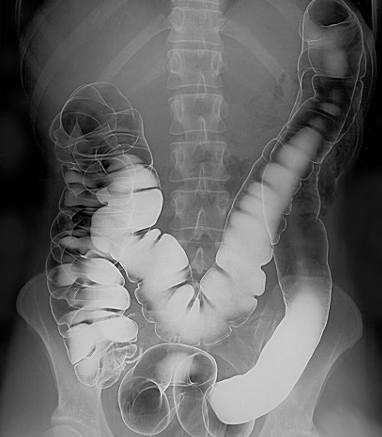
© Glitzy queen00 at English Wikipedia., Public domain, via Wikimedia Commons
Indications
To assess the anatomy of the large bowel and occasionally the terminal ileum.
Abnormalities detected include large bowel obstruction, tumours, ulcers, maladie diverticulaire, inflammatory bowel disease, , Maladie de Hirschsprung and thickening of the lining of the colon or rectum.
A barium enema is not reliable for the diagnosis of rectal pathology.
Therapeutic uses
Conservative treatment with barium, air or saline enema is often effective in children who present with intussusception, unless diagnosis and treatment are delayed.
Barium enema may be effective in reducing large bowel volvulus in children but resection of the involved segment and primary anastomosis is the definitive treatment.
Refractory bleeding colonic diverticulae: high-dose barium enema is as effective as endoscopic haemostasis for the prevention of recurrent diverticular bleeding.1
Cautions and possible complications
Barium enema is uncomfortable for the patient and requires good patient mobility and co-operation. More patients find the procedure embarrassing than do patients having colonoscopy or CT colonography.2 It should not be requested for frail elderly patients unless there is a clear indication.
A rectal examination or sigmoidoscopy is essential to avoid missing abnormalities.
Radiation exposure is relatively low.
The barium enema is a relatively safe procedure. Rare complications include:3
Bowel perforation:
Occurs in between 2-4/10,000 patients, usually related to iatrogenic trauma from catheter placement.
Pre-existing diseased bowel is more likely to perforate than normal healthy bowel.4
The mortality rate associated with intraperitoneal perforation is high due to the combination of barium and bacterial load which causes acute peritonitis and shock.
Barium impaction - causes large bowel obstruction.
Water intoxication.
Allergic reactions.
Arythmies cardiaques.
Prevention of endocarditis
Currently, antibacterial prophylaxis is pas recommended for the prevention of endocardite in those undergoing radiological procedures involving their lower gastrointestinal tract.5 Any infection in patients at risk of endocarditis should be investigated and treated promptly to reduce the risk of endocarditis. Patients at risk of endocarditis should be educated as to the signs of infective endocarditis and told to seek expert advice if these occur.
Contre-indications
Allergy to the latex balloon on the tip of enema tube (rare).
Severe rectal inflammation or recent rectal biopsy (delay for seven days after a full-thickness biopsy). Patients with active colitis should not have a barium enema.
Acute gastrointestinal bleeding (precludes the use of angiography).
Pregnancy: X-rays of the abdomen and pelvis should be avoided.
Preparation and procedure
Low-residue diet for three days prior to the procedure and laxatives 24 hours before.
Nil by mouth after midnight.
Bowel washout immediately prior to procedure.
Antispasmodic (eg, hyoscine butylbromide) may be given to minimise spasm.
The patient lies on their side and an enema tube is inserted into the rectum.
Barium is run into the colon under gravity and radiographs are taken. Air is also then introduced into the rectum for a double-contrast barium enema.
Mises à jour exclusives pour les professionnels de la santé
Restez informé des dernières mises à jour cliniques, des perspectives professionnelles et des conseils fondés sur des preuves. La newsletter Patient Pro sélectionne des contenus essentiels pour les professionnels de santé—livrés directement dans votre boîte de réception.
En vous abonnant, vous acceptez notre Politique de confidentialité. Vous pouvez vous désabonner à tout moment. Nous ne vendons jamais vos données.
Lectures complémentaires et références
- Fujimoto A, Sato S, Kurakata H, et al; Effectiveness of high-dose barium enema filling for colonic diverticular bleeding. Colorectal Dis. 2011 Aug;13(8):896-8. doi: 10.1111/j.1463-1318.2010.02350.x. Epub 2010 Jun 10.
- Von Wagner C, Knight K, Halligan S, et al; Patient experiences of colonoscopy, barium enema and CT colonography: a Br J Radiol. 2009 Jan;82(973):13-9. Epub 2008 Sep 29.
- de Feiter PW, Soeters PB, Dejong CH; Rectal perforations after barium enema: a review. Dis Colon Rectum. 2006 Feb;49(2):261-71.
- Yasar NF, Ihtiyar E; Colonic perforation during barium enema in a patient without known colonic Cases J. 2009 Aug 14;2:6716.
- Prophylaxie contre l'endocardite infectieuse : Prophylaxie antimicrobienne contre l'endocardite infectieuse chez les adultes et les enfants subissant des procédures interventionnelles; Ligne directrice clinique NICE (mars 2008 - dernière mise à jour juillet 2016)
À propos de l'auteurVoir la biographie complète

Dr Colin Tidy, MRCGP
Médecin généraliste, Auteur médical
MBBS, MRCGP, MRCP (Paediatrics), DCH
Le Dr Colin Tidy est un médecin du NHS, basé dans l'Oxfordshire.
À propos du critiqueVoir la biographie complète

Dr Toni Hazell, FRCGP
MBBS, BSc, FRCGP, DFSRH, Dip GU med, DRCOG, DCH (London, UK, 2000)
Le Dr Toni Hazell a obtenu son diplôme de l'École de médecine de l'hôpital St. Mary et a effectué son VTS à l'hôpital Northwick Park.
Historique de l'article
Les informations sur cette page sont rédigées et examinées par des cliniciens qualifiés.
Article également disponible en Anglais, Allemand, Espagnol, Français, Italien, Portugais, Hindi, Hébreu, Arabe, and Suédois.
Prochaine révision prévue : 21 août 2028
23 août 2023 | Dernière version

Demandez, partagez, connectez-vous.
Parcourez les discussions, posez des questions et partagez vos expériences sur des centaines de sujets de santé.

Vous ne vous sentez pas bien ?
Évaluez vos symptômes en ligne gratuitement
Plus en gastroentérologie
- Carcinome anal
- Hépatite auto-immune
- Ischémie intestinale
- Syndrome d'hyperémèse cannabinoïde
- Pancréatite chronique
- Maladies dentaires et parodontales
- Dermatite herpétiforme
- Cancer gastrique
- Hépatite A
- Sténose hypertrophique du pylore infantile
- Atrésie de l'œsophage
- Syndrome d'Osler-Weber-Rendu
- Cholangite biliaire primitive
- Sarcoïdose
- Cancer du foie secondaire
- Stéatohépatite et stéatose
- Soin de stomie
- Ténesme
- Marqueurs tumoraux
- Maladie de Wilson