Presbyopia
Age-related long sight
Peer reviewed by Dr Philippa Vincent, MRCGPLast updated by Dr Colin Tidy, MRCGPLast updated 15 Jan 2024
Meets Patient’s editorial guidelines
- DownloadDownload
- Share
- Language
- Discussion
- Audio Version
- Add to preferred sources on Google
In this series:Hypermetropia
Age-related long-sight (presbyopia) is a normal part of ageing and is not a disease. As you get older, you find it more difficult to see (focus on) near objects. The problem can be corrected by wearing reading glasses or contact lenses. Presbyopia is a type of sight problem called a refractive error.
At a glance
Presbyopia is a type of long-sightedness that happens as you get older.
It is caused by the lens in your eye becoming stiffer and less elastic.
Symptoms often include difficulty reading small print and eye strain, especially in dim light.
Presbyopia usually becomes noticeable around age 40 and most people need reading glasses by 45.
It can be treated with glasses, contact lenses, or surgery.
If you notice any changes in your vision, you should have your eyes checked.
What is presbyopia?
Presbyopia is a long-sight (hypermetropia) eye condition, caused by age.
As part of the ageing process the lens becomes more stiff and less elastic. This makes it more difficult for the lens to change shape - the ciliary muscles have to work harder to make it do so.
Eventually they are unable to do this at all and the lens cannot be thickened. With the lens in its normal resting position you are still able to focus on objects in the distance. However, because the lens cannot thicken, it cannot manage the extra degree of focus (accommodation) which is needed for near objects.
In order to see close-up objects, our eyes have to accommodate. This means that the lens has to change its thickness. Its thickness is adjusted by the ciliary muscles that attach to the suspensory ligaments at either end.
As these muscles tighten, the ligaments lengthen and the lens becomes more thickened and curved. Light rays entering your eye from close objects are brought into sharp focus on the retina.
At what age does presbyopia start?
Presbyopia is a normal part of the ageing process and usually becomes noticeable at around age 40.
By the age of 45 years, most people will need reading glasses. If you already wear glasses or contact lenses, your prescription may alter as a result of age-related long sight.
Types of presbyopia
There are five types of presbyopia:
Incipient presbyopia. This is the very earliest stage, when it may be a bit more difficult to read small print.
Functional presbyopia. This occurs when you begin to notice more problems with near sight.
Absolute presbyopia. If you have this type, your eyes cannot focus on near objects at all (farsightedness).
Premature presbyopia. This term is used when presbyopia occurs before the age of 40 years.
Nocturnal presbyopia. When this occurs, focusing on near objects is particularly difficult in low light conditions.
Presbyopia symptoms
Presbyopia symptoms may start with difficulties with prolonged close-up work, with tiring (eye strain) of the eyes. This may be worse in dim light.
People with presbyopia may also notice:
Difficulty in adjusting vision if you look quickly from a near object to a faraway one.
Blurred vision when looking at objects close up such as reading material.
Headaches.
Eye strain when focusing on close work.
What causes presbyopia?
Presbyopia is a refractive error (see below) caused by normal ageing.
People who have a job that requires a lot of close-up work and people who live and work in a hot climate with lots of ultraviolet sunlight exposure are also at higher risk of premature age-related long sight.
What is a refractive error?
To understand what causes presbyopia, we need to understand what a refractive error is. . Refractive errors are an eyesight problem and a common reason for reduced level of eyesight (visual acuity).
Eye cross-section
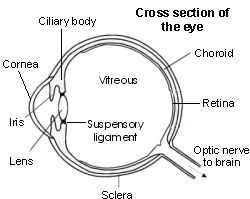
Refraction refers to the bending of light, in this case by the eye, in order to focus it. A refractive error means that the eye cannot focus light on to the retina properly. This usually occurs either due to abnormalities in the shape of the eyeball, or because age has affected the workings of the focusing parts of the eye.
There are four types of refractive error:
Age-related long sight (presbyopia).
Astigmatism (a refractive error due to an unevenly curved cornea).
In order to understand refractive errors fully, it is useful to know how we see.
When we look at an object, light rays from the object pass through the eye to reach the retina. This causes nerve messages to be sent from the cells of the retina down the optic nerve to the vision centres in the brain. The brain processes the information it receives, so that in turn, we can see.
Focusing the eye
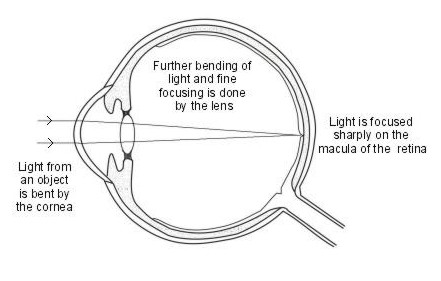
Light rays come off an object in all directions, as they result from the light around us from sun, moon and artificial light bouncing back off the object. The part of this bounced light that come into the eye from an object needs to be focused on a small area of the retina. If this doesn't happen, what we look at will be blurred.
The cornea and lens have the job of focusing light. The cornea does most of the work, as it (refracts) the light rays which then go through the lens, which finely adjusts the focusing. The lens does this by changing its thickness. This is called accommodation. The lens is elastic and can become flatter or more rounded. The more rounded (convex) the lens, the more the light rays can be bent inwards.
The shape of the lens is varied by the small muscles in the ciliary body. Tiny string-like structures called the suspensory ligaments are attached at one end to the lens and at the other to the ciliary body. This is a bit like a trampoline with the central bouncy bit being the lens, the suspensory ligaments being the springs and the ciliary muscles being the rim around the edge.
When the ciliary muscles in the ciliary body tighten, the suspensory ligaments slacken, causing the lens to become fatter. This happens for near objects. For looking at far objects, the ciliary muscle relaxes, making the suspensory ligaments tighten, and the lens thins out.
More bending (refraction) of the light rays is needed to focus on nearby objects, such as when reading. Less bending of light is needed to focus on objects far away.
Presbyopia treatment
Glasses
Presbyopia can be corrected by wearing reading glasses; often the lenses are similar to bifocal lenses. If you already have glasses, bifocal or varifocal lenses may be prescribed to treat your age-related long sight. With these lenses, different parts of the lens have different prescriptions.
Bifocal ('bi' means two) lenses have a lens at the bottom for long sight (to allow close-up vision) and the rest of the lens above (allowing distant vision). Multifocal lenses have at least three focus 'zones' - for distant, middle and near vision, with gradual changes between them. Middle vision is best imagined as that needed for computer screen work.
Contact lenses
For people who already have contact lenses, reading glasses may be prescribed in addition to these to treat presbyopia.
Other options include bifocal or multifocal contact lenses, or wearing a different contact lens in each eye - one to allow near vision, the other for distance vision (monovision contact lenses).
The disadvantage of correcting one eye (effectively to make it slightly short-sighted) is some loss of distance vision in that eye - but the other eye retains good distance vision. Usually the two eyes adapt to the differences between them, so that the patient can see near and far equally well.
Distance vision can be slightly compromised - and some patients notice 'ghosting' (faint double vision) on distant objects which does not always resolve with time.
Surgery
Various surgical options are now offered to correct presbyopia. Some of these work on the principle of correcting one eye for near vision, whilst correcting the other eye to give good distant vision:
Kamra® corneal inlay
The Kamra® corneal inlay was approved by the US FDA in 2015. The inlay is designed to eliminate the need for reading glasses among people between the ages of 45 and 60 years who have good distance vision without glasses but have problems seeing up close due to age-related long sight.
The inlay is a small, thin opaque device with a tiny opening in the centre. It is surgically implanted in the central cornea, directly in front of the pupil of the eye. The central opening in the inlay creates a 'pinhole camera' effect. This effect, also seen if you look through a pinhole in a piece of paper, sharpens near vision while maintaining clear distance vision.
The inlay typically is implanted in the non-dominant eye. This allows both eyes to be used for distance vision, while the inlay sharpens near vision in the non-dominant eye.
Laser eye surgery
Monovision LASIK® (Laser-Assisted In situ Keratomileusis) and PRK® (Photo-Refractive Keratectomy) can be used to remove corneal tissue and reshape the cornea to reduce the need for reading glasses. In monovision laser surgery for presbyopia, this is done for one eye only.
The surgeon fully corrects the distance vision of one eye (usually the dominant eye), and intentionally makes the non-dominant eye mildly short-sighted.
The newly short-sighted eye sees near objects clearly without glasses, although its distant vision may be less good. So, after monovision laser surgery, the dominant eye takes the lead to provide clear distance vision and the non-dominant eye is responsible for sharpening near vision.
See the leaflet on Laser Eye Surgery for further information.
Monovision conductive keratoplasty (CK)
CK uses low-level, radiofrequency energy to shrink fibres in the edge of the cornea to increase the curve and therefore increase its focusing power. Like monovision laser eye surgery, one eye is corrected for close vision and the other left for distance vision.
Monovision of any kind involves some compromise and not everyone adapts well to it. It's a good idea to try monovision with contact lenses before committing to a permanent surgical procedure, in case you don't adapt to it.
Refractive lens exchange (RLE)
RLE is the removal and replacement of the eye's natural lens with an artificial lens to improve vision. The procedure is very similar to cataract surgery. The artificial lens is usually a multifocal lens, but various types are available.
RLE can reduce the need for reading glasses while providing clear distance vision without glasses. It is particularly helpful for patients with age-related long sight who are developing cataracts.
Several other surgical procedures to correct presbyopia are either available or in development, depending on which country you live in. In the UK, these procedures are not routinely done in the NHS.
It is important that you know your facts, including what the procedure involves, the failure rate, side-effects, the risk of complications, and the level of aftercare provided.
You should be given the opportunity to discuss these facts in advance with the surgeon who will be carrying out the procedure.
How often should you have an eye test?
The NHS recommends that most people should get their eyesight tested every two years. Children will routinely be offered eye checks at various stages from birth to school age.
People at high risk of sight problems need more frequent eyesight checks.
This includes people with:
A family history of these conditions.
People over the age of 70 years and children who wear glasses may also need more frequent eye tests.
You should get your eyes checked if you notice any changes in your vision.
Dr Mary Lowth is an author or the original author of this leaflet.
Patient picks for Eye conditions

Eye health
Eye problems
Eye problems range from everyday irritations to serious internal conditions. This leaflet contains a list of conditions which affect the eye, grouped together by the part of the eye which is affected or involved.
by Dr Toni Hazell, FRCGP

Eye health
Hypermetropia
The medical name for long-sightedness is hypermetropia, sometimes called hyperopia. Eyesight problems, such as hypermetropia, are also known as refractive errors. Long-sightedness leads to problems with near vision (seeing things that are close up) and the eyes may commonly become tired. Distance vision (long sight) is, in the beginning, good. Long sight can be corrected by glasses, contact lenses, or laser eye surgery.
by Dr Colin Tidy, MRCGP
Frequently asked questions
What is the difference between presbyopia and other types of long sight?
Presbyopia is specifically age-related long sight, caused by the natural stiffening and loss of elasticity of the eye's lens over time. Other types of long sight (hypermetropia) are refractive errors where the eye cannot focus light correctly, often due to abnormalities in the shape of the eyeball, but are not necessarily tied to the ageing process of the lens itself.
Are bifocal contact lenses available for presbyopia?
Yes, bifocal or multifocal contact lenses are an option for treating presbyopia. Another approach is to use 'monovision' contact lenses, where a different prescription is used in each eye – one for near vision and the other for distance vision.
What does 'monovision' mean in the context of presbyopia treatment?
Monovision is a treatment approach that corrects one eye for near vision and the other eye for distance vision. This can be achieved with contact lenses or surgical procedures like LASIK, PRK, or conductive keratoplasty. The aim is for the brain to adapt and use the appropriate eye for the task, allowing for both near and distant vision without glasses.
What is the purpose of a Kamra corneal inlay?
The Kamra corneal inlay is a small, thin device with a central opening that is surgically implanted into one eye. It creates a 'pinhole camera' effect, which sharpens near vision while maintaining clear distance vision. It is typically implanted in the non-dominant eye for individuals between 45 and 60 who have good distance vision but struggle with close-up tasks due to presbyopia.
When should someone consider refractive lens exchange (RLE)?
Refractive lens exchange (RLE) involves replacing the eye's natural lens with an artificial multifocal lens. This procedure is similar to cataract surgery and can reduce the need for reading glasses while providing clear distance vision. It is particularly helpful for patients who have age-related long sight and are also beginning to develop cataracts.
Further reading and references
- Laser correction of refractive error following non-refractive ophthalmic surgery; NICE Interventional procedures guidance, March 2011
- Corneal inlay implantation for correction of Presbyopia; NICE Interventional Procedure Guidance, April 2013
- Torricelli AA, Junior JB, Santhiago MR, et al; Surgical management of presbyopia. Clin Ophthalmol. 2012;6:1459-66. doi: 10.2147/OPTH.S35533. Epub 2012 Sep 6.
- Professional Standards for Refractive Surgery; Royal College of Ophthalmologists (Dec 2021)
- Katz JA, Karpecki PM, Dorca A, et al; Presbyopia - A Review of Current Treatment Options and Emerging Therapies. Clin Ophthalmol. 2021 May 24;15:2167-2178. doi: 10.2147/OPTH.S259011. eCollection 2021.
- Wolffsohn JS, Davies LN, Sheppard AL; New insights in presbyopia: impact of correction strategies. BMJ Open Ophthalmol. 2023 Jan;8(1):e001122. doi: 10.1136/bmjophth-2022-001122.
About the authorView full bio

Dr Colin Tidy, MRCGP
General Practitioner, Medical Author
MBBS, MRCGP, MRCP (Paediatrics), DCH
Dr Colin Tidy is an NHS Doctor, based in Oxfordshire.
About the reviewerView full bio

Dr Philippa Vincent, MRCGP
General Practitioner, Medical Author
MB BS, Bsc, MRCGP (2000), DCH, DFSRH, DRCOG
Dr Philippa Vincent is an NHS GP working in North London.
Article history
The information on this page is written and peer reviewed by qualified clinicians.
Article also available in English, German, Spanish, French, Italian, Portuguese, Hindi, Hebrew, Arabic, and Swedish.
Next review due: 11 Jan 2029
15 Jan 2024 | Latest version
Join the conversation
Share your thoughts or experiences with others in our patient communities.

Ask, share, connect.
Browse discussions, ask questions, and share experiences across hundreds of health topics.

Feeling unwell?
Assess your symptoms online for free
Sign up to the Patient newsletter
Your weekly dose of clear, trustworthy health advice - written to help you feel informed, confident and in control.
By subscribing you accept our Privacy Policy. You can unsubscribe at any time. We never sell your data.
More in eye health
- Acute angle-closure glaucoma
- Amblyopia (lazy eye)
- Astigmatism
- Blepharitis
- Cataracts
- Chalazion
- Corneal injury and foreign bodies
- Ectropion
- Entropion
- Episcleritis and scleritis
- Eye floaters, flashes and haloes
- Eye infection (herpes simplex)
- Eye problems
- Giant Cell Arteritis
- Hay fever
- House dust mite and pet allergy
- Infective conjunctivitis
- Retinal vein occlusion
- Stye
- Vitreous haemorrhage