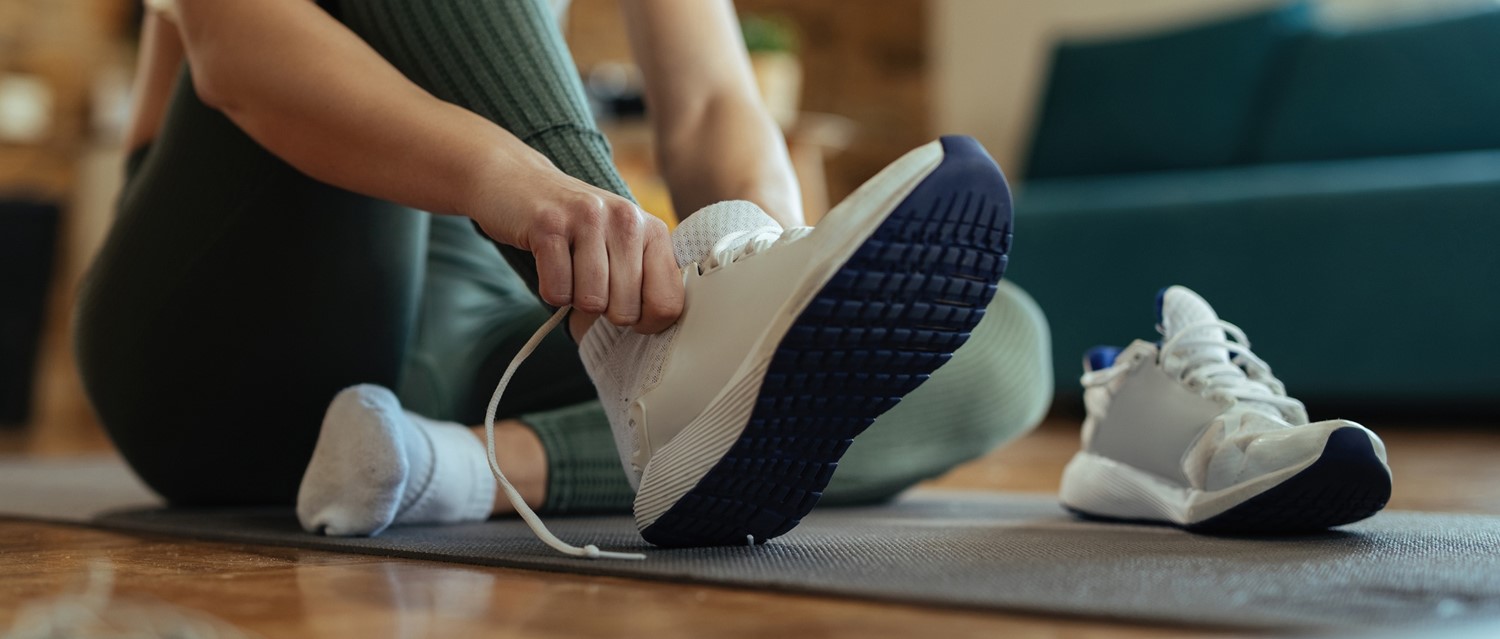
Conseils pour reprendre votre routine d'exercice après le confinement
Revu par Dr Sarah JarvisDernière mise à jour par Gillian HarveyDernière mise à jour 21 Jul 2020
Respecte les directives éditoriales
- TéléchargerTélécharger
- Partager
- Language
- Discussion
- Version audio
- Ajouter aux sources préférées sur Google
Le confinement nous a tous affectés de différentes manières. En ce qui concerne la forme physique, certains d'entre nous ont intensifié leurs efforts — en courant pour la première fois ou en faisant de longues promenades. D'autres ont été malades, ont dû s'occuper des autres ou ont tout simplement trouvé cela trop difficile. À mesure que le confinement se relâche, quelle est la meilleure façon de retrouver notre forme ou même de devenir en forme pour la première fois ?
Modify your expectations
If you worked out regularly prior to lockdown but have lost fitness since, it's tempting to want to resume old levels of activity immediately. However, if you’ve lost fitness or been unable to keep up your regular routine, it's important to walk before you can run.
"You may need to modify your expectations. If you're used to using 5 kg weights in your workouts you may need to switch to 2 or 3. It's more important to maintain form when l'exercice. If you jump right back to where you used to be there's a risk of injury and you might be out even longer," explains Mollie Millington, personal trainer.
The same is true if you've put on weight due to inactivity. "If you gained weight during lockdown and you try to lose that weight too quickly, you'll probably be setting yourself up to fail. Create a new fitness routine, and treat it like a fresh start," says Alexandra McMillan, London-based personal trainer.
Refresh your knowledge
With many exercises, quality is even more important than quantity. If you're revisiting your downward dog, or trying out a bicep curl, it's important you ensure your form is correct. "For example, if you're doing a bicep curl but pivoting from the waist instead of the elbow, the exercise just won't be as effective," explains Millington.
It's worth reading up on proper form, watching YouTube videos, or if time and funds allow, booking a session with a trainer to revisit exercises.
Listen to your body
There's no point overdoing it or exhausting yourself by trying to get back to your old level of fitness too quickly. Choosing lighter weights or fewer reps isn't a sign of failure, but evidence that you are working towards a goal sensibly rather than risking exhaustion or injury.
"It's important to find the right balance," explains Millington. "If you don't have rest days, your muscles won't have time to heal. If you don't get enough sommeil, your body won't have time to process the changes you're making."
Rest doesn't have to mean lying or sitting with our feet up. Instead, if we feel well enough, it's worth trying active rest - for example, by walking to work, or taking a walk with family or friends.
Get 'sport ready'
You may have kept up your fitness levels by running throughout lockdown, but that doesn't necessarily mean you can throw yourself around on a court. If your local outdoor tennis court has opened, or you fancy a game of badminton in the back garden, remember that these kinds of sports require us to move differently. That means it may be necessary to ease ourselves in rather than going for the grand slam straightaway.
"Running on the road, your body's movement is very one-direction and forward. If you want to play tennis, you need to be very agile with different actions. Your body isn't going to be used to having that flexibility, that response time, moving front to back. You need to consider your risk of injury, your ankles, your legs," advises Millington.
Practise aftercare
If you were pretty fit prior to lockdown, you may be surprised how you feel the day after returning to your exercise routine. If you experience pain, it's important to assess what's going on in your body and look after yourself. "Sharp pain is a bad thing and probably indicates an injury. But dull pain probably means your muscles are a bit sore from being active," explains Millington.
"It's really important to warm up before exercise and perform cooldown exercises afterwards," she says. "Especially for those going back in to sport. If you're still a bit sore the next day, try stretching out your muscles or taking a warm bath. If you can, it's worth booking in with a local physio.
"If you're super sore, it's a sign that you overdid it. Take it easy during workouts to reduce the risk of an injury that will put you out for even longer," advises Millington.
Keep motivated
If you've lost fitness over the last few months, or are finding it hard to motivate yourself, it's worth getting an accountability partner. "Finding a friend or family member who will meet up and work out with you can be really helpful," agrees Millington.
It's also worth trying something new, which will be easier as more exercise venues start to open up. "You want to make it fun," says Millington. "Try something new - dancing, fencing, swimming - the important thing is that you keep moving."
Focus on health
It's also important to remember that coronavirus hasn't gone away. During this stressful time, self-care is all the more important.
Exhausting yourself, or going on a restrictive diet may affect your ability to cope with niveaux de stress or illness. Instead, try to set goals which focus on fitness and health. "Go with what makes you feel good, rather than worrying too much about what's in the mirror," advises McMillan.
Sélections des patients pour articles sur la pandémie
COVID-19
Assouplissement du confinement : quel est le plan et est-il réaliste ?
Après une année entière de confinements successifs et nos vies bouleversées, c'est un soulagement pour beaucoup d'entendre le gouvernement annoncer ses plans pour assouplir les restrictions liées au COVID-19 au cours des prochains mois. Mais sont-ils réalistes ?
par Milly Evans
COVID-19
COVID-19 : Les confinements peuvent-ils changer nos personnalités ?
Près de deux ans après que l'épidémie de COVID-19 a été déclarée pandémie mondiale, le variant Omicron se propage comme une traînée de poudre à travers le Royaume-Uni. Pour aider à freiner le taux d'infections et alléger la pression sur les hôpitaux, de nouvelles restrictions pourraient être introduites, y compris un confinement. Bien que cela puisse être une mesure nécessaire, ce sera sans aucun doute difficile pour de nombreuses personnes. Mais les confinements peuvent-ils avoir un impact à plus long terme sur notre façon de penser et d'agir ?
par Lydia Smith
À propos de l'auteurVoir la biographie complète
Gillian Harvey
Rédacteur Indépendant
Licence (Hons) en Anglais
Gillian est une écrivaine indépendante et chroniqueuse pour divers journaux et magazines nationaux.
À propos du critiqueVoir la biographie complète

Dr Sarah Jarvis
Consultant Clinique
MA (Cantab), BM, BCh (Oxon), DRCOG, FRCGP, MBE
Après avoir suivi une formation en médecine à Cambridge et Oxford, le Dr Sarah Jarvis MBE est devenue médecin généraliste.
Historique de l'article
Les informations sur cette page sont examinées par des cliniciens qualifiés.
Article également disponible en Anglais, Allemand, Espagnol, Français, Italien, Portugais, Hindi, Hébreu, Arabe, and Suédois.
21 Jul 2020 | Dernière version

Demandez, partagez, connectez-vous.
Parcourez les discussions, posez des questions et partagez vos expériences sur des centaines de sujets de santé.

Vous ne vous sentez pas bien ?
Évaluez vos symptômes en ligne gratuitement
Inscrivez-vous à la newsletter Patient
Votre dose hebdomadaire de conseils de santé clairs et fiables - rédigés pour vous aider à vous sentir informé, confiant et maître de la situation.
En vous abonnant, vous acceptez notre Politique de confidentialité. Vous pouvez vous désabonner à tout moment. Nous ne vendons jamais vos données.
Plus sur la COVID-19
- Coronavirus COVID-19 : comment faire de l'exercice à la maison
- Coronavirus COVID-19 : que puis-je faire selon les nouvelles règles ?
- COVID-19 : Quand devriez-vous faire un test antigénique et quand devriez-vous faire un test PCR ?
- La pandémie a-t-elle eu un impact sur l'obésité infantile ?
- Comment la pandémie de COVID-19 a-t-elle affecté l'accès à la contraception ?
- Comment réserver votre vaccin de rappel COVID-19
- Comment conserver un mode de vie de confinement
- Comment rendre les masques et les couvre-visages plus confortables
- L'avenir des vaccinations contre la COVID-19
- Quels sont les symptômes de la variante Pirola du COVID-19 ?
- Quel impact la COVID-19 a-t-elle eu sur le dépistage du VIH ?