
Liste de contrôle des symptômes de la méningite
Revu par Dr Helen Huins, MRCGPRédigé par Dr Mary Harding, MRCGPPublié à l'origine 24 sept. 2017
Respecte les directives éditoriales
- TéléchargerTélécharger
- Partager
- Language
- Discussion
- Version audio
- Ajouter aux sources préférées sur Google
Les symptômes suivants peuvent indiquer une méningite ou une septicémie. Mais notez : tous les symptômes peuvent ne pas être présents. Par exemple, les symptômes classiques de raideur de la nuque et d'éruption cutanée peuvent ne pas se manifester. Voir ci-dessous pour d'autres symptômes possibles. Si vous suspectez une méningite ou une septicémie - consultez immédiatement un médecin.
What are meningitis and septicaemia?
Méningite is an inflammation of the lining that covers the brain and spinal cord (the meninges). It is usually caused by infection with germs (bacteria or viruses.)
Septicémie (sepsis) is an infection of the blood with bacteria (blood poisoning). If bacteria multiply and release poisons (toxins) into the blood, it can cause serious illness.
Meningitis and septicaemia are separate diseases. However, the most common cause of bacterial meningitis (the meningococcus) often causes septicaemia at the same time. So a person with meningitis could have:
Symptoms and signs of meningitis (15 in 100 cases).
Symptoms and signs of septicaemia (25 in 100 cases, or one quarter).
Symptoms and signs of both meningitis and septicaemia (60 in 100 cases).
Meningitis can occur at any age but is most common in children and young people.
What are the symptoms and signs of meningitis and septicaemia?
In the early stages of meningitis and septicaemia, it is often difficult to distinguish these conditions from minor illnesses. This is because they may start with mild symptoms similar to other common infections. So it is important to know about the early warning symptoms which might suggest a more serious condition. It is also important to know the signs of serious illness and to know when an ambulance should be called.
Common early warning symptoms
Many children who are developing meningitis or septicaemia have nonspecific symptoms such as just feeling or looking generally unwell. These symptoms may include having a high temperature, being more tired than usual and feeling sick.
However, three symptoms that commonly develop early on - often before the more classic symptoms listed later - are:
Leg pains - which can become severe and prevent a child from standing or walking.
Cold hands or feet - even if the child has a high temperature.
Pale or mottled skin
Pale, dusky or blue colour of the skin around the lips.
Rash - commonly occurs but not always
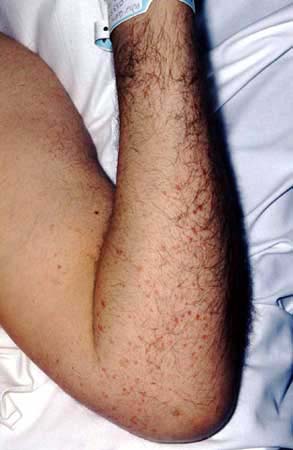
A typical rash is common with meningococcal infection. The rash is red or purple. Small spots develop at first and may occur in groups anywhere on the body. They often grow to become blotchy and look like little bruises. One or two may develop at first but many may then appear in different parts of the body. Check all over the body for a rash. If skin is dark, it may be harder to spot the rash - check in lighter-skinned areas such as palms or soles.
PETECHIAL RASH
Purpuric Rash
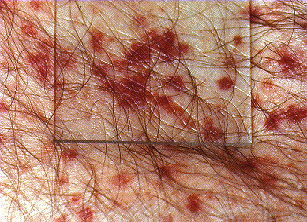
The spots/blotches do not fade when pressed (unlike many other rashes). To check for this, place a clear glass firmly on one of the spots or blotches. If the spot/blotch does not fade and you can still see it through the glass, get medical help immediately.
Glass test for meningitis rash
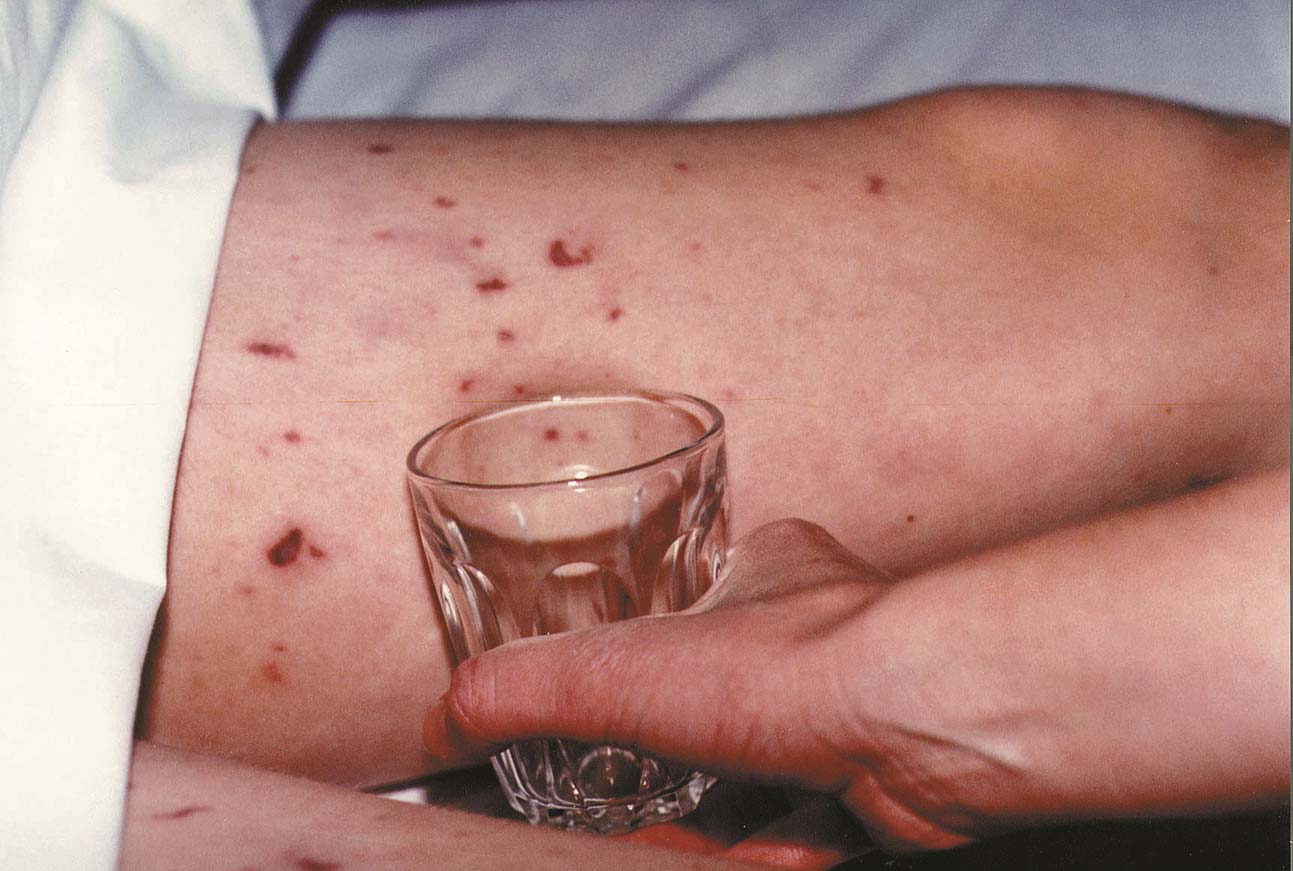
Reproduced with permission from Meningitis Now.
Remarque: a rash does not occur in all cases of meningitis and septicaemia but can be quite characteristic when it does occur.
Autres symptômes
Other symptoms that may occur in babies
Ceux-ci incluent :
Excessive crying - often high-pitched or moaning and different to their usual cry.
Fast breathing or unusual patterns of breathing.
A high temperature (fever) - but the baby may not look hot and the skin may look pale or blotchy, or turn blue. The hands and feet may feel cold. The baby may shiver.
Will not take feeds - sometimes repeatedly being sick (vomiting).
Being irritable - especially when picked up and handled.
Drowsiness or sleepiness - does not wake easily.
A bulging fontanelle sometimes develops. The fontanelle is the soft spot on a baby's head.
Jerky movements may occur and the body may appear stiff. Sometimes the opposite occurs and the body appears quite floppy. Fits (convulsions) sometimes develop.
Other symptoms that may occur in older children and adults
Ceux-ci incluent :
Fever and shivering - however, the hands and feet often feel cold.
Stiff neck - cannot bend the neck forward.
Headache - which can become severe.
Respiration rapide.
Aches and pains in muscles or joints - the pains can become quite severe.
Not wanting to eat or drink.
The skin may look pale or blotchy, or turn blue.
Dislike of bright lights - will shut eyes and turn away from the light.
Drowsiness or confusion - may appear vacant.
Feeling sick or repeated vomiting. Sometimes tummy (abdominal) pain and diarrhoea.
Fits (convulsions).
The course of symptoms
The symptoms often develop quickly, over a few hours or so. The symptoms can occur in any order and not all may occur. Sometimes symptoms develop more slowly, over a few days. The symptoms may suggest a less serious illness at first. For example, fever, headaches, and vomiting are common with many viral illnesses such as flu. Therefore, even if you think it was flu to start with, if symptoms become worse then it may be meningitis or septicaemia.
What should I do if I am worried it might be meningitis?
If your child has (or you have) any of these symptoms, speak to a doctor or nurse today. (Call your GP surgery, or - in the UK - dial 111, or talk to the out-of hours GP):
Getting more unwell.
Not drinking.
Passing less urine than usual.
Appearing dry (dehydrated). Signs of this include:
The soft spot on the baby's head (fontanelle) seeming to be sunken.
Bouche sèche.
Yeux enfoncés.
Excessive drowsiness.
Temperature (fever) not getting better with paracetamol or ibuprofen, even for a little while.
Temperature of 39°C or more in a baby of 3 to 6 months.
If your child has (or you have) any of these symptoms, dial 999/112/911 and request an ambulance immediately:
Being difficult to wake up (unrousable).
Being floppy.
Pale, blue, or mottled skin
A weak, high-pitched or continual cry in a baby.
Difficulty breathing or grunting-type breathing.
Fits (convulsions).
Temperature of 38°C or more in a baby under 3 months old.
The soft spot on the baby's head (fontanelle) bulging out.
A new red/purple rash which has come on suddenly and does not fade when a glass tumbler is pressed against it.
Sélections des patients pour Méningite et septicémie

Infections
Vidéo : Comment attrape-t-on une méningite bactérienne ?
La méningite est une affection facile à prévenir si vous profitez des vaccinations disponibles gratuitement. Cependant, si vous la contractez, elle peut être extrêmement grave et même mettre votre vie en danger. Nos experts vous offrent des conseils utiles et pratiques pour rester en sécurité.
par Dr Sarah Jarvis

Infections
Vaccination privée contre le MenB : qui peut la envisager et comment elle fonctionne
La vaccination a révolutionné la prévention de la méningite au Royaume-Uni. Cependant, toutes les formes de la maladie méningococcique ne sont pas couvertes par les programmes de vaccination de routine pour tous les groupes d'âge. L'une des souches les plus importantes encore présente au Royaume-Uni est le méningocoque du groupe B (MenB). Alors que les bébés sont systématiquement vaccinés contre MenB, de nombreux adolescents et adultes ne le sont pas. En conséquence, certaines personnes choisissent d'accéder au vaccin MenB de manière privée, en particulier si elles estiment être à risque accru. Comprendre ce qu'est MenB, qui peut bénéficier de la vaccination et comment fonctionne la vaccination privée peut vous aider à décider si cela vous convient.
par Thomas Andrew Porteus, MBCS
À propos de l'auteurVoir la biographie complète
Rédigé par

Dr Mary Harding, MRCGP
Médecin généraliste, Auteur médical
BA, MA, MB, BChir, MRCGP, DFFP
Le Dr Mary Harding a obtenu son diplôme de l'école de médecine de l'Université de Cambridge en 1989.
À propos du critiqueVoir la biographie complète
Dr Helen Huins, MRCGP
Médecin généraliste, Auteur médical
MB, BS, Lond, DCH, DRCOG, MRCGP, JCPTGP, DFFP
Helen a obtenu son diplôme à l'hôpital Guy's en 1989 et a quitté Londres en 1990 pour s'installer à la campagne.
Historique de l'article
Article également disponible en Anglais, Allemand, Espagnol, Français, Italien, Portugais, Hindi, Hébreu, Arabe, and Suédois.
24 sept. 2017 | Publié à l'origine
Écrit par :
Dr Mary Harding, MRCGPRevu par
Dr Helen Huins, MRCGP
Participez à la conversation
Partagez vos pensées ou expériences avec les autres dans notre communautés de patients.

Demandez, partagez, connectez-vous.
Parcourez les discussions, posez des questions et partagez vos expériences sur des centaines de sujets de santé.

Vous ne vous sentez pas bien ?
Évaluez vos symptômes en ligne gratuitement
Inscrivez-vous à la newsletter Patient
Votre dose hebdomadaire de conseils de santé clairs et fiables - rédigés pour vous aider à vous sentir informé, confiant et maître de la situation.
En vous abonnant, vous acceptez notre Politique de confidentialité. Vous pouvez vous désabonner à tout moment. Nous ne vendons jamais vos données.