Asbestos-related diseases
Peer reviewed by Prof Cathy Jackson, MRCGPLast updated by Dr Louise Newson, MRCGPLast updated 25 May 2016
Meets Patient’s editorial guidelines
- DownloadDownload
- Share
- Language
- Discussion
- Audio Version
- Add to preferred sources on Google
This page has been archived.
It has not been reviewed recently and is not up to date. External links and references may no longer work.
People exposed to asbestos can develop diseases in later life. These most commonly affect the lungs but can also affect the lining of the tummy (abdomen). Some conditions - for example, mesothelioma or lung cancer - are more serious than others. This leaflet gives a brief overview of the diseases that are related to having an exposure to asbestos in the past.
At a glance
Asbestos is a fire and heat-resistant material formerly used in buildings for insulation.
All types of asbestos (white, brown, blue) are linked to cancers.
Asbestos fibres are dangerous when disturbed and breathed in or swallowed.
Asbestos-related diseases mainly affect the lungs and include scarring and cancers.
Pleural plaques indicate past asbestos exposure but usually cause no symptoms.
Diffuse pleural thickening can cause shortness of breath and chest tightness.
What is asbestos?
Asbestos is a material that was used in the past in buildings. It is an insulating material that is both heat-resistant and fire-resistant. There are different types of asbestos: white, brown and blue.
It used to be thought that blue and brown asbestos were more harmful than white asbestos but it is now known that all three forms are linked to cancers. Although they are all harmful, blue and brown asbestos are the most strongly linked with cancers and they have not been imported into the UK since 1985. However, they are still present in some buildings and equipment produced before the ban. White asbestos has been banned in the UK since 1999.
Asbestos is more likely to be found in buildings built or refurbished before the year 2000. Anyone who is involved in building maintenance is potentially at risk if they disturb asbestos. The danger lies in any activity that disturbs the asbestos fibres, including removal, drilling, sanding and cutting. It is asbestos dust or fibres which cause the harm when they are breathed in (inhaled) or swallowed (ingested). Asbestos materials which are left undisturbed are probably safe.
Having a previous exposure to asbestos is associated with various different diseases. These mainly affect your lungs and include the following.
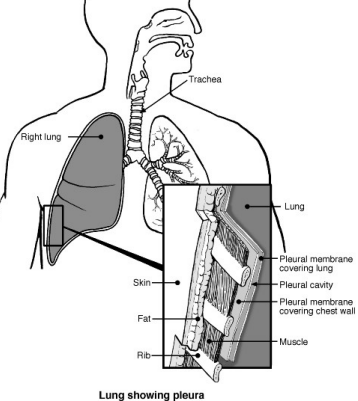
Lungs and airways with pleura
Pleural plaques
The pleura is a thin membrane with two layers. One layer lines the inside of your chest wall. The other layer covers your lungs.
Between the two layers of pleura (your pleural cavity) is a tiny amount of fluid. This acts like lubricating oil between your lungs and your chest wall as they move when you breathe.
Pleural plaques are small, raised areas or tissue which usually occur on your pleura. These are sometimes found when you have a chest X-ray for another condition. Pleural plaques are not usually associated with any symptoms but can occasionally cause chest pain. They are an indication that you have been exposed to asbestos at some time in your life. There is some evidence that people with pleural plaques are more likely to develop mesothelioma (see 'Mesothelioma', below). They are not, however, a risk factor for asbestosis (see 'Asbestosis', below).
Diffuse pleural thickening
Diffuse pleural thickening is a thickening of your pleura of either one or both lungs. It is sometimes associated with a build-up of fluid in between the two layers of pleura. It most commonly leads to worsening shortness of breath and also tightness in your chest, as your lungs cannot fully expand when you breathe in.
A chest X-ray may show the diffuse pleural thickening. A CT scan and breathing tests (spirometry) may also be performed.
There is currently no treatment for diffuse pleural thickening. However, the outlook (prognosis) is often good as, for many people, the condition does not worsen with time.
Asbestos pleurisy or effusion
Asbestos pleurisy is inflammation of your pleura next to your lungs. This is often associated with a build-up of fluid around your lung (an effusion). This often leads to pain when you breathe in and also worsening shortness of breath.
A chest X-ray may show this condition. However, a sample of the fluid around your lungs is often taken to confirm the diagnosis. A small sample (biopsy) of your pleura may need to be taken to look at under the microscope to confirm the diagnosis.
The fluid is usually drained. It can sometimes come back (recur) in the future.
Asbestosis
Asbestosis is a condition that causes scarring of your lungs. Asbestosis usually develops at least twenty years after being exposed to a large amount of asbestos. The most common symptoms are shortness of breath which progressively worsens with time. In addition, a cough may be present, which is usually a dry cough.
Asbestosis is usually diagnosed from the appearance of a chest X-ray and/or a CT scan of the chest. Breathing tests (spirometry) may also be done. Occasionally, a small sample (biopsy) of your lung may be needed to confirm the diagnosis.
Although asbestosis is incurable, there are different treatments available to help improve the symptoms it causes. Inhalers are often given to help with shortness of breath. It may sometimes be treated with steroid tablets and other medication.
Mesothelioma
Mesothelioma is a type of cancer that occurs in the tissues which cover your lungs or tummy (abdomen). The lining around your lungs is the pleura and in your abdomen it is called the peritoneum. See separate leaflet called Mesothelioma for more details.
Lung cancer
Asbestos exposure is a risk for all types of lung cancer. This risk is increased further if you also smoke. See separate leaflet called Lung Cancer for more details.
Cancer of the throat (larynx)
Most cases of cancer of the larynx occur in people who smoke. However, a previous exposure to asbestos may be a risk factor for cancer of the larynx. See separate leaflet called Laryngeal (Throat) Cancer for more details.
Compensation
People with asbestos-related lung disease may be eligible for compensation through the following:
Industrial Injuries Disablement Benefit (IIDB) from the Department for Work and Pensions (see references below).
A civil law claim for damages from the employer at the time of asbestos exposure.
Patient picks for Occupational health

Cancer
Lung cancer
Lung cancer (cancer of the lung) is common worldwide. Around 4 in 10 cases develop in people over the age of 75 years, usually in smokers. If lung cancer is diagnosed at an early stage, there is a chance of a cure. In general, the more advanced the cancer (the more it has grown and spread), the less chance that treatment will be curative. However, treatment can often slow the progress of the cancer.
by Dr Colin Tidy, MRCGP

Cancer
Mesothelioma
Mesothelioma is an uncommon type of cancer that occurs in the tissues covering internal organs, particularly your lungs or less commonly your tummy (abdomen). Past exposure to asbestos is the main risk factor for mesothelioma. The first symptoms are variable but can include shortness of breath, chest pain or abdominal swelling. It is not usually possible to cure mesothelioma but there are different treatments to help with symptoms.
by Dr Colin Tidy, MRCGP
Frequently asked questions
What is the incubation period for asbestos-related diseases?
Asbestosis usually develops at least twenty years after being exposed to a large amount of asbestos. The article also notes that brown and blue asbestos have not been imported into the UK since 1985, and white asbestos since 1999, but diseases are still linked to past exposure.
If I am diagnosed with an asbestos-related condition, can it affect other parts of my body?
Asbestos exposure is primarily linked to diseases affecting the lungs, such as pleural plaques, diffuse pleural thickening, asbestos pleurisy, asbestosis, mesothelioma, and lung cancer. However, mesothelioma can also occur in the tissues covering your tummy (abdomen), and a previous exposure to asbestos may also be a risk factor for cancer of the throat (larynx).
How do doctors confirm a diagnosis of asbestos-related pleurisy?
While a chest X-ray may show the condition, a sample of the fluid around your lungs is often taken to confirm the diagnosis. Additionally, a small sample (biopsy) of your pleura might be needed to be examined under a microscope.
What are the treatment options for asbestos pleurisy?
The fluid build-up associated with asbestos pleurisy is usually drained. However, it's possible for the fluid to recur in the future.
Is it possible to receive financial support if I develop an asbestos-related lung disease?
Yes, people with asbestos-related lung disease may be eligible for compensation. This can include the Industrial Injuries Disablement Benefit (IIDB) from the Department for Work and Pensions, or a civil law claim for damages from the employer responsible for the asbestos exposure.
Further reading and references
- Asbestos related disease statistics; Health and Safety Executive (HSE)
- Asbestos health and safety; Health and Safety Executive
- Industrial Injuries Disablement Benefits - technical guidance; Dept for Work and Pensions
- Roe OD, Stella GM; Malignant pleural mesothelioma: history, controversy and future of a manmade epidemic. Eur Respir Rev. 2015 Mar;24(135):115-31. doi: 10.1183/09059180.00007014.
About the authorView full bio

Dr Louise Newson, MRCGP
BSc (Hons) Pathology, MB, ChB (Hons), MRCP, MRCGP, DFFP, FRCGP
Louise qualified from Manchester University in 1994 and is a GP and menopause expert in Solihull, West Midlands.
About the reviewerView full bio

Prof Cathy Jackson, MRCGP
Medical Author
BSc (Hons) Physiology, MB, ChB, MRCGP, MD
Professor Cathy Jackson graduated from Manchester Medical School having gained a first-class honours degree in physiology along the way.
Article history
The information on this page is written and peer reviewed by qualified clinicians.
Article also available in English, German, Spanish, French, Italian, Portuguese, Hindi, Hebrew, Arabic, and Swedish.
25 May 2016 | Latest version
Join the conversation
Share your thoughts or experiences with others in our patient communities.

Ask, share, connect.
Browse discussions, ask questions, and share experiences across hundreds of health topics.

Feeling unwell?
Assess your symptoms online for free
Sign up to the Patient newsletter
Your weekly dose of clear, trustworthy health advice - written to help you feel informed, confident and in control.
By subscribing you accept our Privacy Policy. You can unsubscribe at any time. We never sell your data.
More in general health
- 6-in-1 vaccine
- Actinic keratosis
- AskPatient
- Breast screening
- Bullying
- Clostridioides difficile
- End of life care
- Exercise and physical activity
- Hepatitis A vaccine
- Hepatitis B vaccine
- Immunisation for flu
- Medical cannabis in palliative care
- Newborn hearing test
- NHS talking therapies - self referral
- Passive smoking
- Pregnancy screening tests
- Preventing steroid-induced osteoporosis
- Sexual assault
- Simple, secure access to your NHS GP record
- Sun and sunburn