Tache de vin
Birthmark
Revu par Dr Toni Hazell, MRCGPDernière mise à jour par Dr Hayley Willacy, FRCGP Dernière mise à jour 31 Oct 2022
Respecte les directives éditoriales
- TéléchargerTélécharger
- Partager
- Language
- Discussion
- Version audio
A port-wine stain is a differently coloured patch of skin that a baby is born with. It is usually over their face, neck or scalp, and looks pink or pale purple. It is often called a port-wine birthmark now.
Dans cet article:
Sélections de vidéos pour Autres problèmes de peau
Continuez à lire ci-dessous
What is a port-wine stain?
A baby's skin is normally pretty much the same colour all over. But with a port-wine stain the baby has a patch of skin which looks different to their usual skin colour. It is usually a pink or pale purple patch on one side of their scalp, neck or face.
That's why they're called 'port-wine': because port (the alcoholic drink) is usually dark red.
Are port-wine birthmarks hereditary?
Retour au sommaireGenerally speaking, port-wine stains are just random events and there isn't anyone else in the family who has one.
How common are port-wine stains?
Birthmarks are common, and about 1 in 300 newborns have a port-wine stain. That is fairly common. In rare cases it can develop in early childhood. But you might not see too many people with them, because some patches might be small and barely noticeable. Some people might have had them treated at a young age and the red colour has faded away, or they may be using camouflage products to cover them up.
Continuez à lire ci-dessous
What causes a port-wine stain?
Retour au sommaireA port-wine stain is also called a naevus flammeus or, more commonly, a firemark.
It is almost always a type of birthmark. It is caused by abnormal development of tiny blood vessels.
Usually port-wine stains are present at birth. They are formed because the tiny blood vessels (capillaries) in the skin are too big (dilated).
Normally we have microscopic nerves that keep the blood vessels small (constricted) most of the time. This keeps skin cool and pale usually.
In port-wine stains the nerves that control the blood vessels don't work properly, so they are permanently dilated. The result is that the skin looks red when it shouldn't.
Usually the redness is in a patch on the face, neck, scalp or upper chest.
What are the symptoms of a port-wine stain?
Retour au sommaireGenerally the only symptom of a port-wine stain is the appearance.
They are not painful or itchy.
A port-wine stain is treated to reduce the chance of its appearance distressing the child. .
Continuez à lire ci-dessous
What do port-wine birthmarks look like?
Retour au sommairePort-wine stains are pigmented birthmarks, they can vary in size from a few millimetres across to a big patch covering almost all of one half of someone's face, however they can appear anywhere on the body. Their colour can vary from pale red to deep purple.
The picture below shows an adult's hand. Stain colour is often lighter in babies, as port-wine stains tend to darken with age:
Port-wine stain hand
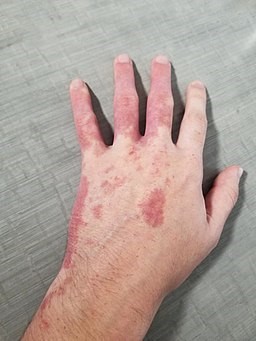
© Aamartinez0626 (Own work), CC BY-SA 4.0, via Wikimedia Commons
Do port-wine stains fade?
Retour au sommaireThey are not harmful, but if just left alone port-wine stains tend to darken over the years. The overlying skin is smooth and flat at first. By middle age the overlying skin can become thickened and lumpy (a cobblestone-like appearance). A lot of people find it distressing to live with skin like this on their face and therefore request treatment.
How would a doctor diagnose a port-wine stain?
Retour au sommaireThere is no particular test for a port-wine stain.
The diagnosis is made on the appearance of a newborn's skin.
A biopsy is not normally necessary.
A port-wine stain should not be confused with a 'salmon patch' or 'stork mark' (sometimes called a 'stork bite') that almost half of babies have, on the back of their neck in the midline. This fades over about a year and is entirely harmless.
Are any further tests done?
Retour au sommaireBecause very rarely something could be wrong with the baby's brain or eyes, if a baby has a port-wine stain they are usually checked by a specialist doctor. They will probably have a brain scan and a detailed eye check.
Do they mean something else is wrong with the baby?
Retour au sommaireAbout 1 in 100 babies born with a port-wine stain on the face have problems of the eye or brain. If 1 in 300 babies have a port-wine stain and 1 in 100 of these have something else wrong then you can see how rare these problems are: they only affect 1 in 30,000 babies.
Problèmes oculaires: may develop if the port-wine stain is on the eyelid area. If a child has a port-wine stain next to an eye then an eye specialist will normally check the child regularly until they are adult.
Brain abnormalities: are an uncommon association with port-wine stains of the face. This is due to extensive blood vessel abnormalities in the brain (the Sturge-Weber syndrome). Épilepsie and other problems may then develop.
Spine abnormalities and varices: can be other associated problems.
The majority of children with port-wine stains do pas have these complications.
How doctors remove a port-wine stain birthmark
Retour au sommaireTraitement au laser
Pulsed dye laser is the treatment of choice for port-wine stains. It is a treatment that was developed in the 1980s, so plenty is known about it.
The treatment fires tiny lasers at the blood vessels in the skin, making them seal off.
Initially just a small area will be treated, as a test. This can judge how well the child handles the treatment and whether they find it too painful. Children say it feels like being flicked by a rubber band.
The skin can be numbed with local anaesthetic cream beforehand. But if the child finds it too painful or there is a large area to be treated then they can have the treatment under a general anaesthetic. Most hospitals will only give a general anaesthetic over the age of 2 years for the laser treatment.
Typically about six laser sessions are given over a period of a year.
Laser therapies work best when used at a young age and when the port-wine stain is pale pink rather than deep purple.
About three quarters of children have a good response to laser treatment, with the port-wine stain getting much paler.
In the long term the skin area can go back to a darker colour, about ten years after laser treatment.
NHS funding for laser treatment is not always guaranteed.
Camouflage cream
For skin patches that have not responded well to laser, or if the person would like a bit more cover-up for a special occasion, camouflage creams can used. These come in a wide variety of colours and can be matched to the person's skin colour.
Waterproof creams have been designed. Usually the cream is removed each night with a cleanser.
When is the best time to treat a port-wine birthmark ?
Retour au sommaireMost port-wine stains are quite pale and flat in a newborn. If left alone they gradually get thicker, bumpy and darker. This is why early treatment, in a young child, is better than in an adult.
Sélections de patients pour Autres problèmes de peau

Santé de la peau, des ongles et des cheveux
Erythème noueux
Erythema nodosum is a condition that causes red rounded lumps (nodules) to form just below the skin surface, most commonly on the shins. In most people, no specific cause or trigger can be found. But in some people a trigger (commonly a streptococcal infection or sarcoidosis) can be identified. Usually, the nodules heal within six to eight weeks with no treatment needed. However, it is important to look for a possible underlying trigger, as this may need treatment.
par Dr Hayley Willacy, FRCGP

Santé de la peau, des ongles et des cheveux
Psoriasis en gouttes
Le psoriasis en gouttes est une affection de la peau qui provoque de petites plaques rouges claires, squameuses, dispersées sur presque tout le corps. Il survient souvent quelques semaines après une infection de la gorge causée par un germe (bactérie) appelé streptocoque bêta-hémolytique du groupe A.
par Dr Colin Tidy, MRCGP
Lectures complémentaires et références
- Sturge-Weber Syndrome, SWS; Hérédité Mendélienne en Ligne chez l'Homme (OMIM)
- Sabeti S, Ball KL, Burkhart C, et al; Consensus Statement for the Management and Treatment of Port-Wine Birthmarks in Sturge-Weber Syndrome. JAMA Dermatol. 2021 Jan 1;157(1):98-104. doi: 10.1001/jamadermatol.2020.4226.
- Wanitphakdeedecha R, Ng JNC, Yan C, et al; Quality of Life and Psychological Effects of Port-Wine Stain: A Review of Literature. Clin Cosmet Investig Dermatol. 2021 Jun 22;14:681-690. doi: 10.2147/CCID.S315804. eCollection 2021.
- Jeon H, Bernstein LJ, Belkin DA, et al; Pulsed Dye Laser Treatment of Port-Wine Stains in Infancy Without the Need for General Anesthesia. JAMA Dermatol. 2019 Apr 1;155(4):435-441. doi: 10.1001/jamadermatol.2018.5249.
Continuez à lire ci-dessous
Historique de l'article
Les informations sur cette page sont rédigées et examinées par des cliniciens qualifiés.
Prochaine révision prévue : 30 oct. 2027
31 oct. 2022 | Dernière version

Demandez, partagez, connectez-vous.
Parcourez les discussions, posez des questions et partagez vos expériences sur des centaines de sujets de santé.

Vous ne vous sentez pas bien ?
Évaluez vos symptômes en ligne gratuitement
Inscrivez-vous à la newsletter Patient
Votre dose hebdomadaire de conseils de santé clairs et fiables - rédigés pour vous aider à vous sentir informé, confiant et maître de la situation.
En vous abonnant, vous acceptez notre Politique de confidentialité. Vous pouvez vous désabonner à tout moment. Nous ne vendons jamais vos données.