Psoriasis en gouttes
Revu par Dr Hayley Willacy, FRCGP Dernière mise à jour par Dr Colin Tidy, MRCGPDernière mise à jour 13 Oct 2022
Respecte les directives éditoriales
- TéléchargerTélécharger
- Partager
- Language
- Discussion
- Version audio
- Ajouter aux sources préférées sur Google
Dans cette série :PsoriasisArthrite psoriasiquePsoriasis des ongles
Le psoriasis en gouttes est une affection de la peau qui provoque de petites plaques rouges claires, squameuses, dispersées sur presque tout le corps. Il survient souvent quelques semaines après une infection de la gorge causée par un germe (bactérie) appelé streptocoque bêta-hémolytique du groupe A.
En un coup d'œil
Le psoriasis en gouttes est une affection cutanée qui se développe rapidement, souvent après une infection de la gorge.
Elle provoque de petites taches roses surélevées avec une fine écaille blanche, généralement sur le corps et les membres.
Les taches apparaissent généralement en un ou deux jours et peuvent être légèrement prurigineuses.
Il est diagnostiqué par son apparence et si une infection de la gorge s'est récemment produite.
Le psoriasis en gouttes disparaît souvent de lui-même en quelques semaines ou mois.
Dans la plupart des cas, les taches ne réapparaissent pas après le nettoyage.
What is guttate psoriasis?
Although it has the name 'psoriasis', guttate psoriasis is almost a completely different condition to the usual psoriasis. It is a skin condition that comes on quickly, usually a few weeks after a throat infection. Some medications can also cause it.
Guttate psoriasis causes
For some reason a group A beta-haemolytic streptococcus infection, which can cause a really sore throat, sometimes causes a skin reaction.
It's thought to be caused by your immune system going into 'overdrive' and accidentally reacting to your own skin.
The throat infection is found in about 80% of cases.
No one can quite figure out why this happens but some people seem to be more prone to it than others. It might be to do with your genetic make-up.
In this way it's similar to the way a throat infection can lead to rhumatismale aiguë.
Can anything else cause guttate psoriasis?
Rarely some medications can cause guttate psoriasis, particularly lithium (used for mental health problems) and beta-blockers (used in heart conditions).
What does guttate psoriasis look like?
The word 'gutta' means 'drop' in Latin so that's where the name guttate psoriasis comes from: it can look like tiny pink drops have been scattered on the person's body. They are usually slightly raised, with a thin white scale. They don't hurt, but they can be a bit itchy.
Guttate psoriasis hands
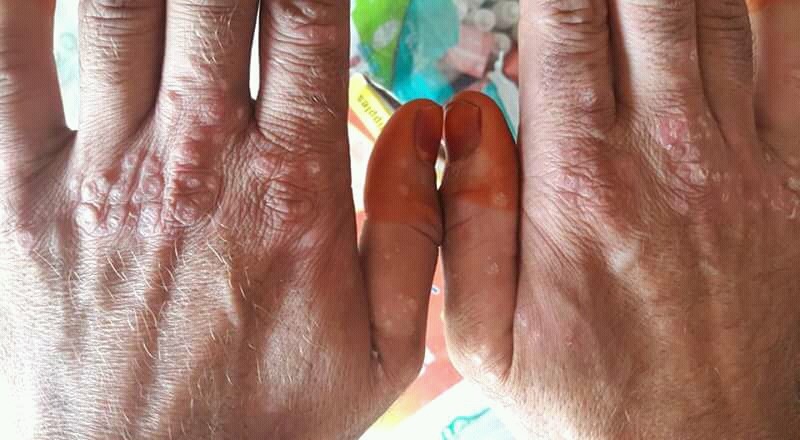
© Mohammad2018, CC BY-SA 4.0, via Wikimedia Commons
The above image shows guttate psoriasis on the back of someone's hands:
The spots come on pretty quickly, over just a day or two.
They usually cover the chest, tummy, upper arms and thighs.
Usually the palms of the hands and soles of the feet are not affected.
It only occasionally affects your head and face.
They are slightly raised, light pink skin marks that might have a white scale to their surface.
Does guttate psoriasis make you feel ill?
Usually the appearance of the spots is the worst thing about it.
It doesn't usually make you feel ill or feverish.
The spots are not usually painful, but they can be a tiny bit itchy (only a little bit though).
You can imagine that coming up in spots all over your body in just a few days can be pretty distressing: a lot of people are quite upset when they see their doctor.
Guttate psoriasis treatment
The good news is, guttate psoriasis typically fades by itself within a few weeks to a few months.
It doesn't necessarily need treating unless it's really bothering the person. No particular treatment option has been shown to work better than others.
A GP may prescribe a mild steroid cream if the lesions are itchy - although in practice it is quite hard to spread cream over such a large area of the body. It is worth nourishing the skin with simple moisturisers.
Although it is related to a bacterial throat infection, giving antibiotics doesn't actually speed up the spots going away.
A dermatologist may use 'light therapy' which is where they beam UV light at you in a special box (a bit like tanning!). This is a specialised treatment that isn't available in all hospitals. It can help to clear up the guttate psoriasis a bit quicker than otherwise.
Guttate psoriasis diagnosis
There aren't any particular tests for guttate psoriasis.
It's diagnosed by the way it looks and also by finding out if there has been a throat infection a few weeks before. Occasionally a blood test can be used to detect the streptococcus germ (bacterium): this is called an anti-streptolysin antibody assay.
A skin biopsy is not usually needed. If it isn't quite clear what the skin condition is, a specialist skin doctor (dermatologist) might use a small microscope (a dermatoscope) to look at it more closely.
Can guttate psoriasis be confused with anything else?
There are other conditions that give similar skin problems.
Pityriasis rosé can look a bit like guttate psoriasis, but doesn't follow a throat infection.
Pityriasis lichenoides can resemble guttate psoriasis, but again doesn't follow a throat infection. And the lesions look a bit different to guttate psoriasis.
See also the separate leaflet on Skin Rashes.
Who is affected by guttate psoriasis?
Usually young people get guttate psoriasis, in their teens or twenties. Men and women are affected equally.
It seems to occur all over the world.
No one really quite knows how common it is. In general, a GP in the UK would have heard of it and probably know how to diagnose it, but they may not have seen a case themselves for many years.
What's the outlook like after having guttate psoriasis?
In nearly two thirds of people with guttate psoriasis, the spots clear up and never come back.
Occasionally the spots turn into a more long-term type of psoriasis called plaque psoriasis. This can be treated with similar creams and light treatment.
Once it's cleared, sometimes (but not very often) a second outbreak of guttate psoriasis happens. This could happen if the streptococcus bug is lurking in your tonsils.
Thankfully the guttate psoriasis never properly scars, although sometimes it can leave tiny pale marks where it used to be: these should fade with time though.
What happens after the first outbreak?
Usually it comes and goes and then that's all there is to it. In about 80% of people the spots will fade in three weeks to three months and never come back. But in some people it carries on to be long-term plaque psoriasis. Sometimes you can get a second outbreak, particularly if the streptococcus germ (bacterium) is still in your throat or tonsils.
Sélections des patients pour Autres affections cutanées

Santé de la peau, des ongles et des cheveux
Gelures
Les engelures sont des blessures causées par l'exposition de certaines parties du corps au froid. Il existe différents degrés d'engelures. Lors d'une engelure superficielle, la peau peut récupérer complètement avec un traitement rapide. Cependant, si l'engelure est profonde, les dommages aux tissus peuvent être permanents et une perte de tissu peut survenir. La façon la plus importante de prévenir les engelures est de sortir du froid. Si vous êtes exposé au froid, assurez-vous de porter des vêtements de protection adéquats.
par Dr Toni Hazell, FRCGP
Santé de la peau, des ongles et des cheveux
Psoriasis
Psoriasis is a long-term skin condition that can also affect the nails and joints. It tends to flare up from time to time. Treatment with various creams or ointments can often clear or reduce patches (plaques) of psoriasis. Special light therapy and/or powerful medication are treatment options for severe cases where creams and ointments have not worked very well. People with psoriasis are more likely than usual to develop cardiovascular disease (heart disease and strokes).
par Dr Doug McKechnie, MRCGP
Questions fréquemment posées
Puis-je empêcher le développement du psoriasis en gouttes si j'ai une infection de la gorge streptococcique ?
L'article indique que le psoriasis en gouttes apparaît généralement quelques semaines après une infection de la gorge, le plus souvent causée par une infection à streptocoque bêta-hémolytique du groupe A. Cependant, il ne fournit pas d'informations sur la possibilité de prévenir l'apparition du psoriasis en gouttes en traitant précocement l'infection de la gorge à streptocoque.
Le psoriasis en gouttes laisse-t-il des cicatrices ?
Le psoriasis en gouttes ne laisse jamais de cicatrices à proprement parler. Cependant, il peut parfois laisser de petites marques pâles là où se trouvaient les taches. Ces marques pâles devraient s'estomper avec le temps.
Quelle est la probabilité que le psoriasis en gouttes réapparaisse après avoir disparu ?
Chez près de deux tiers des individus, les taches disparaissent et ne réapparaissent pas. Parfois, bien que rarement, une deuxième poussée peut survenir, surtout si le germe streptocoque reste dans les amygdales.
Quelle est la fréquence du psoriasis en gouttes, et les médecins généralistes le connaissent-ils bien ?
Personne ne sait vraiment à quel point le psoriasis en gouttes est courant. Cependant, un médecin généraliste (MG) au Royaume-Uni en aurait généralement entendu parler et saurait probablement comment le diagnostiquer, même s'il n'a pas vu de cas lui-même depuis de nombreuses années.
Le psoriasis en gouttes peut-il être douloureux ?
Les taches de psoriasis en gouttes ne sont généralement pas douloureuses. L'apparence des taches et une légère démangeaison sont généralement les principales préoccupations.
Lectures complémentaires et références
- Maruani A, Samimi M, Stembridge N, et al; Non-antistreptococcal interventions for acute guttate psoriasis or an acute guttate flare of chronic psoriasis. Cochrane Database Syst Rev. 2019 Apr 8;4:CD011541. doi: 10.1002/14651858.CD011541.pub2.
- Psoriasis en gouttes; DermNet
- Guttate Psoriasis; Société de Dermatologie de Soins Primaires.
- Psoriasis; NICE CKS, septembre 2022 (accès réservé au Royaume-Uni)
À propos de l'auteurVoir la biographie complète

Dr Oliver Starr, MRCGP
MBChB, BMedSc, MRCS, MRCGP, DRCOG
Dr Oliver Starr is a general practitioner in Hertfordshire and an undergraduate tutor at University College Medical School.
À propos du critiqueVoir la biographie complète

Dr Hayley Willacy, FRCGP
Médecin généraliste, Auteur médical
MBChB (1992), DRCOG, DFFP, MRCOG (Part 1) MRCGP (2007), DFSRH (2013), MSc - medical education (2020)
Le Dr Hayley Willacy était médecin généraliste au NHS travaillant dans le nord-ouest de l'Angleterre, qui a pris sa retraite de la pratique clinique en 2022 après 30 ans.
Historique de l'article
Les informations sur cette page sont rédigées et examinées par des cliniciens qualifiés.
Article également disponible en Anglais, Allemand, Espagnol, Français, Italien, Portugais, Hindi, Hébreu, Arabe, and Suédois.
Prochaine révision prévue : 12 oct. 2027
13 Oct 2022 | Dernière version
8 Jul 2017 | Publié à l'origine
Écrit par :
Dr Oliver Starr, MRCGP

Demandez, partagez, connectez-vous.
Parcourez les discussions, posez des questions et partagez vos expériences sur des centaines de sujets de santé.

Vous ne vous sentez pas bien ?
Évaluez vos symptômes en ligne gratuitement
Inscrivez-vous à la newsletter Patient
Votre dose hebdomadaire de conseils de santé clairs et fiables - rédigés pour vous aider à vous sentir informé, confiant et maître de la situation.
En vous abonnant, vous acceptez notre Politique de confidentialité. Vous pouvez vous désabonner à tout moment. Nous ne vendons jamais vos données.