
Scarlet fever: a doctor's advice
Peer reviewed by Dr Colin Tidy, MRCGPLast updated by Dr Krishna Vakharia, MRCGPLast updated 14 Dec 2023
Meets Patient’s editorial guidelines
- DownloadDownload
- Share
- Language
- Discussion
- Audio Version
- Add to preferred sources on Google
With a surge in cases of scarlet fever, GP and mum, Dr Krishna Vakharia, our clinical director here at Patient.info, talks about what you need to know and what to do if you're worried.
When is a fever or sore throat more than just that and when does it become scarlet fever?
When our then 3-year-old developed a fever, was sick, and then felt better - we put it down to a bug. As this is our third child, we are used to dealing with kids with fevers, runny noses, and being sick.
A day later, he was off his food and had a high temperature. Looking into his mouth, I saw white spots on his tongue - a sign of scarlet fever. He had also developed a rash - another scarlet fever symptom.
As a GP, I knew the signs, so I rang 111, and a couple of hours later I had a prescription for antibiotics. Within 48 hours he was a lot better and starting to eat more. We later heard that there were a few children in his nursery that had been treated for scarlet fever.
What is scarlet fever?
Bacteria called Group A streptococcus (GAS) - or strep A - can cause a number of different infections such as impetigo, cellulitis, and strep A throat (bacterial tonsillitis) These bacteria can also cause scarlet fever. This infection usually affects children under 10, but adults too - It is very infectious.
Scarlet fever has been around for centuries and every few years, there is a rise in cases. It was the main cause of death in children under 10 in the 1800s, due to people living in overcrowded houses. Now, as people are more spread out, the infection tends to be more contained so there are fewer deaths.
How common is scarlet fever?
In the UK there are normally a few cases of scarlet fever every year - these tend to be in children and usually come with mild symptoms. Every few years, there is usually a period that is much worse than others. The last outbreak was in 2017-2018 when the highest number of cases since 1960 were recorded. We have also seen increased cases of unwell children with pneumonia or invasive Group A strep (iGAS) - causing more widespread infection.
iGAS is when Strep A goes into the blood stream or anywhere else it shouldn't, such as in the muscles or the lungs. It can make you very unwell and can lead to death. It is quite rare, but cases are increasing.
What are the symptoms of strep A?
The classic symptoms of strep A throat are the same as those of tonsillitis. GPs use the Centor criteria to decide when someone may need antibiotics. Two or more of these symptoms usually means that a sore throat is likely to be caused by strep A. This criteria is hard to use in children as they often have symptoms that may not fit. In these cases we do a thorough examination to see how likely it is their symptoms are due to strep A.
Strep A symptoms
Sore throat.
Fever - temperatures are usually over 38°C.
No cough.
White spots on the tonsils.
Painful, swollen neck lymph nodes.
It is often very difficult to predict when strep A throat can become scarlet fever.
How to tell if it's scarlet fever
My son had a sore throat with red and white spots on his tonsils first, and then I noticed he had a 'strawberry tongue' - a red tongue covered in white spots. On his tummy, he had developed a red, bumpy rash that felt like sandpaper.
Strawberry tongue
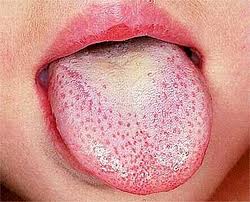
© By Afag Azizova (Own work) via Wikimedia Commons
In people with darker skin, the rash is often difficult to see so doctors usually go by feel. This rash can spread throughout the body and can make the skin peel.
In most cases, antibiotics will make patients better. All that's needed to prevent spreading Strep A is to stay clear of others while you have the symptoms, and for 24 hours after you start antibiotics. The rash can last for up to seven days and often children can feel quite tired during the whole episode.
You can go back to school or work once you have been on antibiotics for 24 hours and you no longer have a fever.
When should we worry?
Call your doctor or go to A&E immediately if you have these symptoms:
No improvement after 48 hours of antibiotics.
If temperatures don't go down after giving paracetamol and ibuprofen.
Fever lasting more than five days.
Symptoms are getting worse.
If children have stopped eating and drinking.
If there are less than three good wet nappies or children have not been for a wee, or have a dry nappy for more than 12 hours.
Call 999/emergency numbers if:
Your child is lethargic, unresponsive.
They have fever, headache and are not moving their neck.
The rash does not disappear with the glass test - when you place the side of a glass against the rash and it can still be seen.
They are not making sense when they talk.
Light is affecting their eyes.
They cannot swallow their saliva and are drooling.
They are struggling to breathe- if you can see the ribs being sucked in or they cannot talk or lie flat because they are too breathless.
What are the complications of scarlet fever?
As well as the increase in children with complications from scarlet fever, there has also been an increase in pneumonia and iGAS. Both can cause serious illness.
Practical tips for managing a sore throat
Ice lollies - they provide energy and fluids. They are also soothing when you have a burning throat.
Water - drink often and take sips. Try not to glug down too much at once as this can make you feel sick.
Food - just eat what you can and want to eat, same goes for kids. Even if, like in my child’s case, it is just yogurt and white chocolate buttons. They can catch up on nutrition when they feel better.
Take paracetamol and ibuprofen as they need it for fever and pain. Look at the packet for recommended doses and never give more than this.
If you are not sure, or you're worried - seek help.
As a parent, it can be hard to work out when to worry and call for help. I often tell my patients that you know your child the best, so if you are concerned, call your doctor.
Scarlet fever is still rare, and more often than not your child will have a sore throat from a virus. If it is strep A your child may need antibiotics. If there is a scarlet fever alert - often from the government or schools - it is really there to let GPs and parents know to explore further if confronted with a fever and sore throat - and to then act quickly when there may be a chance it could be scarlet fever or iGAS.
Patient picks for Skin rashes

Skin, nail and hair health
Common skin complaints: understanding tinea versicolor
If you've noticed a rash of patchy colours develop on your skin, you may have tinea versicolor - which also goes by the name pityriasis versicolor. This common skin condition can happen to anyone, no matter how healthy and fit they are, and can be managed with various treatments.
by Amberley Davis

Skin, nail and hair health
What causes our skin to break out in hives?
Hives - also known as urticaria - is a relatively common itchy rash that causes red or white bumps on the skin. According to the British Association of Dermatologists (BAD), it affects around one in five people at some point in their lives, and in around half of cases the trigger is unknown. But, if you're breaking out in hives, here's what could be behind those itchy bumps.
by Sarah Graham
About the authorView full bio

Dr Krishna Vakharia, MRCGP
Chief Medical Officer for Health, Optum UK
MBChB, MRCGP(2013), BMedSci (hons), DFSRH, DRCOG, PGDipDerm (Distn)
Dr Krishna Vakharia is an NHS GP. She is also a regular examiner for the postgraduate Diploma in Practical Dermatology at Cardiff University as well as being the Chief Medical Officer for health at Optum UK.
About the reviewerView full bio

Dr Colin Tidy, MRCGP
General Practitioner, Medical Author
MBBS, MRCGP, MRCP (Paediatrics), DCH
Dr Colin Tidy is an NHS Doctor, based in Oxfordshire.
Article history
The information on this page is peer reviewed by qualified clinicians.
Article also available in English, German, Spanish, French, Italian, Portuguese, Hindi, Hebrew, Arabic, and Swedish.
14 Dec 2023 | Latest version
5 Dec 2022 | Originally published
Authored by:
Dr Krishna Vakharia, MRCGP
Join the conversation
Share your thoughts or experiences with others in our patient communities.

Ask, share, connect.
Browse discussions, ask questions, and share experiences across hundreds of health topics.

Feeling unwell?
Assess your symptoms online for free
Sign up to the Patient newsletter
Your weekly dose of clear, trustworthy health advice - written to help you feel informed, confident and in control.
By subscribing you accept our Privacy Policy. You can unsubscribe at any time. We never sell your data.
More in skin, nail and hair health
- Do you need to try an avocado face mask?
- Does Bio-Oil help acne scars?
- Does the menopause cause hair loss?
- Does vaping age or damage your skin?
- Eczema management plans: do they help control your eczema?
- Eczema, psoriasis, and ringworm: what's the difference?
- How to avoid tick bites and Lyme disease
- How to keep your feet problem-free
- How to look after your skin during chemotherapy
- How to soothe a nettle sting
- How to treat sunburn blisters
- Is coconut oil good for your hair?
- Is there a link between diet and acne?
- The best ways to get rid of head lice
- The mental health impact of skin conditions
- The warning signs of heatstroke and heat exhaustion
- What is vulvar dermatitis?
- Why eczema itches - and how to stop it
- Why is my facial eczema worse in summer?
- NewWhy losing weight can cause hair loss - and what to do about it