Qu'est-ce que la créatine ? Avantages, utilisations et risques
Revu par des pairs par Dr Colin Tidy, MRCGPRédigé par Josh AldermanPublié à l'origine 12 Mar 2026
Respecte les directives éditoriales
- TéléchargerTélécharger
- Partager
- Language
- Discussion
- Version audio
- Ajouter aux sources préférées sur Google
Creatine is one of the most popular sports supplements in the UK. Often associated with gym training and muscle building, creatine is widely used to support strength and performance. But it isn’t just for athletes - it’s a naturally occurring substance found in your body and in certain foods.
So, what does creatine do, what are the potential creatine benefits, and are there any downsides to consider?
What is creatine?
Creatine is a natural compound made in your liver, kidneys and pancreas from amino acids. Around 95% of it is stored in your muscles, with small amounts found in your brain.1
You also get creatine from foods such as red meat and fish. However, the amount from diet alone is much lower than the amount typically provided by supplements.
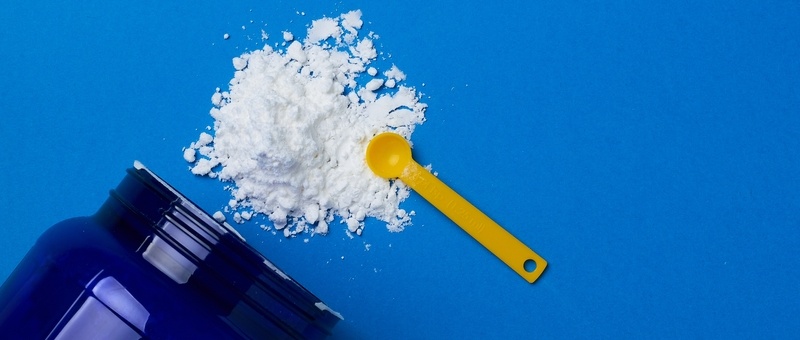
Creatine supplements are usually sold as powders, capsules, or tablets. The most widely studied and commonly used form is creatine monohydrate.2
How does creatine work?
Creatine plays an important role in energy production. It helps your body make adenosine triphosphate (ATP), which is the main energy source your cells use, especially during short bursts of intense activity.
Taking creatine increases the amount stored in your muscles.
This may help your muscles:
Produce energy more quickly.
Sustain high-intensity activity for slightly longer.
Recover more effectively between sets.
So when it comes to short, high-powered efforts such as weightlifting, sprinting, or HIIT, creatine can make a real impact-but it doesn’t offer the same benefit for longer, steady-state endurance exercise.
What are the benefits of creatine?
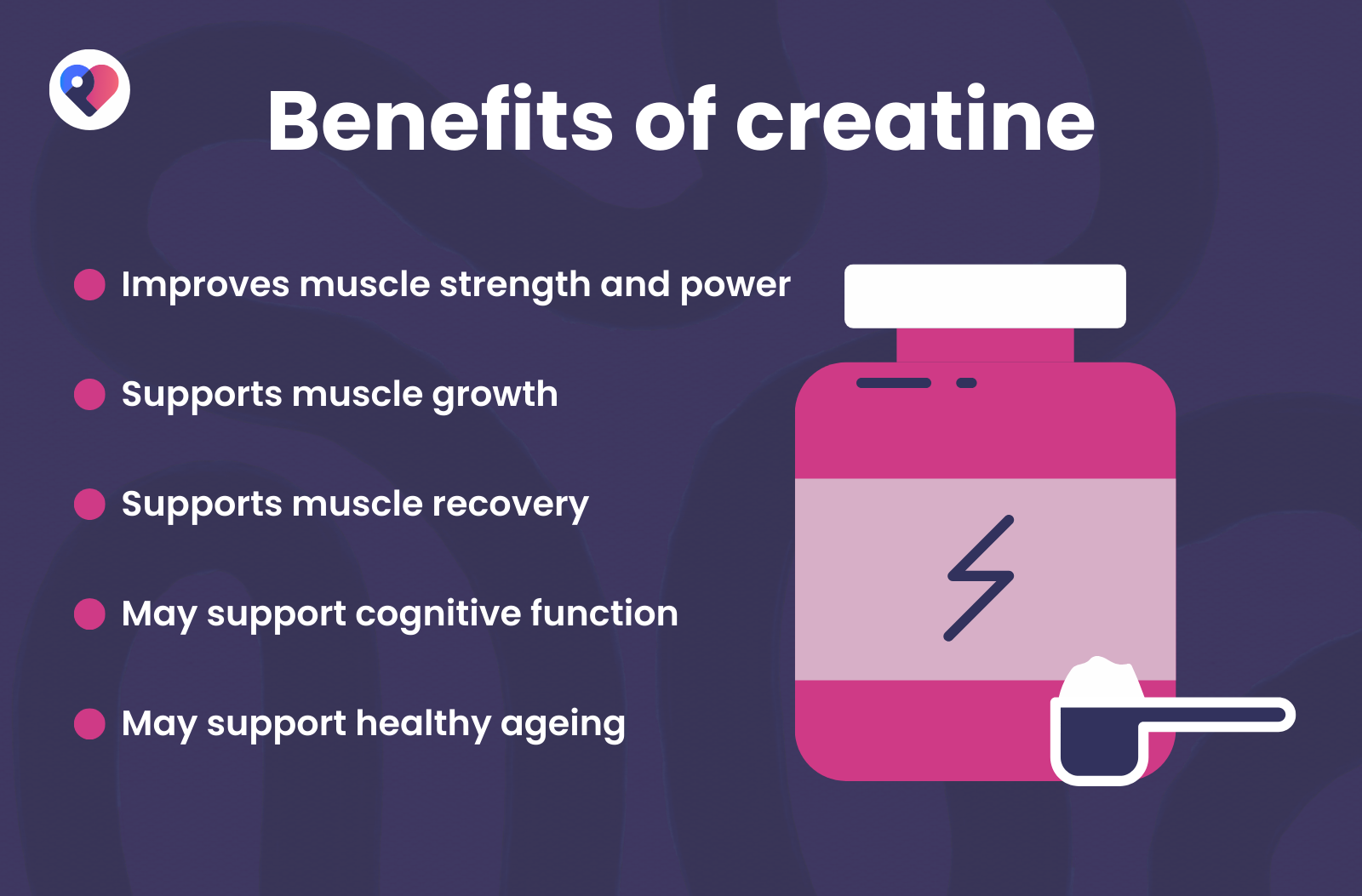
If you're thinking about adding creatine to your routine, here are five reasons it might be worth it.
© Patient / Heather Ainsworth
1. Improves muscle strength and power
Creatine may increase muscle strength and power output.3Many people find they can lift slightly heavier weights or perform more repetitions.
2. Supports muscle growth
Creatine can contribute to increased muscle size.4 This is partly due to greater training capacity and partly because creatine draws water into muscle cells.
A small increase in body weight is common in the first few weeks. This is usually water stored in muscle, not fat.
3. Supports muscle recovery
Some evidence suggests creatine may help support muscle recovery after intense exercise,5 allowing more consistent training.
4. May support cognitive function
Because creatine is also present in the brain, researchers are studying whether it may support memory or mental performance in certain situations as well as possibly aid in combating conditions such as démence.5 More research is needed before firm conclusions can be made.
5. May support some medical conditions
Creatine has also been studied in a range of medical conditions that affect muscle strength and energy production. These include inherited muscle disorders such as dystrophie musculaire and other myopathies,6 as well as mitochondrial disorders,8 where the body’s ability to produce energy is impaired.
Researchers have also explored its potential role in neurological conditions such as Maladie de Parkinson7et sclérose en plaques,8 and in age-related muscle loss (sarcopenia). 9
While some small studies suggest creatine may improve muscle strength or reduce fatigue in certain groups, results have been mixed and benefits are not consistent.
Is creatine safe?
For healthy adults taking recommended doses, creatine is generally considered safe. It is one of the most researched supplements available.
Side effects of creatine
Possible side effects include:
Temporary weight gain.
Ballonnements.
Mild stomach discomfort.
These effects are more likely with higher doses. Drinking enough fluids may help reduce digestive symptoms.
There is no strong evidence that creatine causes kidney damage in healthy people using standard doses.
Should you speak to a doctor before taking creatine?
Creatine may not be suitable for everyone.
Seek medical advice if you:
Have kidney or liver disease.
Sont enceintes ou allaitent.
Are under 18.
Have a long-term medical condition.
Take regular medicine.
As with all supplements, product quality can vary. Choosing reputable brands is advisable.
Résumé
Creatine is a naturally occurring compound that helps your muscles produce energy during short bursts of high-intensity activity. When taken as a supplement, it may improve strength, power, and muscle mass - particularly when combined with structured training.
The main creatine benefits relate to improved exercise performance and increased muscle size. For most healthy adults taking recommended doses, creatine is considered safe, with mild side effects such as temporary weight gain or bloating.
However, creatine isn’t suitable for everyone. If you have kidney disease, are pregnant, or manage a long-term health condition, it’s important to seek medical advice before starting supplementation.
Creatine can be a useful addition to a well-balanced training plan - but it’s not a replacement for regular exercise and a healthy diet.
Questions fréquemment posées
Is creatine safe to take every day?
Yes, for most healthy adults, taking 3-5 grams of creatine daily is considered safe. Consistency is more important than cycling on and off.
Does creatine cause hair loss?
There is limited evidence linking creatine to hair loss. A small study suggested it may increase levels of a hormone linked to male pattern baldness, but this has not been confirmed in larger research. There is no clear evidence that creatine directly causes hair loss.10
Does creatine damage your kidneys?
In healthy people using recommended doses, creatine has not been shown to damage kidney function. However, people with existing kidney disease should avoid it unless advised by a doctor.
Do you need a loading phase?
A loading phase (around 20 grams daily for 5-7 days) can increase muscle creatine stores more quickly. However, it is not essential. Taking 3-5 grams daily will achieve similar levels over several weeks.
Can you take creatine without exercising?
Creatine may still increase muscle stores without exercise, but most creatine benefits are seen when combined with resistance training.
Sélections des patients pour Vitamines et compléments alimentaires
Régime et nutrition
Quels sont les bienfaits de la vitamine E ?
La vitamine E est un ingrédient très apprécié dans toute routine de soins de la peau. Mais elle est également essentielle pour votre santé et le bon fonctionnement de votre corps. Découvrez pourquoi et comment obtenir suffisamment de vitamine E ici.
par Victoria Raw
Santé des seniors
Les meilleurs compléments anti-âge pour votre santé
Le terme anti-âge est inscrit sur de nombreux emballages de crèmes de beauté et autres produits de soins de la peau. Mais que signifie anti-âge à l'intérieur du corps ? Ici, cela va au-delà de l'apparence de nos rides, vers un vieillissement interne sain. Cela signifie à quel point nos cellules et organes restent en bonne santé et capables de lutter contre le déclin et les maladies à mesure que nous vieillissons - afin que nous puissions vivre heureux le plus longtemps possible. Nous explorons les compléments anti-âge qui aident notre corps à faire exactement cela, selon les experts.
par Lawrence Higgins
Questions fréquemment posées
When is the best time to take creatine?
The article does not specify an optimal time to take creatine. The most important factor for creatine supplementation is consistency in daily intake to maintain muscle stores, rather than the specific timing relative to workouts or meals.
Is creatine considered a drug or a hormone?
Creatine is neither a drug nor a hormone. It is a natural compound made in your liver, kidneys, and pancreas from amino acids. It's also obtained from foods like red meat and fish and is widely available as a supplement.
What is the typical dosage for creatine supplements?
For most healthy adults, a daily dosage of 3-5 grams of creatine is considered safe to take every day. A loading phase of around 20 grams daily for 5-7 days can also be used to increase muscle creatine stores more quickly, but it isn't essential.
How long does it take to see the benefits of creatine?
While a loading phase can increase muscle creatine stores more quickly, consistent daily intake of 3-5 grams will achieve similar muscle saturation levels over several weeks. Therefore, changes in strength, power, or muscle size may become noticeable after a few weeks of consistent use, especially when combined with resistance training.
Lectures complémentaires et références
- Felipe Ribeiro et al. "Creatine supplementation and muscle-brain axis: a new possible mechanism?." Frontiers in Nutrition, 12 (2025).
- R. Kreider et al. "Bioavailability, Efficacy, Safety, and Regulatory Status of Creatine and Related Compounds: A Critical Review."
- Camic CL, Hendrix CR, Housh TJ, et al; The effects of polyethylene glycosylated creatine supplementation on muscular strength and power. J Strength Cond Res. 2010 Dec;24(12):3343-51. doi: 10.1519/JSC.0b013e3181fc5c5c.
- Drzewiecki, Artur, et al. “The Effect of Creatine on Muscle Mass Gain: A Literature Review”. Quality in Sport,
- Xu, Chen, et al. “The Effects of Creatine Supplementation on Cognitive Function in Adults: A Systematic Review and Meta-Analysis.”
- Kley, Rudolf A, et al. “Creatine for Treating Muscle Disorders.” Cochrane Database of Systematic Reviews
- Yea-Hyun Leem, et al. “Creatine Supplementation with Exercise Reduces α-Synuclein Oligomerization and Necroptosis in Parkinson’s Disease Mouse Model.” The Journal of Nutritional Biochemistry, vol. 126
- Ostojic, Sergej M. “Creatine and Multiple Sclerosis.” Nutritional Neuroscience
- Dolan, Eimear, et al. “Muscular Atrophy and Sarcopenia in the Elderly: Is There a Role for Creatine Supplementation?”
- Lak, Mohammadyasin, et al. “Does Creatine Cause Hair Loss? A 12-Week Randomized Controlled Trial.” Journal of the International Society of Sports Nutrition, vol. 22
À propos de l'auteurVoir la biographie complète

Josh Alderman
Responsable SEO
Licence (Hons) Médias et Journalisme Imprimé
Josh est un responsable SEO chez Patient avec plus de 4 ans d'expérience dans le domaine de la santé.
À propos du critiqueVoir la biographie complète

Dr Colin Tidy, MRCGP
Médecin généraliste, Auteur médical
MBBS, MRCGP, MRCP (Paediatrics), DCH
Le Dr Colin Tidy est un médecin du NHS, basé dans l'Oxfordshire.
Historique de l'article
Les informations sur cette page sont examinées par des cliniciens qualifiés.
Article également disponible en Anglais, Allemand, Espagnol, Français, Italien, Portugais, Hindi, Hébreu, Arabe, and Suédois.
Next review due: 12 Mar 2029
12 Mar 2026 | Publié à l'origine
Écrit par :
Josh AldermanRevu par des pairs par
Dr Colin Tidy, MRCGP

Demandez, partagez, connectez-vous.
Parcourez les discussions, posez des questions et partagez vos expériences sur des centaines de sujets de santé.

Vous ne vous sentez pas bien ?
Évaluez vos symptômes en ligne gratuitement
Inscrivez-vous à la newsletter Patient
Votre dose hebdomadaire de conseils de santé clairs et fiables - rédigés pour vous aider à vous sentir informé, confiant et maître de la situation.
En vous abonnant, vous acceptez notre Politique de confidentialité. Vous pouvez vous désabonner à tout moment. Nous ne vendons jamais vos données.
Plus sur l'alimentation et la nutrition
- 10 bienfaits surprenants du chou pour la santé
- 5 repas végétariens riches en protéines pour maintenir votre force
- 7 idées de petit-déjeuner céto faciles et délicieuses
- Au-delà du raisin : découvrir les bienfaits du resvératrol pour la santé
- Le régime alimentaire peut-il affecter votre TDAH ?
- Le kombucha peut-il améliorer votre santé ?
- Changer vos habitudes alimentaires après un diagnostic de diabète de type 2
- Les vitamines gélifiées sont-elles efficaces ?
- Comment l'alimentation affecte-t-elle la démence ?
- Comment se débarrasser des gaz intestinaux : remèdes maison efficaces
- Comment préparer des pommes de terre rôties saines
- Comment préparer une farce saine
- Boire de l'huile d'olive est-il bon pour vous ?
- Y a-t-il un lien entre l'alimentation et l'acné ?
- Magnésium : Bienfaits pour la santé et risques
- Quels sont les bienfaits de la vitamine E ?
- Quel est le meilleur régime pour la maladie de Crohn ?
- Qu'est-ce que le régime Ornish et peut-il transformer votre santé ?
- Quels aliments peuvent réduire votre stress et votre anxiété ?
- Quels vitamines de grossesse ai-je vraiment besoin ?