
Comment s'auto-examiner pour le cancer des testicules
Revu par Dr Krishna Vakharia, MRCGPRédigé par Lydia SmithPublié à l'origine 20 oct. 2022
Respecte les directives éditoriales
- TéléchargerTélécharger
- Partager
- Language
- Discussion
- Version audio
- Ajouter aux sources préférées sur Google
Examiner vos testicules peut être un moyen simple de s'assurer qu'il n'y a pas de bosses ou de grosseurs inhabituelles, ce qui peut être le premier signe de cancer des testicules. Cependant, il peut être difficile de savoir ce que vous faites, surtout si vous ne l'avez jamais fait auparavant.
Quelle est la fréquence du cancer des testicules ?
Le cancer des testicules est un type de cancer très courant. Il y a environ 2 400 nouveaux cancer testiculaire cas au Royaume-Uni chaque année1, ce qui représente plus de six chaque jour. Effectuer un auto-examen est une partie importante pour rester en bonne santé - surtout si vous avez des antécédents familiaux de cancer des testicules, et remarquer des changements tôt pourrait signifier détecter les cellules cancéreuses plus tôt.
Pourquoi est-il important de vérifier ses propres testicules ?
"Vérifier régulièrement vos testicules est une partie importante pour maintenir votre santé,” déclare Kieran Kelly, directeur de l'association caritative contre le cancer des testicules La Fondation OddBalls.
"C'est rapide, facile et cela pourrait potentiellement vous sauver la vie. Il est important de vérifier régulièrement car vous devez savoir ce qui vous semble normal. Par conséquent, si vous remarquez des changements, vous pouvez être proactif et demander l'aide médicale nécessaire."
Comment examiner vos testicules
À partir de la puberté, il est important de vérifier votre testicules régulièrement. Testiculaire le cancer est généralement toujours guéri, mais il est plus facile à traiter lorsqu'il est diagnostiqué tôt. S'examiner une fois par mois signifie que vous savez ce qui est normal pour vous.
Tout d'abord, vous devez tenir votre scrotum dans la paume de votre main. Utilisez vos doigts et votre pouce pour examiner chaque testicule. Vous devez rechercher des bosses ou des gonflements, toute anomalie ou toute différence entre vos testicules.
"Le meilleur moment pour vous examiner est après avoir pris un bain chaud ou une douche chaude, car vos testicules deviennent plus souples et plus faciles à palper pour détecter tout changement physique," dit Kelly.
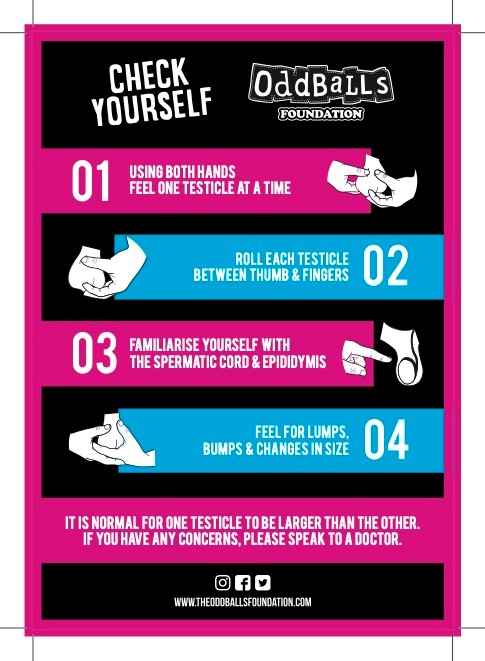
Kelly recommande un processus en quatre étapes pour s'auto-examiner. "La première étape consiste à utiliser les deux mains pour sentir un testicule à la fois. La deuxième étape consiste à rouler le testicule entre votre pouce et vos doigts pour détecter tout changement," dit-il.
"La troisième étape encourage les gens à se familiariser avec le cordon spermatique et le tube de l'épididyme (- tube qui transporte le sperme - qui se connecte à l'arrière de chaque testicule," ajoute Kelly.
L'épididyme ressemble à un tube enroulé et il est courant d'avoir des kystes inoffensifs et bénins boules dans cette zone, qui peut être traitée. Cependant, chaque masse doit être évaluée par précaution.
"Enfin, la quatrième étape consiste à vérifier la présence de bosses, de gonflements et de tout changement de taille. Il est important de noter qu'il est normal qu'un testicule soit plus grand que l'autre. Nous encourageons tout le monde à consulter un médecin s'ils ont la moindre inquiétude, car il vaut toujours mieux prévenir que guérir."
Vérificateur de Testicules de la Fondation Oddballs
Quels sont les signes du cancer des testicules ?
Le symptôme le plus courant du testiculaire le cancer est une masse dans un testicule, ou une douleur sourde ou une sensation de lourdeur dans le scrotum. Un autre symptôme est une masse indolore ou un gonflement dans un testicule, qui peut soudainement grossir et devenir douloureux.
"Certaines personnes ayant été diagnostiquées avec un cancer des testicules n'ont pas pu signaler de signes spécifiques, mais elles avaient simplement l'impression que quelque chose n'allait pas ou n'était pas normal pour elles", déclare Kelly. D'autres conditions peuvent également causer des bosses ou des gonflements. La plupart des bosses ne sont pas le cancer. Cependant, il est important que vous demandiez à votre médecin de vérifier tout ce qui est inhabituel dès que possible.
Que devez-vous faire si vous êtes préoccupé par le cancer des testicules ?
Si vous remarquez des changements dans vos testicules ou si vous êtes inquiet que quelque chose ne semble pas normal, il est important de ne pas vous sentir gêné et de parler à votre médecin dès que possible. Toutes les bosses et les gonflements ne sont pas un signe de cancer des testicules, mais si vous recevez un diagnostic, la chimiothérapie, la radiothérapie et la chirurgie sont les trois principaux traitements. Bien que le cancer puisse être un diagnostic effrayant, les perspectives et les taux de survie pour le cancer des testicules sont parmi les meilleurs de tous les cancers2.
"Il est important de faire vérifier les choses tôt, car le traitement du cancer des testicules est beaucoup plus efficace lorsqu'il est commencé tôt," dit Kelly.
Pour en savoir plus
Sélections des patients pour Conditions des testicules

Santé des hommes
Pourquoi y a-t-il du sang dans mon sperme ?
La présence de sang dans votre sperme indique souvent un problème, mais il est généralement temporaire et rarement grave. Si cela se produit plus d'une fois ou si vous avez d'autres symptômes inexpliqués, vous devriez consulter un médecin.
par Amberley Davis

Santé des hommes
Apprendre à connaître vos testicules
Si vous êtes un jeune homme ou un adolescent, vous devriez connaître la sensation normale de vos testicules (testes). Signalez tout changement ou grosseur à votre médecin.
par Dr Laurence Knott
À propos de l'auteurVoir la biographie complète

Lydia Smith
Rédacteur de reportages
Licence, Master, MSc
Lydia Smith est une journaliste primée et rédactrice spécialisée qui a beaucoup écrit sur la santé des femmes et la santé mentale. Elle prépare actuellement un MSc en psychologie.
À propos du critiqueVoir la biographie complète

Dr Krishna Vakharia, MRCGP
Médecin-chef pour la santé, Optum UK
MBChB, MRCGP(2013), BMedSci (hons), DFSRH, DRCOG, PGDipDerm (Distn)
Le Dr Krishna Vakharia est un médecin généraliste du NHS. Elle est également examinatrice régulière pour le diplôme de troisième cycle en dermatologie pratique à l'Université de Cardiff, ainsi que médecin-chef pour la santé chez Optum UK.
Historique de l'article
Les informations sur cette page sont examinées par des cliniciens qualifiés.
Article également disponible en Anglais, Allemand, Espagnol, Français, Italien, Portugais, Hindi, Hébreu, Arabe, and Suédois.
20 oct. 2022 | Publié à l'origine
Écrit par :
Lydia SmithRevu par
Dr Krishna Vakharia, MRCGP

Demandez, partagez, connectez-vous.
Parcourez les discussions, posez des questions et partagez vos expériences sur des centaines de sujets de santé.

Vous ne vous sentez pas bien ?
Évaluez vos symptômes en ligne gratuitement
Inscrivez-vous à la newsletter Patient
Votre dose hebdomadaire de conseils de santé clairs et fiables - rédigés pour vous aider à vous sentir informé, confiant et maître de la situation.
En vous abonnant, vous acceptez notre Politique de confidentialité. Vous pouvez vous désabonner à tout moment. Nous ne vendons jamais vos données.
Plus sur la santé des hommes
- Problèmes de vessie que les hommes ne devraient pas ignorer
- Les hommes peuvent-ils souffrir de dépression postnatale ?
- Cystite chez les hommes
- Les hommes doivent-ils faire des exercices de Kegel ?
- Le cancer des testicules affecte-t-il votre fertilité ?
- Apprendre à connaître vos testicules
- Quelle est la fréquence des troubles alimentaires chez les hommes ?
- Comment les problèmes d'érection peuvent affecter votre relation
- Comment votre mode de vie peut être une cause de faible nombre de spermatozoïdes
- Options de test PSA
- La décision de la circoncision adulte : pourquoi, où et comment ?
- La routine de soins pour hommes la plus simple
- Quels sont les signes de la dépression chez les hommes ?
- Quelles sont les causes de la calvitie masculine ?
- Ce que c'est d'avoir un cancer du sein quand on est un homme
- Qu'est-ce qui déclenche les troubles alimentaires chez les hommes ?
- Quelle est la taille moyenne des hommes ?
- Pourquoi les hommes sont-ils moins enclins à porter de la crème solaire ?
- Pourquoi y a-t-il du sang dans mon sperme ?
- Aurons-nous un jour une pilule contraceptive masculine ?