Éctropion
Revu par Dr Doug McKechnie, MRCGPDernière mise à jour par Dr Colin Tidy, MRCGPDernière mise à jour 19 déc. 2024
Respecte les directives éditoriales
- TéléchargerTélécharger
- Partager
- Language
- Discussion
- Ask Patient
- Version audio
- Ajouter aux sources préférées sur Google
Dans cette série :Paupière enfléeOrgeletChalazionBléphariteAnesthésie locale pour votre opération des yeux
L’éctropion est une affection dans laquelle une partie ou la totalité de la paupière inférieure se tourne vers l’extérieur, loin de l’œil. Il existe plusieurs causes, mais la plus courante est un vieillissement de la paupière qui survient chez certaines personnes âgées. Une opération simple peut généralement résoudre le problème.
Points clés
Ectropion is an eye condition where the lower eyelid turns outward, exposing the inner eyelid surface and affecting tear drainage.
Elle est principalement causée par le vieillissement et la laxité de la paupière, mais elle peut également résulter d'une paralysie faciale, de cicatrices, de blessures ou d'une chirurgie des paupières.
Les symptômes courants incluent les yeux larmoyants, l'irritation, la rougeur et l'exposition de la surface de l'œil, ce qui peut entraîner des dommages si non traité.
Treatment involves using lubricating eye drops or ointments, but surgery may be needed to tighten or reposition the eyelid and protect the eye.
What is an ectropion?
Œil avec ectropion
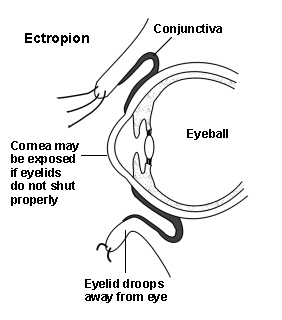
When part or all of the lower eyelid turns outwards away from the eye, the condition is known as an ectropion. Someone looking at you might be able to see part of the pink inner surfaces of the eyes
What causes an ectropion?
An eye ectropion mainly occurs in older people. It is thought that the small eyelid muscles around the eye become weak with ageing. In most cases there is no other underlying problem. Additional images of the condition can be found under Further Reading and References below.
An ectropion may also be caused by any condition that causes scarring of the eyelid or near the eyelid. For example, a burn, infection, tumour or injury to the eyelid.
Any condition that causes weakness of the facial nerves and muscles, including facial paralysis, may also affect the eyelid and cause an ectropion.
Ectropion symptoms
Symptoms of ectropion include:
One eye alone may be affected, although age-related ectropion most commonly affects both eyes.
The inner lining of the eyelid that droops forward may become dry and sore.
In severe ectropion the whole length of the eyelid may turn outwards; milder cases may just involve part of the lid.
The affected eye might have excessive tearing to protect the surface (cornea) of the eye and keep the eye lubricated, so the eye may become constantly watery.
The part of the eyelid next to the nose usually droops the most. This is next to the tear duct where tears normally drain into the nose. Tears may roll off the drooping part of the eyelid.
Damaged cornea. The cornea is the transparent front part of the eye. The eyes may not close properly if you have an ectropion. Therefore, the cornea is not fully protected and can become dry and sore. A corneal ulcer may develop. As the cornea is vital for vision, this can affect your eyesight.
When to see a doctor about ectropion
You should see a doctor if you think you have ectropion. If necessary, your GP will refer you to an eye specialist (ophthalmologist) for further assessment and treatment.
Si votre œil est très rouge et douloureux ou si vous avez une vision réduite ou une sensibilité à la lumière, vous devez contacter un médecin généraliste ou le NHS 111 immédiatement, ou vous rendre au service des urgences de l'hôpital le plus proche.
Ectropion treatment
Le traitement de l'ectropion dépend de la gravité et de la cause sous-jacente.
Mild ectropion may not need any treatment.
Les problèmes mineurs liés à un ectropion peuvent répondre à des mesures simples telles que des gouttes pour les yeux ou une pommade oculaire pour aider à réduire l'irritation.
Il est également préférable d'éviter de se frotter ou de s'essuyer les yeux autant que possible.
Des gouttes ophtalmiques antibiotiques peuvent être nécessaires pour tout épisode de conjonctivite infectieuse.
For severe ectropion, an operation will be recommended:
Ectropion surgery aims to tighten the skin and muscles around the eyelid. The operation may be done using local anaesthetic to numb the eyelid, and a mild sedative to help you relax.
The type of eyelid surgery you have depends on the condition of the tissue surrounding your eyelid and on the cause of your ectropion:
Ectropion caused by aging. Your surgeon will remove a small part of your lower eyelid at the outer edge. When the lid is stitched together, the tendons and muscles of the lid will be tightened, causing the lid to rest properly on the eye.
Ectropion caused by scar tissue from injury or previous surgery may require a skin graft to help support the lower lid. Some patients with facial paralysis or significant scarring need a second procedure to completely correct your ectropion.
If you cannot shut your eye properly then you may be prescribed some lubricating eye ointment to help protect the cornea. You may also be advised to tape the lower and upper eyelids together overnight to protect your cornea when you are asleep.
If your ectropion causes watery eyes, when wiping your eyelids do it in a direction up and in (towards the nose). This prevents you from pulling the eyelid downward and making the ectropion worse.
Complications with ectropion
An ectropion may interfere with the drainage of tears, which can make the eyes more vulnerable to bacterial infections (eg, infective conjunctivitis).
Si vous avez un ectropion sévère et non traité, vous pourriez développer un ulcère cornéen (un ulcère à la surface de l'œil). Un ulcère cornéen peut affecter votre vision.
Can you prevent ectropion?
It is often not possible to prevent an ectropion but if the ectropion has been caused by a condition that causes scarring of the eyelid or near the eyelid (eg, burn, infection, tumour or injury), then early and effective treatment of the potential cause may help to prevent an ectropion from developing.
Questions fréquemment posées
Is ectropion serious?
Ectropion isn’t usually serious, but it can cause discomfort, watery eyes, and irritation if left untreated. In some cases, it may lead to infection or damage to the eye’s surface, so medical advice is recommended.
Does ectropion go away on its own?
Ectropion usually doesn’t go away on its own. Mild cases may improve with lubricating eye drops or ointments, but more severe cases often need minor surgery to correct the eyelid position.
Dr Mary Lowth est l'auteur ou l'auteur original de ce dépliant.
Sélections des patients pour Problèmes de paupières

Santé des yeux
Blépharospasme
Le blépharospasme est une condition dans laquelle le clignement ou la fermeture spasmodique des yeux se produit à un rythme accru. Cela va d'une condition légère et embarrassante de contraction ou de battement d'une paupière à des spasmes sévères de fermeture des yeux qui interrompent la vision utile. Le blépharospasme secondaire est une réponse courante à de nombreuses affections oculaires courantes et peut être causé par certaines conditions affectant le système nerveux. Ce dépliant concerne principalement le blépharospasme primaire, également appelé blépharospasme essentiel bénin (BEB). Le BEB ne peut pas être guéri, mais est généralement géré avec succès par des injections de toxine botulique, répétées à intervalles réguliers. Au Royaume-Uni, si vous avez un blépharospasme, vous devez en informer l'Agence des permis de conduire et des véhicules (DVLA).
par Dr Hayley Willacy, FRCGP
Santé des yeux
Chalazion
Un chalazion est un petit kyste qui se forme sur la paupière lorsqu'une glande sébacée est bloquée ou enflammée. Il est généralement indolore et affecte principalement la paupière supérieure.
par Dr Philippa Vincent, MRCGP
Lectures complémentaires et références
- Bergstrom R, Czyz CN; Reconstruction de l'ectropion de la paupière inférieure. StatPearls, mai 2023.
- Guthrie AJ, Kadakia P, Rosenberg J; Eyelid Malposition Repair: A Review of the Literature and Current Techniques. Semin Plast Surg. 2019 May;33(2):92-102. doi: 10.1055/s-0039-1685473. Epub 2019 Apr 26.
- Borrelli M, Geerling G; Current concepts of ocular adnexal surgery. GMS Interdiscip Plast Reconstr Surg DGPW. 2013 Feb 27;2:Doc06. doi: 10.3205/iprs000026. eCollection 2013.
À propos de l'auteurVoir la biographie complète
Mis à jour par

Dr Colin Tidy, MRCGP
Médecin généraliste, Auteur médical
MBBS, MRCGP, MRCP (Paediatrics), DCH
Le Dr Colin Tidy est un médecin du NHS, basé dans l'Oxfordshire.
À propos du critiqueVoir la biographie complète

Dr Doug McKechnie, MRCGP
Rédacteur Médical
MA, MBBS, MSc, DRCOG, MRCP(UK), MRCGP(2021), FHEA
Le Dr Doug McKechnie est un médecin généraliste du NHS travaillant à Londres. Il travaille à plein temps en clinique et est également le chef adjoint du module de Pratique Clinique et Professionnelle à l'École de Médecine de l'University College London.
Historique de l'article
Article également disponible en Anglais, Allemand, Espagnol, Français, Italien, Portugais, Hindi, Hébreu, Arabe, and Suédois.
Prochaine révision prévue : 18 déc. 2027
19 déc. 2024 | Dernière version
Partagez vos pensées ou expériences avec les autres dans notre communautés de patients.
Accès simple à des traitements fiables et à des services de santé en ligne.
Common conditions
Get help with common conditions through the NHS, without a GP appointment.





Inscrivez-vous à la newsletter Patient
Votre dose hebdomadaire de conseils de santé clairs et fiables - rédigés pour vous aider à vous sentir informé, confiant et maître de la situation.
En vous abonnant, vous acceptez notre Politique de confidentialité. Vous pouvez vous désabonner à tout moment. Nous ne vendons jamais vos données.