La vérité sur les graisses dans votre alimentation
Revu par Dr Sarah JarvisDernière mise à jour par Amberley DavisDernière mise à jour 22 févr. 2024
Respecte les directives éditoriales
- TéléchargerTélécharger
- Partager
- Language
- Discussion
- Version audio
- Ajouter aux sources préférées sur Google
Les graisses alimentaires ont reçu leur lot de mauvaise presse, mais toutes les graisses ne sont pas mauvaises pour nous. Nous explorons ce groupe alimentaire important, en séparant le sain du malsain, et le fait de la fiction.
What is fat?
What we call fat is actually the family name for a whole host of individual fatty acids. These are split into two groups - saturated and unsaturated - depending on key aspects of their structure.
Saturated fats
Saturated fats are straight, dense chains of molecules and this characteristic makes them typically solid at room temperature. Saturated fats are less healthy for your heart as they push up LDL cholestérol levels - the 'bad' cholesterol that can build up in your arteries and cause problems.
You can find saturated fats in animal products, such as:
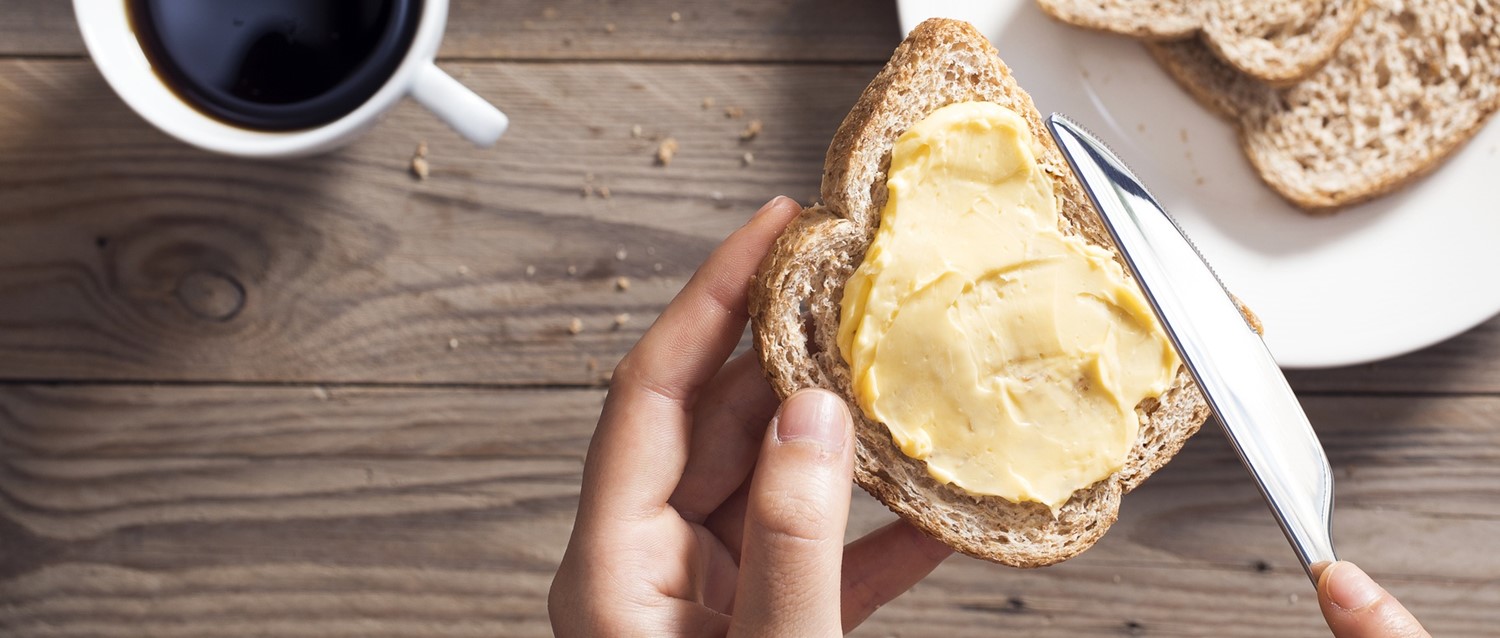
Butter.
Cream.
Lard.
Fromage.
Fatty meats - including lamb, pork and beef.
Processed meats - including sausages, bacon and burgers.
Saturated fats are also in vegetable products, such as:
Coconut fat.
Palm oil.
Processed treats are contributing a large amount of saturated fat to a typical Western diet:
Gâteaux.
Biscuits.
Pies.
Pâtisseries.
Bonbons.
Unsaturated fats
Unsaturated fats are less dense and are liquid at room temperature. Unsaturated fats are believed to be healthier options. Studies have shown that they can reduce your cholesterol levels and protect against cardiovascular disease1.
They are split into monounsaturated fats and polyunsaturated fats, and include:
Noix.
Graines.
Avocat.
Oily fish.
Olive, rapeseed, and other vegetable oils - but not palm and coconut oils.
Graisses trans
A third group, trans fats, only exist in tiny amounts in a few natural foods, such as:
Ruminant meat - such as meat from cows, sheep, and goats.
Produits laitiers.
However, in the 1970s, large amounts of trans fats were manufactured by changing the structure of unsaturated fats to force them to be solid at room temperature. These were then added to a range of processed foods, such as:
Margarine.
Gâteaux.
Biscuits.
In the last few decades, efforts have been made to minimise trans fats in products, due to concerns about their negative effect on blood cholesterol levels and heart disease risk.
Intakes of trans fats in the UK have now reduced to half the maximum limit2. In the UK, there is no legal requirement to list trans fats on labels but you can check product ingredient lists for 'hydrogenated fats/oils' which may contain trans fats. Takeaway foods are also a source, as the high temperature heating of vegetable oil boosts the trans fat content.
Is dietary fat healthy?
There is no need to fear dietary fat as it's essential for health. Fat provides energy, helps to keep us warm, cushions our vital organs, protects our body cells and acts as a carrier for fat-soluble vitamines, such as A, D, E and K. More than half of the brain is fat3 and our cognitive development and brain functions rely on essential fatty acids that cannot be made by our bodies.
However, fats are a rich source of calories, making them easy to overeat. As an example, one 50 g cube of cheddar cheese has the same calories as two medium bananas. Also, several high-fat foods, such as biscuits, cakes, confectionery, desserts, and ice cream, are high in sugar too.
Which types of fats are the healthiest?
We should try to focus on unsaturated fats, while limiting our consumption of saturated and trans fats.
Professor of nutritional immunology, Philip Calder from the University of Southampton, says: "Fats affect the way that cells and tissues in the body work. Some, like omega-3s - which are unsaturated - are better for us because they promote optimal cell and tissue function. Ultimately, this relates to improved wellbeing and less risk of disease."
According to Professor Calder, his top choice would be omega-3s from oily fish, although: "Plant omega-3s from nuts, especially walnuts, and monounsaturated fats like those in olive oil, are important too."
Should we avoid some fats?
Apart from artificial trans fats, there's no need to cut out any particular fats from the diet - but we should limit our saturated fat consumption.
The effect of saturated fats on cholesterol and heart disease has been under debate in recent years4. The confusion may have arisen because scientists now know that individual saturated fatty acids have different effects on the body and are not one entity as previously believed5.
However, in 2019 the UK's Scientific Advisory Committee on Nutrition found that6:
Too much saturated fat increases your chances of cardiovascular disease, coronary heart disease, and high blood pressure.
The average person's intake of saturated fat is too high - and should be reduced to no more than 10% of their total dietary energy.
Saturated fats should be replaced with unsaturated fats, carbohydrates, or proteins.
How to eat the right fats
The best way to do this is to rebalance our fats towards plant sources, choose lean meats, poultry and oily fish, and keep high-calorie fatty foods to a minimum.
Sian Porter, spokesperson for the British Dietetic Association, says: "In the UK we eat too much of the saturated fats found in cakes, biscuits, pies, pastries, confectionery, and fatty meats so we need to cut down these foods."
She adds: "As for cooking, it depends on what you’re making but, in the main, try to use small amounts of unsaturated fats such as olive oil and rapeseed oil.
"Poor storage and constant reuse can change the fatty acids into harmful forms so always store your oils away from sunlight in a cool, dark place and replace regularly.
Butter, ghee, and coconut fat are fine to use occasionally in small amounts if you like the taste but there's no evidence that adding them to your diet offers any benefits."
Pour en savoir plus
Sélections des patients pour Régime alimentaire
Régime et nutrition
Qu'est-ce que le régime Ornish et peut-il transformer votre santé ?
Le régime Ornish est un plan à base de plantes, initialement développé par le Dr Dean Ornish comme moyen de prévenir et de renverser les maladies cardiaques. Il promeut un régime pauvre en graisses et riche en fibres, accompagné de changements significatifs de mode de vie. Il vous encourage à réduire votre consommation de sucre et d'aliments transformés, tout en intégrant un exercice régulier et en gérant le stress.
par Victoria Raw
Régime et nutrition
Comment l'alimentation affecte votre cœur
L'expression 'vous êtes ce que vous mangez' est particulièrement vraie en ce qui concerne votre cœur. Ce que vous mettez dans votre corps a un impact énorme sur votre foie, vos intestins, vos reins et votre cerveau - mais aussi sur vos artères, qui fournissent à tous vos organes l'oxygène vital.
par Josh Alderman
À propos de l'auteurVoir la biographie complète

Dr Carrie Ruxton, PhD, Nutrition Infantile
Diététicien et Écrivain en Santé
Doctorat, Nutrition Infantile
Dr Carrie Ruxton a obtenu son diplôme de diététicienne à l'Université Queen Margaret, Édimbourg, avant de décrocher un doctorat en nutrition infantile.
À propos du critiqueVoir la biographie complète

Dr Sarah Jarvis
Consultant Clinique
MA (Cantab), BM, BCh (Oxon), DRCOG, FRCGP, MBE
Après avoir suivi une formation en médecine à Cambridge et Oxford, le Dr Sarah Jarvis MBE est devenue médecin généraliste.
Historique de l'article
Les informations sur cette page sont examinées par des cliniciens qualifiés.
Article également disponible en Anglais, Allemand, Espagnol, Français, Italien, Portugais, Hindi, Hébreu, Arabe, and Suédois.
Prochaine révision prévue : 22 fév 2027
22 févr. 2024 | Dernière version
16 Feb 2018 | Publié à l'origine
Écrit par :
Dr Carrie Ruxton, PhD, Nutrition Infantile

Demandez, partagez, connectez-vous.
Parcourez les discussions, posez des questions et partagez vos expériences sur des centaines de sujets de santé.

Vous ne vous sentez pas bien ?
Évaluez vos symptômes en ligne gratuitement
Inscrivez-vous à la newsletter Patient
Votre dose hebdomadaire de conseils de santé clairs et fiables - rédigés pour vous aider à vous sentir informé, confiant et maître de la situation.
En vous abonnant, vous acceptez notre Politique de confidentialité. Vous pouvez vous désabonner à tout moment. Nous ne vendons jamais vos données.
Plus sur l'alimentation et la nutrition
- 5 friandises d'Halloween saines
- 5 repas végétariens riches en protéines pour maintenir votre force
- 5 repas rapides et sains pour les étudiants
- Changer votre alimentation peut-il atténuer les symptômes de l'endométriose ?
- Changer votre alimentation peut-il aider le psoriasis ?
- Les vitamines peuvent-elles vraiment prévenir la perte de cheveux ?
- Les 'superaliments' existent-ils vraiment ?
- Manger des aliments épicés aide-t-il à perdre du poids ?
- Les shots de gingembre pour la santé : mode ou réalité ?
- Recettes de pancakes sains pour votre régime
- Quelle est la santé de l'eau aromatisée ?
- Combien de viande rouge devriez-vous manger ?
- Comment augmenter votre niveau d'énergie et vous sentir moins fatigué en hiver
- Comment avoir un barbecue plus sain
- Jus : Est-ce que presser des fruits et légumes est bon pour nous ?
- Probiotiques pour le SII : sont-ils efficaces ?
- Quel est le meilleur régime pour la maladie de Crohn ?
- Quels aliments aident à combattre l'infection ?
- Pourquoi les aliments ultra-transformés sont-ils si addictifs - et comment réduire leur consommation
- Pourquoi vous n'avez pas besoin de détox