
Qu'est-ce que le Guide Eatwell ? Un régime équilibré expliqué
Revu par Dr Krishna Vakharia, MRCGPRédigé par Victoria RawPublié à l'origine 25 oct. 2024
Respecte les directives éditoriales
- TéléchargerTélécharger
- Partager
- Language
- Discussion
- Version audio
The UK government's National Diet and Nutrition Survey (NDNS) found a worrying drop in people's intake of important nutrients in the UK. Even with access to a wide range of information on the subject, many people still aren't sure what makes up a balanced diet. However, if you're feeling overwhelmed by dietary bumf, the Eatwell Guide offers a simple easy-to-follow framework for healthy eating.
Dans cet article:
Sélections de vidéos pour Régime alimentaire
The Eatwell Guide is a useful way of knowing how much of each food group you should eat to stay healthy. The Health and Food Supplement Information Service (HSIS) says that including each of these groups in your diet can help reduce your chance of developing some serious health conditions such as heart disease, diabetes and stroke.
Continuez à lire ci-dessous
What is the Eatwell Guide?
The Eatwell Guide - created by Public Health England - is a tool that shows the recommended amounts of different food groups needed for a healthy diet. It breaks down the perfect proportions of these groups in a simple, visual way.
Isabelle Spellissy, registered associate nutritionist, Innermost, London, UK explains: "The Eatwell Guide acts as a general framework for a balanced diet, and is designed to be adaptable for the UK population. Its recommendations are broader than some diets - such as the Mediterranean diet - though it still emphasises the importance of eating fruits, vegetables, whole grains and lean protein sources."
Sebnem Unluisler, Chief Longevity Officer and Genetic Engineer, London Regenerative Institute says that the Eatwell Guide provides guidance on the types and amounts of foods you should eat to make sure your body receives all the necessary nutrients.
These foods are divided into five main groups:
Fruits and vegetables - these should make up more than one third of your daily food intake, and include the recommended five portions of fruit and veg a day.
Glucides amylacés - such as whole grain bread, brown rice, and potatoes, which should also make up one third.
Proteins - such as beans, pulses, fish, eggs, and lean cuts of meat and mince, with a focus on variety, including plant-based sources.
Dairy or dairy alternatives - should be low-fat or lower-sugar options.
Oils and spreads - to be used in small amounts, prioritising unsaturated fats over saturated and trans fats.
"The Guide advises that you reduce your intake of foods high in fat, sugar, and salt - such as sweets, fried foods, and sugary drinks," says Unluisler. "It encourages you to drink water as your go-to beverage, suggesting low-fat milk or unsweetened drinks as alternatives."
Le Guide Eatwell
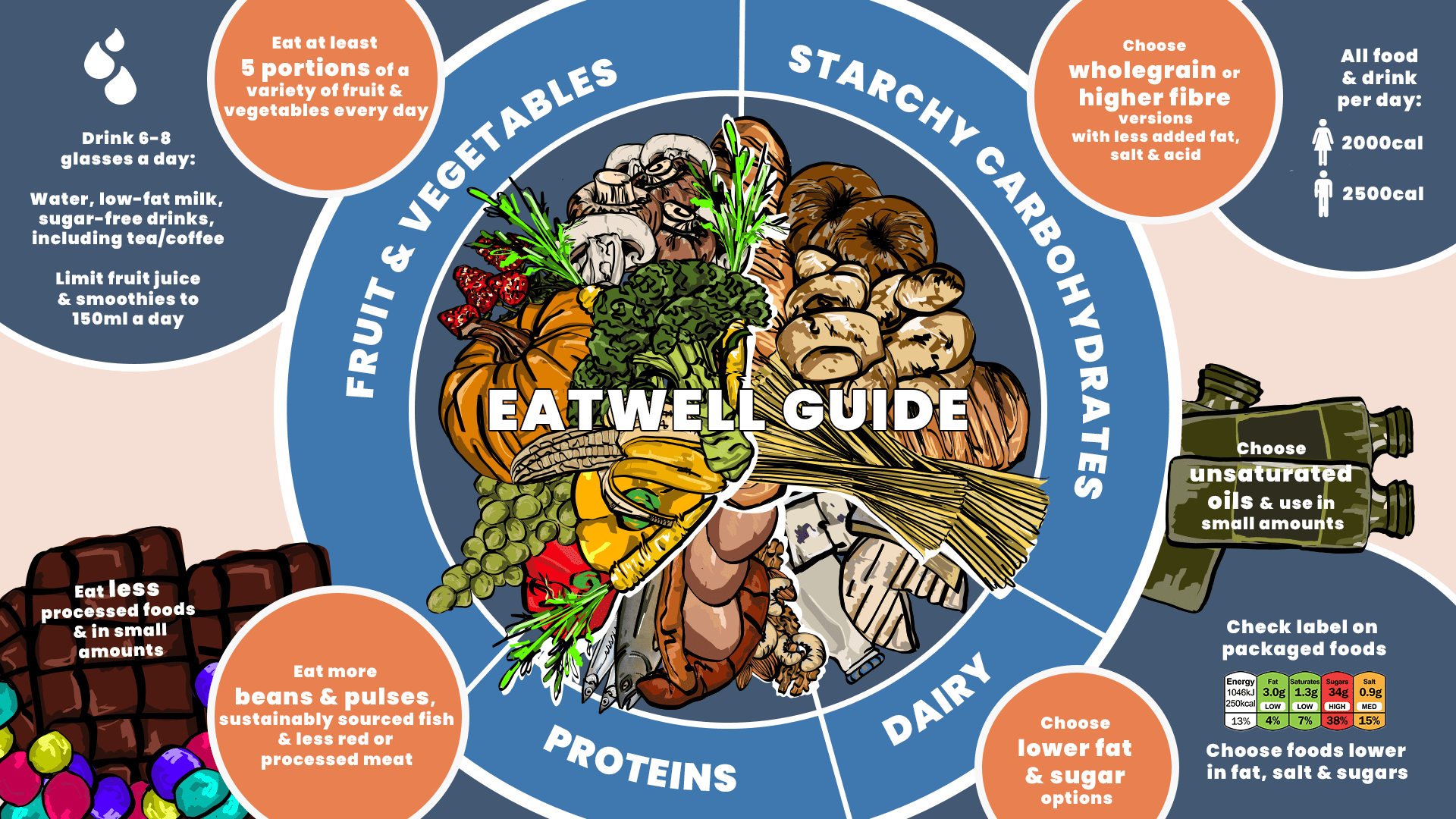
Source: Public Health England in association with the Welsh Government, Food Standards Scotland and the Food Standards Agency in Northern Ireland
Graphique : Ben Hudson
How can the Eatwell Guide help you?
Retour au sommaireA nutritious diet is crucial for your wellbeing. A balanced intake of nutrients can boost energy, maintain a healthy weight, and keep your body functioning well.
Spellissy says: "By focusing on a variety of food groups, the Eatwell Guide ensures you're getting all the necessary vitamins, minerals, fibre and healthy fats needed for overall wellness."
Healthy ageing plays a crucial role in maintaining cellular health, and reducing your chance of age-related conditions.
Unluisler says: "A high intake of fruits and vegetables - rich in vitamins, minerals and antioxidants - will protect your skin, and reduce the signs of ageing."
According to Unluisler, a balanced intake of proteins, healthy fats and carbohydrates can:
Support heart health.
Lower cholesterol and blood pressure.
Protect your brain against cognitive decline.
Improve mood and mental well-being.
Reduce symptoms of anxiety and depression.
She adds that by encouraging the consumption of whole grains and limiting sugary foods, following the Eatwell Guide can contribute to stable blood sugar levels, reducing the likelihood of insulin resistance and type 2 diabetes.
Continuez à lire ci-dessous
Who should follow the Eatwell Guide?
Retour au sommaireThe Eatwell Guide is designed to serve a wide range of the UK population, making it a suitable dietary model for most people - including children over two years of age, and older adults.
Spellissy says, that people with specific dietary needs may need to modify certain aspects of the Eatwell Guide to fit their personal nutritional requirements.
People with the following conditions may need to adjust their portions or food choices:
Food allergies or intolerances - such as lactose intolerance.
Medical conditions - such as coeliac disease, kidney disease, diabetes.
"Adjustments might also be required if you're pregnant, an athlete, older, or following a vegetarian or vegan diet," adds Spellissy.
How to use the Eatwell Guide
Retour au sommaireThe Eatwell Guide - Source: Public Health England
Planning meals and controlling portion sizes help make the Eatwell Guide easier to follow, and ensure you're following its daily recommendations.
Spellissy advises you start by filling half your plate with fruits and vegetables - a quarter with starchy carbohydrates, preferably whole grains, and the remaining quarter with protein.
An example of a healthy, well-balanced plate might include:
Seasoned or spiced grilled chicken - protein.
Wholegrain rice - starch.
A colourful variety of roasted vegetables - such as broccoli, carrots and bell peppers.
A glass of water, milk, or a sugar-free drink.
Unluisler recommends the following tips for incorporating healthier foods:
Go for healthy snacks - such as fruit, nuts or yoghurt.
Cut down your intake of processed foods.
Choose healthier cooking methods - such as baking, grilling or steaming.
Try new recipes that incorporate different food groups - these could include stir-fries or salads that combine various vegetables and proteins.
If you have specific dietary needs you should work with a registered dietitian to customise the Eatwell Guide to your requirements. This will ensure you're meeting your nutritional goals, while addressing any health concerns.
Sélections de patients pour Régime alimentaire

Régime et nutrition
Tout ce que vous devez savoir sur le jeûne de sardines de 3 jours
Vous avez peut-être entendu parler de quelque chose appelé le jeûne aux sardines. Malgré son nom, il ne s'agit pas d'abandonner le petit poisson argenté. Si c'était le cas, cela ne serait probablement pas une grande tendance — après tout, qui mange suffisamment de sardines pour avoir besoin d'une pause en premier lieu ? En réalité, le jeûne aux sardines consiste à ne manger que des sardines pendant jusqu'à 72 heures. Nous examinons de plus près l'origine du jeûne aux sardines, la réflexion qui le sous-tend, et si cette tendance santé inhabituelle fait vraiment ce qu'elle promet.
par Victoria Raw

Régime et nutrition
Moyens simples de suivre un régime méditerranéen
Un régime méditerranéen évoque une image de poisson frais et de salades colorées arrosées d'huile d'olive, accompagnées d'un verre de vin rouge - le tout en étant assis au soleil bien sûr. Bien que nous n'ayons pas de soleil fiable au Royaume-Uni, nous pouvons certainement profiter des nombreux bienfaits pour la santé offerts par le régime méditerranéen.
par Lynn Stephen
Continuez à lire ci-dessous
Historique de l'article
Les informations sur cette page sont examinées par des cliniciens qualifiés.
Next review due: 25 Oct 2027
25 oct. 2024 | Publié à l'origine
Écrit par :
Victoria RawRevu par
Dr Krishna Vakharia, MRCGP

Demandez, partagez, connectez-vous.
Parcourez les discussions, posez des questions et partagez vos expériences sur des centaines de sujets de santé.

Vous ne vous sentez pas bien ?
Évaluez vos symptômes en ligne gratuitement
Inscrivez-vous à la newsletter Patient
Votre dose hebdomadaire de conseils de santé clairs et fiables - rédigés pour vous aider à vous sentir informé, confiant et maître de la situation.
En vous abonnant, vous acceptez notre Politique de confidentialité. Vous pouvez vous désabonner à tout moment. Nous ne vendons jamais vos données.