Traitement des infections à levures récurrentes
Revu par des pairs Dr Philippa Vincent, MRCGPDernière mise à jour par Dr Hayley Willacy, FRCGP Dernière mise à jour 31 juil. 2024
Respecte les directives éditoriales
- TéléchargerTélécharger
- Partager
- Language
- Discussion
- Version audio
- Ajouter aux sources préférées sur Google
Dans cette série :Écoulement vaginalMycose vaginaleVaginose bactériennePrévenir et traiter la vaginose bactérienne
Une infection à levures récurrente (candidose vaginale) est définie comme une épisode de candidose quatre fois ou plus par an. Dans certains cas, il existe une raison médicale pour laquelle vous êtes plus susceptible d'avoir une infection à candidose. Certains traitements hormonaux peuvent également influencer votre risque de récidive.
En un coup d'œil
La mycose vaginale récurrente signifie avoir quatre épisodes ou plus de mycose dans une année.
Elle peut être causée par un diabète mal contrôlé ou un système immunitaire affaibli.
Les médecins peuvent effectuer des tests comme un prélèvement vaginal pour confirmer la cause de vos symptômes.
Le traitement implique souvent des médicaments antifongiques pendant une période plus longue que d'habitude.
Un traitement d'entretien avec des médicaments comme le fluconazole peut aider à empêcher le retour du muguet.
Des changements de mode de vie peuvent aider à réduire votre risque d'infections récurrentes.
Consultez votre médecin si les symptômes ne s'améliorent pas ou si de nouveaux symptômes apparaissent.
A vaginal yeast infection (la mycose vaginale) is an extremely common cause of sécrétions vaginales - up to 3 in 4 women will have at least one episode during their lives. In most cases, thrush in women settles with simple treatment, either topical (applied to the vagina in the form of pessaries or antifungal creams) or oral (a tablet or tablets). However, some women either have repeated new infections, or find that they still have symptoms because the initial thrush treatment has not been effective.
What causes recurring yeast infections?
Speculum examination showing vaginal thrush
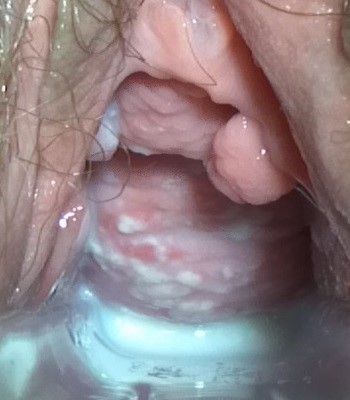
© Mikael Häggström, CC0, via Wikimedia Commons
Of women who develop a first bout of vaginal thrush, about 5 in 100 of them will get problems with recurring thrush. In most cases, the reason why this occurs is not known. Some women just seem more prone than usual to develop thrush. However women with high blood sugar (due to poorly controlled diabetes) and women with weakened immune systems may be more likely to develop recurrent thrush.
There is some debate as to whether women taking thérapie de remplacement hormonal (TRH) or birth control pills such as the pilule contraceptive orale combinée (COC) are more likely to develop a recurring yeast infection - the evidence is not yet clear.
How do I get rid of a recurring yeast infection?
If you have repeated bouts of thrush then one option is simply to treat each bout as and when it occurs. See the separate leaflet Vaginal thrush (Yeast infection) for treatments for thrush.
Recurrent thrush is defined as 4 or more symptomatic episodes per year. If you have four or more episodes of vaginal thrush a year, with at least 2 episodes confirmed by a swab test, your doctor may suggest a different approach.
Before they do this, they may want to exclude another cause for your symptoms. This could include:
Taking a vaginal swab and sending it the laboratory to check for evidence of thrush or other infection.
Checking the pH (acidity level) in your vagina using a simple test strip. A lower pH (4.5 or below) makes it more likely that thrush is the cause. A higher pH (above 4.5) makes la vaginose bactérienne (BV) or trichomonas infection (a sexually transmitted infection) more likely.
Other swabs or tests as appropriate.
Treatment for recurrent thrush
Using one of the usual treatments for vaginal thrush (topical treatments or tablets) - but for longer than usual. Your doctor will advise exactly how long to use the treatment for. Vaginal thrush can be treated with over the counter medicines, but as you need a longer course of treatment, your GP will give you a prescription for treatment if you need it.
How the recurring yeast infection is treated will also depend on your preferences and other factors such as whether you can tolerate the treatment, or have ever reacted badly to it, your age and whether you're pregnant (in which case vaginal pessaries will usually be advised). If you're 12-15 years old, or it's not clear whether your symptoms are due to recurrent vaginal thrush, your doctor may recommend a hospital specialist referral.
The first-line recommended 'induction treatment' is three doses of fluconazole 150 mg tablets (to be taken every 72 hours).
This is followed by regular 'maintenance treatment' to stop the thrush coming back, with once weekly tablets of fluconazole 150 mg for six months.
If you can't take fluconazole tablets for whatever reason, topical therapy (such as clotrimazole 500 mg vaginal pessary) can be used as induction treatment for 7-14 days, depending on how your symptoms respond. Maintenance treatment would then be a clotrimazole 500 mg vaginal pessary inserted once a week for six months or itraconazole tablets 50-100 mg once daily for six months.
Most women remain clear of thrush during maintenance treatment. If you and your doctor decide maintenance treatment is best for you, this will usually last for six months.
After treatment is stopped, many women remain free of thrush, or only develop the occasional bout again. However, some women return to developing recurring yeast infections. If this happens, the treatment plan can be repeated, and maintenance treatment continued for longer.
Regardless of the treatment you and your doctor agree, it's important to use lifestyle measures to reduce your risk of recurring yeast infections (you can find out more below). In addition, you should speak to your doctor if:
Your symptoms don't improve with treatment.
You develop thrush whilst on maintenance treatment. This may indicate that you have a resistant strain of Candida spp. which may require an alternative treatment.
You become pregnant or are breastfeeding.
You develop side-effects from the medication.
You develop new symptoms, such as smelly discharge, ulcers or blisters, abnormal vaginal bleeding or a bloodstained discharge.
You feel unwell in yourself.
Can I prevent recurring yeast infections?
The yeast that causes yeast infections, called Candida spp. such as Candida albicans, thrives in warm, moist, airless environments. General lifestyle changes that help prevent single episodes of vaginal thrush can also help reduce the risk of recurrent thrush.
Si vous avez diabète, your risk of recurring yeast infections is higher if your blood sugar is consistently high. Working with your diabetes team to bring your blood sugar under control can cut the risk of recurrent bouts of thrush.
If you experience recurring yeast infections, your doctor or nurse may also discuss your current method of contraception with you and suggest a change. There has been talk in the past about the pilule contraceptive orale combinée (COC) (the birth control pills that contain both oestrogen and progesterone hormones) possibly making recurrent vaginal thrush more likely. However, the evidence around this is a little unclear.
Sélections des patients pour Problèmes vaginaux et vulvaires

Santé des femmes
Vulve qui démange
La plupart des femmes ressentent de temps en temps des démangeaisons de la vulve et du vagin. Cependant, dans le cas du prurit vulvaire, les démangeaisons sont persistantes et causent de la détresse.
par Dr Rosalyn Adleman, MRCGP

Santé des femmes
Lichen scléreux
Lichen sclerosus is an uncommon skin condition. It most commonly affects the genital skin (vulva) of women. It can occur at any age.
par Dr Colin Tidy, MRCGP
Questions fréquemment posées
Le muguet récurrent peut-il être le signe d'un problème de santé sous-jacent plus grave ?
Bien que la cause du muguet récurrent soit souvent inconnue, elle peut parfois être liée à certaines conditions de santé. Les femmes ayant un taux de sucre élevé dans le sang, comme celles atteintes de diabète mal contrôlé, ou les personnes ayant un système immunitaire affaibli, peuvent être plus sujettes à développer un muguet récurrent. Si vous souffrez de muguet récurrent, votre médecin pourrait explorer ces possibilités.
Comment les médecins déterminent-ils si mes symptômes récurrents sont définitivement dus au muguet, ou à autre chose ?
Si vous ressentez des symptômes récurrents de muguet, votre médecin prendra probablement un prélèvement vaginal à envoyer à un laboratoire. Cela aide à confirmer la présence de muguet ou à identifier d'autres infections. Ils peuvent également vérifier le niveau de pH dans votre vagin à l'aide d'une bandelette de test simple. Un pH bas (4,5 ou moins) suggère un muguet, tandis qu'un pH plus élevé (au-dessus de 4,5) pourrait indiquer une vaginose bactérienne ou une infection à trichomonas.
Si j'ai entre 12 et 15 ans, le traitement pour les mycoses récurrentes est-il différent ?
Oui, si vous avez entre 12 et 15 ans, ou s'il y a une incertitude quant à savoir si vos symptômes sont dus à une mycose vaginale récurrente, votre médecin pourrait recommander une orientation vers un spécialiste hospitalier pour une évaluation et une prise en charge supplémentaires.
Que dois-je faire si je suis enceinte ou si j'allaite et que je souffre de mycoses récurrentes ?
Si vous êtes enceinte ou allaitez et développez des mycoses récurrentes, il est important de parler à votre médecin. Dans ces cas, les ovules vaginaux sont généralement l'option de traitement recommandée.
Y a-t-il des effets secondaires auxquels je devrais faire attention pendant le traitement des mycoses récidivantes ?
Oui, si vous ressentez des effets secondaires du médicament prescrit pour le muguet récurrent, vous devez contacter votre médecin immédiatement. Il pourra vous conseiller sur la manière de les gérer ou suggérer un traitement alternatif si nécessaire.
Que faire si mes symptômes ne s'améliorent pas avec le traitement pour les mycoses récidivantes, ou s'aggravent ?
Si vos symptômes ne s'améliorent pas avec le traitement prescrit, ou si vous développez de nouveaux symptômes tels qu'un écoulement malodorant, des ulcères, des cloques, des saignements vaginaux anormaux ou un écoulement teinté de sang, vous devriez absolument consulter votre médecin. Contactez-le également si vous développez une mycose pendant le traitement d'entretien, car cela pourrait indiquer une souche résistante nécessitant un traitement différent.
Lectures complémentaires et références
- Candida - génital féminin : infection récurrente; NICE CKS, octobre 2023 (accès réservé au Royaume-Uni)
- Candida - génital féminin; NICE CKS, octobre 2023 (accès réservé au Royaume-Uni)
- Vaginose bactérienne; NICE CKS, juillet 2023 (accès réservé au Royaume-Uni)
- Écoulement vaginal; NICE CKS, février 2024 (accès réservé au Royaume-Uni)
À propos de l'auteurVoir la biographie complète

Dr Hayley Willacy, FRCGP
Médecin généraliste, Auteur médical
MBChB (1992), DRCOG, DFFP, MRCOG (Part 1) MRCGP (2007), DFSRH (2013), MSc - medical education (2020)
Le Dr Hayley Willacy était médecin généraliste au NHS travaillant dans le nord-ouest de l'Angleterre, qui a pris sa retraite de la pratique clinique en 2022 après 30 ans.
À propos du critiqueVoir la biographie complète

Dr Philippa Vincent, MRCGP
Médecin généraliste, Auteur médical
MB BS, Bsc, MRCGP (2000), DCH, DFSRH, DRCOG
Dr Philippa Vincent est un médecin généraliste du NHS travaillant dans le nord de Londres.
Historique de l'article
Les informations sur cette page sont rédigées et examinées par des cliniciens qualifiés.
Article également disponible en Anglais, Allemand, Espagnol, Français, Italien, Portugais, Hindi, Hébreu, Arabe, and Suédois.
Prochaine révision prévue : 30 juil. 2027
31 juil. 2024 | Dernière version

Demandez, partagez, connectez-vous.
Parcourez les discussions, posez des questions et partagez vos expériences sur des centaines de sujets de santé.

Vous ne vous sentez pas bien ?
Évaluez vos symptômes en ligne gratuitement
Inscrivez-vous à la newsletter Patient
Votre dose hebdomadaire de conseils de santé clairs et fiables - rédigés pour vous aider à vous sentir informé, confiant et maître de la situation.
En vous abonnant, vous acceptez notre Politique de confidentialité. Vous pouvez vous désabonner à tout moment. Nous ne vendons jamais vos données.
Plus sur la santé des femmes
- Accouchement assisté
- Contact avec la varicelle pendant la grossesse
- Implant contraceptif
- Injection contraceptive
- Grossesse extra-utérine
- Épilepsie et contraception
- Dysfonction sexuelle féminine
- Cancer gynécologique
- Est-il sûr de sauter vos règles avec la pilule ?
- Vulve qui démange
- Douleur dans le quadrant inférieur gauche pendant la grossesse
- Dispositif intra-utérin au lévonorgestrel
- Grossesse molaire
- Kyste ovarien
- Soulagement de la douleur pendant l'accouchement
- Prolapsus des organes pelviens
- Dépression postnatale
- Tests de dépistage pendant la grossesse
- Pilule contraceptive uniquement progestative
- Écoulement vaginal