Kystes épidermoïdes et pilaires
Sebaceous cysts
Revu par Dr Colin Tidy, MRCGPDernière mise à jour par Dr Doug McKechnie, MRCGPDernière mise à jour 12 juin 2023
Respecte les directives éditoriales
- TéléchargerTélécharger
- Partager
- Language
- Discussion
- Version audio
- Ajouter aux sources préférées sur Google
Epidermoid and pilar cysts are commonly referred to as 'sebaceous cysts' (pronounced 'seb-ay-shuss'). They are overgrowths of skin cells (called keratin) held together in a little capsule, or sac.
They are harmless smooth lumps just under the surface of the skin. They are not cancerous and do not require removal unless they are bothering you by the look or the feel of them.
They can occur almost anywhere in the body, but are commonly found on the back or scalp.
En un coup d'œil
Cysts are sacs in the body filled with fluid or semi-fluid material.
Epidermoid and pilar cysts are common types found under the skin.
Epidermoid cysts often appear on the face, neck, chest, and back.
Pilar cysts commonly develop on the scalp, especially in middle-aged women.
These cysts usually appear as smooth, round, painless lumps under the skin.
Cysts are non-cancerous but can become red, inflamed, and painful if infected.
You should see a doctor if a cyst grows quickly or becomes painful.
What are cysts?
A cyst is a sac that is filled with a fluid or semi-fluid material. Cysts develop in various places in the body and arise from different tissues in the body. Two of the most common types of cyst that occur under the skin surface are epidermoid and pilar cysts.
These cysts are often called sebaceous cysts but this term is no longer correct, as the origin of these cysts is not from the sebaceous glands in the skin, as was once thought.
Many doctors still call them sebaceous cysts, though.
What is an epidermoid cyst?
An epidermoid cyst is a cyst where the cyst sac forms from epidermal cells that normally occur on the top layer of the skin (the epidermis).
There are lots of other names for epidermoid cysts, such as epidermal cysts, inclusion cysts, and keratin cysts.
What is a pilar cyst?
A pilar cyst is a cyst where the cyst sac forms from cells similar to those that are in the bottom of hair follicles (where hairs grow from).
A pilar cyst is also known as a trichilemmal cyst.
In both cases, the semi-fluid content of the cyst looks a bit like cottage cheese. This substance is soggy keratin. Keratin is made by skin cells and is the substance that hairs are made from and the substance that covers the top layer of the skin.
Who gets them?
Epidermoid cysts can affect anyone but are most common in young and middle-aged adults. They can appear anywhere on the skin but develop most commonly on the face, neck, chest, upper back and sometimes on the scrotum.
Pilar cysts can affect anyone but are most common in middle-aged women. They can appear anywhere on the skin but develop most commonly on the scalp. It is common for several to develop at the same time on the scalp.
Epidermoid and pilar cysts symptoms
Epidermoid and pilar cysts are smooth round lumps which you can see and feel just beneath the skin surface. They are very common.
They range in size but often they are small, like a pea. Sometimes, they can grow slowly over many months to become a few centimetres in diameter. They look very similar to each other but can be distinguished from each other if the cells that form the cyst sac are looked at under the microscope.
Epidermoid and pilar cysts usually cause no symptoms. Occasionally:
Cysts can become infected, when they may become red, inflamed and painful. A course of antibiotics will usually clear an infection if it occurs. Sometimes they settle down even without antibiotics.
The cyst may leak the cheese-like material on to the skin if the cyst is punctured or damaged.
A little horn may grow on the skin over the cyst.
A cyst may form in an uncomfortable place such as in the genital skin or beside a nail.
This photo shows the typical appearance of an epidermoid cyst on someone's neck:
Epidermoid cyst on the neck
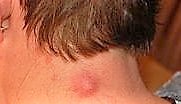
© Steven Fruitsmaak (Own work) - close-up view, CC BY-SA 3.0, via Wikimedia Commons
What causes epidermoid and pilar cysts?
It seems that some cells that are normally near to the surface of the skin (cells of the epidermis or cells in hair follicles) get into deeper parts of the skin and continue to multiply. The cells that multiply form into a sac and produce the keratin that they would normally make on the top layer of the skin. The keratin becomes soggy and forms into a cheese-like substance and a cyst can occur.
Usually epidermoid cysts pop up for no particular reason: there is nothing you can do to prevent them. They are not related to cleanliness, nor will exfoliating stop them occurring.
Pilar cysts on the scalp can be hereditary and run in families, although this is rare.
Rarely, epidermoid cysts can occur due to genetic disorders. A genetic condition might be present if someone has a lot of epidermoid cysts in unusual locations (like on the fingers and toes).
Are epidermoid and pilar cysts painful?
Not usually. If they do not bother you then it is best just to leave them alone. If one has grown recently it's worth asking your doctor to check that it is a harmless cyst. Sometimes a person with an epidermoid or pilar cyst requests that it be removed. This is usually for one of three reasons:
Cosmetic reasons. For example, the cyst is in an obvious site on the skin and looks unsightly.
They are sometimes easy to catch and traumatise. This typically occurs on the scalp when combing hair.
If the cyst often becomes infected or irritating.
Epidermoid and pilar cysts are non-cancerous (benign). They do not spread to other parts of the body or cause any serious problems.
Removal of epidermoid and pilar cysts
If required, the cyst can usually be easily removed by a simple operation under local anaesthetic. The surrounding skin is numbed by injecting some local anaesthetic. A small cut is made over the cyst. It can then be gradually teased out by the doctor. The wound is then stitched up. A small scar will result. Sometimes, after the removal of a cyst, it gradually regrows in the same site under the scar.
Bear in mind you then exchange a small cyst for a scar: some people would rather have been left with the cyst, once they see the results of the surgery.
Sélections des patients pour Éruptions cutanées

Santé de la peau, des ongles et des cheveux
Éruption cutanée due à la chaleur et chaleur épineuse
L'éruption cutanée due à la chaleur est l'un des types les plus courants d'éruption cutanée, et elle est également connue sous le nom de miliaire, de chaleur épineuse ou d'éruption de sueur. L'éruption cutanée due à la chaleur survient chez certaines personnes lorsqu'elles transpirent beaucoup. Elle peut être très prurigineuse. Elle est due à un blocage des canaux sudoripares qui provoque l'infiltration de la sueur dans les cellules de la peau. Le principal traitement est de rester au frais autant que possible.
par Dr Rosalyn Adleman, MRCGP

Santé de la peau, des ongles et des cheveux
Éruption polymorphe à la lumière
L'éruption polymorphe à la lumière est une éruption cutanée qui peut survenir lorsque vous vous exposez au soleil.
par Dr Hayley Willacy, FRCGP
Questions fréquemment posées
Can sebaceous cysts be itchy?
Epidermoid and pilar cysts, sometimes incorrectly called sebaceous cysts, usually do not cause any symptoms. While they can become inflamed, painful, or leak, the article does not mention itchiness as a typical symptom.
Do pilar cysts keep growing?
Epidermoid and pilar cysts can grow slowly over several months, sometimes reaching a few centimeters in diameter.
How to prevent scalp cysts?
The article states that epidermoid cysts usually appear for no particular reason, and there is nothing specific you can do to prevent them. They are not linked to cleanliness or exfoliating. While pilar cysts on the scalp can sometimes be hereditary, the article does not provide methods for prevention.
Lectures complémentaires et références
- Cysts; DermNet NZ
- Jawa DS, Sircar K, Somani R, et al; Gorlin-Goltz syndrome. J Oral Maxillofac Pathol. 2009 Jul;13(2):89-92. doi: 10.4103/0973-029X.57677.
- Ali SY, Prabhat S, Ramanamurty ChV, et al; Coexistence of porokeratosis of Mibelli with Gardner's syndrome: A rare case report. Indian Dermatol Online J. 2011 Jul;2(2):94-6. doi: 10.4103/2229-5178.86001.
- Verma S, Kushwaha JK, Sonkar AA, et al; Giant sublingual epidermoid cyst resembling plunging ranula. Natl J Maxillofac Surg. 2012 Jul;3(2):211-3. doi: 10.4103/0975-5950.111386.
À propos de l'auteurVoir la biographie complète

Dr Doug McKechnie, MRCGP
Rédacteur Médical
MA, MBBS, MSc, DRCOG, MRCP(UK), MRCGP(2021), FHEA
Le Dr Doug McKechnie est un médecin généraliste du NHS travaillant à Londres. Il travaille à plein temps en clinique et est également le chef adjoint du module de Pratique Clinique et Professionnelle à l'École de Médecine de l'University College London.
À propos du critiqueVoir la biographie complète

Dr Colin Tidy, MRCGP
Médecin généraliste, Auteur médical
MBBS, MRCGP, MRCP (Paediatrics), DCH
Le Dr Colin Tidy est un médecin du NHS, basé dans l'Oxfordshire.
Historique de l'article
Les informations sur cette page sont rédigées et examinées par des cliniciens qualifiés.
Article également disponible en Anglais, Allemand, Espagnol, Français, Italien, Portugais, Hindi, Hébreu, Arabe, and Suédois.
Prochaine révision prévue : 12 mai 2028
12 juin 2023 | Dernière version

Demandez, partagez, connectez-vous.
Parcourez les discussions, posez des questions et partagez vos expériences sur des centaines de sujets de santé.

Vous ne vous sentez pas bien ?
Évaluez vos symptômes en ligne gratuitement
Inscrivez-vous à la newsletter Patient
Votre dose hebdomadaire de conseils de santé clairs et fiables - rédigés pour vous aider à vous sentir informé, confiant et maître de la situation.
En vous abonnant, vous acceptez notre Politique de confidentialité. Vous pouvez vous désabonner à tout moment. Nous ne vendons jamais vos données.
Plus sur la santé de la peau, des ongles et des cheveux
- Acné
- Albinisme
- Eczéma atopique
- Maladie de Bowen
- Maladie des griffes du chat
- Morsures de chien et de chat
- Émollients et crèmes pour l'eczéma
- Infection fongique du cuir chevelu
- Éruption cutanée due à la chaleur et chaleur épineuse
- Plaies infectées
- Chéloïde
- Lipome
- Sclérodermie localisée
- Cancer de la peau mélanome
- Pemphigus vulgaire
- Psoriasis
- Roséole
- Dermatite séborrhéique
- Zona
- Éruptions cutanées