Pityriasis rosé
Revu par Dr Colin Tidy, MRCGPDernière mise à jour par Dr Hayley Willacy, FRCGP Dernière mise à jour 30 déc. 2024
Respecte les directives éditoriales
- TéléchargerTélécharger
- Partager
- Language
- Discussion
- Version audio
- Ajouter aux sources préférées sur Google
Dans cette série :Infections virales de la peauFeux sauvagesInfection primaire par l'herpès labialMolluscum contagiosum
La pityriasis rosée est une éruption auto-limitée, c'est-à-dire qu'elle disparaît d'elle-même sans traitement. Bien que l'éruption puisse être assez spectaculaire, la maladie est très bénigne. Elle touche le plus souvent les jeunes adultes, mais peut concerner tous les âges.
En un coup d'œil
Pityriasis rosea is a common, self-limiting skin rash found in children and young adults.
A single "herald patch" often appears first, followed by a more widespread rash.
The rash can be itchy, but there are no known remedies to clear it faster.
Simple creams, menthol, antihistamines, or steroid creams may help with itching.
Pityriasis rosea is not considered contagious.
It typically clears up within 2 to 12 weeks, but can last longer.
See your doctor if the rash lasts over three months or if itching is severe.
What is pityriasis rosea?
Pityriasis rosea is a self-limiting rash that can occur both in adults and in children. Pityriasis rosea is more common in children and young adults. It is most common in people aged between 10 and 35 years. It is more common in the spring and autumn months. Unfortunately, having pityriasis rosea during the first 15 weeks of pregnancy is associated with miscarriage and preterm delivery.
Pityriasis rosea symptoms
Most people with pityriasis rosea feel perfectly well but are aware of a rash. The rash may be itchy but is not always. Some people may have:
A mild headache.
Une température élevée (fièvre).
A feeling of sickness (nausea).
A feeling of being more tired than usual.
Any symptoms that do occur usually start before the rash appears. Some people develop intense itching before the rash first appears.
Occasionally, some people also have affected areas in their mouths - for example, blisters or ulcers.
Pityriasis rosea treatment
Pityriasis rosea is a condition that will clear itself naturally. No treatment is needed.
Although this rash disappears without leaving a scar, some people find they have marks of discolouration on their skin for a few months.
There are no known pityriasis rosea remedies that will clear the rash more quickly than its natural course. The following may help if itching is a problem:
Avoid fragranced soaps, hot water, wool and synthetic fabrics.
As much as possible try not to scratch. It is thought that scratching can make itch worse and an itch-scratch vicious cycle may develop with regular scratching. (That is, you itch more because you scratch, so you scratch more because you itch more ... and so on.)
Simple creams (also called emollients) may be soothing to the skin and reduce the itching.
A menthol cream or ointment may be cooling and soothing.
Comprimés antihistaminiques may help to reduce the itching. These can be prescribed by your doctor or bought from a pharmacy.
Your doctor may prescribe a steroid cream if your itching is more severe.
If symptoms are very severe you may be referred to a skin specialist who may advise some ultraviolet light treatment. There is no definite evidence that this is effective; however, it is often tried. Other treatments, such as aciclovir, may also be considered.
Pityriasis rosea causes
Its exact cause is unknown. No germ (bacterium, virus, or fungus) has been found in people with the rash. However, certain types of human herpes viruses may be a part of the cause. It is not associated with food, medicines or stress. However, some medicines can cause a rash which looks similar to pityriasis rosea.
What does the rash look like in pityriasis rosea?
A 'herald patch' usually appears on the skin first. This is usually an oval- or round-shaped patch which can vary from 2-5 cm in diameter. This is usually pink/red in colour. It most commonly appears on your chest or upper back. It can sometimes appear on your tummy (abdomen), neck, back, thigh or upper arms. However, many cases do not have a herald patch or it goes unnoticed.
Around 5-15 days later a more widespread rash gradually appears over about 10 days. Most commonly this is on the back or the chest and abdomen. This rash can spread over much of your body. However, it does not usually affect your face.
The rash usually consists of oval-shaped spots 1-3 cm in diameter which are pinky in colour. These spots are smaller than the herald patch. Often the spots seem to form lines in parallel with your skin creases.
This rash may be very itchy. The rash fades in time but this may take several weeks. It leaves no marks or scarring. Second attacks are very rare but have been reported.
This description is the typical case which most people seem to have. Occasionally, the rash may just affect the arms and legs. Rarely, it can cause scaling or flaking of the skin, which can be troublesome.
Pityriasis rosea on the abdomen
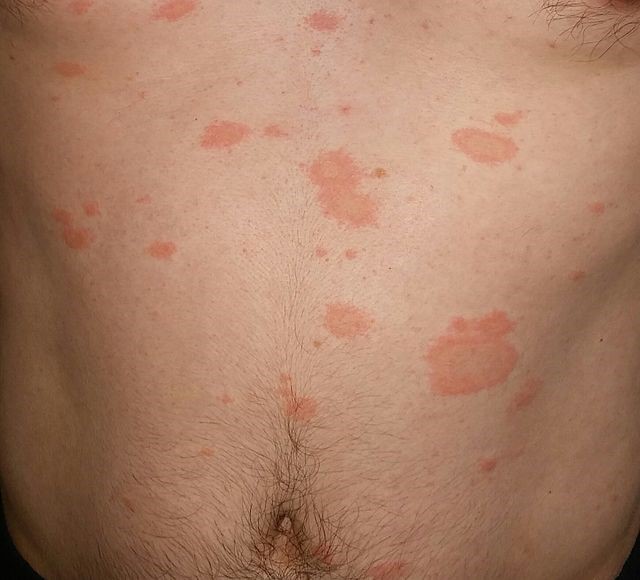
© Marekzerzan, CC BY-SA 4.0, via Wikimedia Commons
Further pictures of pityriasis rosea can be found at the DermNet NZ and DermIS websites - see references below.
Frequently Asked Questions:
Is pityriasis rosea contagious?
Pityriasis is not usually contagious so does not spread to other people.
Ai-je besoin de tests ?
Usually no tests are needed. Your doctor will be able to diagnose pityriasis rosea from the typical rash. If the rash does not go away after three months, or if the itching is very bad, you may be referred to a skin specialist (dermatologist). You may also be referred if your doctor is not sure about the diagnosis.
How long can pityriasis rosea last?
It usually lasts for 2-12 weeks but can last as long as five months. Most commonly it lasts about five weeks before going away completely. If the rash is lasting a longer time, you may need to see a skin specialist to check the diagnosis.
Can stress cause pityriasis rosea?
The exact cause for pityriasis rosea is not yet known but so far no association between pityriasis rosea and stress has been found.
Sélections des patients pour Éruptions cutanées

Santé de la peau, des ongles et des cheveux
Éruption cutanée due à la chaleur et chaleur épineuse
L'éruption cutanée due à la chaleur est l'un des types les plus courants d'éruption cutanée, et elle est également connue sous le nom de miliaire, de chaleur épineuse ou d'éruption de sueur. L'éruption cutanée due à la chaleur survient chez certaines personnes lorsqu'elles transpirent beaucoup. Elle peut être très prurigineuse. Elle est due à un blocage des canaux sudoripares qui provoque l'infiltration de la sueur dans les cellules de la peau. Le principal traitement est de rester au frais autant que possible.
par Dr Rosalyn Adleman, MRCGP

Santé de la peau, des ongles et des cheveux
Éruption polymorphe à la lumière
L'éruption polymorphe à la lumière est une éruption cutanée qui peut survenir lorsque vous vous exposez au soleil.
par Dr Hayley Willacy, FRCGP
Questions fréquemment posées
Can you have pityriasis rosea without a herald patch?
Yes, while a 'herald patch' is typically the first sign, many cases do not have one, or it might go unnoticed. The widespread rash appears about 5-15 days after the herald patch would have appeared, if present.
Is pityriasis rosea dangerous?
Pityriasis rosea is a self-limiting rash, meaning it will clear up on its own. Most people feel perfectly well despite having the rash. However, if pityriasis rosea occurs during the first 15 weeks of pregnancy, it is associated with miscarriage and preterm delivery.
Is pityriasis rosea linked to cancer?
No, there is no information in the article to suggest a link between pityriasis rosea and cancer. The condition clears up on its own and does not leave scars, although some people may have discolouration for a few months.
Can pityriasis rosea spread to the face?
The rash in pityriasis rosea usually appears on the back, chest, and abdomen, spreading over much of the body. However, it does not usually affect your face.
How did I get pityriasis rosea?
The exact cause of pityriasis rosea is unknown. No specific germ (bacterium, virus, or fungus) has been definitively identified as the cause, although certain types of human herpes viruses might play a role. It is not associated with food, medicines, or stress, although some medicines can cause a similar-looking rash.
Lectures complémentaires et références
- Pityriasis rosé; NICE CKS, avril 2020 (accès réservé au Royaume-Uni)
- Contreras-Ruiz J, Peternel S, Jimenez Gutierrez C, et al; Interventions for pityriasis rosea. Cochrane Database Syst Rev. 2019 Oct 30;2019(10). doi: 10.1002/14651858.CD005068.pub3.
- Pityriasis Rosea; DermIS (Système d'Information en Dermatologie)
- Pityriasis rosé; DermNet NZ
À propos de l'auteurVoir la biographie complète

Dr Hayley Willacy, FRCGP
Médecin généraliste, Auteur médical
MBChB (1992), DRCOG, DFFP, MRCOG (Part 1) MRCGP (2007), DFSRH (2013), MSc - medical education (2020)
Le Dr Hayley Willacy était médecin généraliste au NHS travaillant dans le nord-ouest de l'Angleterre, qui a pris sa retraite de la pratique clinique en 2022 après 30 ans.
À propos du critiqueVoir la biographie complète

Dr Colin Tidy, MRCGP
Médecin généraliste, Auteur médical
MBBS, MRCGP, MRCP (Paediatrics), DCH
Le Dr Colin Tidy est un médecin du NHS, basé dans l'Oxfordshire.
Historique de l'article
Les informations sur cette page sont rédigées et examinées par des cliniciens qualifiés.
Article également disponible en Anglais, Allemand, Espagnol, Français, Italien, Portugais, Hindi, Hébreu, Arabe, and Suédois.
Prochaine révision prévue : 29 déc. 2027
30 déc. 2024 | Dernière version

Demandez, partagez, connectez-vous.
Parcourez les discussions, posez des questions et partagez vos expériences sur des centaines de sujets de santé.

Vous ne vous sentez pas bien ?
Évaluez vos symptômes en ligne gratuitement
Inscrivez-vous à la newsletter Patient
Votre dose hebdomadaire de conseils de santé clairs et fiables - rédigés pour vous aider à vous sentir informé, confiant et maître de la situation.
En vous abonnant, vous acceptez notre Politique de confidentialité. Vous pouvez vous désabonner à tout moment. Nous ne vendons jamais vos données.
Plus sur la santé de la peau, des ongles et des cheveux
- Alopécie areata
- Punaises de lit
- Dermatite de contact
- Dermatite herpétiforme
- Eczéma discoïde
- Eczéma chez les enfants
- Psoriasis en gouttes
- Piqûre de méduse
- Épilation au laser
- Lipome
- Cancer de la peau mélanome
- Piqûres de moustiques
- Psoriasis
- Rosacée
- Gale
- Ulcères cutanés
- Soleil et coups de soleil
- Ulcères veineux de la jambe