Psoriasis des ongles
Maladie des ongles psoriasiques
Revu par des pairs par Dr Colin Tidy, MRCGPDernière mise à jour par Dr Doug McKechnie, MRCGPDernière mise à jour 17 avr. 2023
Respecte les directives éditoriales
- TéléchargerTélécharger
- Partager
- Language
- Discussion
- Version audio
- Ajouter aux sources préférées sur Google
Dans cette série :PsoriasisPsoriasis en gouttesArthrite psoriasique
Psoriasis is a persistent (chronic) skin condition which tends to flare up from time to time. About half of the people who have psoriasis also have changes affecting their nails. Psoriatic nail disease is very variable in appearance and severity.
Psoriasis affecting the nails can be mild and not need any treatment. More severe nail psoriasis is often difficult to treat but modern treatments can be effective.
En un coup d'œil
Nail psoriasis is a type of psoriasis affecting fingernails and toenails.
It is not caused by infection and you cannot pass it on to anyone else.
Symptoms include pitting, separation of the nail from the skin, and a chalk-like build-up under the nail.
Keep nails short and dry, wear gloves for manual work, and avoid false nails.
If nail psoriasis is causing problems, your doctor may refer you to a skin specialist.
Treatment can be difficult and slow, as nails grow slowly.
What is nail psoriasis?
Psoriatic nail disease is a type of psoriasis. It is not caused by infection and you cannot pass it on to anyone else.
Psoriasis is a common skin condition that usually causes patches (plaques) of red, scaly skin but sometimes affects the nails and cuticles. There is also a form of arthritis that is linked to psoriasis, called psoriatic arthritis. Psoriatic nail disease is particularly common if you have psoriatic arthritis. You can read more about these conditions in the separate leaflets called Psoriasis et Psoriatic Arthritis.
What causes nail psoriasis?
Nail psoriasis is caused by the same processes as psoriasis elsewhere. Skin cells grow abnormally rapidly, causing a layer of immature, poorly-functioning skin cells to emerge on the outermost layer of the skin. The immune system is involved in this process, as it seems to attack healthy skin cells by mistake, and trigger skin cells to divide and grow too quickly.
The symptoms and signs of nail psoriasis depend on which part of the nail is affected by psoriasis. For example:
If the nail matrix - the part which produces new nails - is affected, small areas of abnormal cells develop in patches on the nail. As the nail grows, those patches deepen and cause pitting of the nail plate (the hard part of the nail).
If an area of psoriasis grows in the nail bed (the area beneath the nail plate), it can push the nail plate up, detaching the nail plate from the nail bed (onycholysis).
What does nail psoriasis look like?
Psoriatic nail
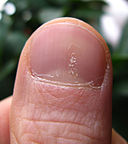
© Seenms, CC BY-SA 3.0, via Wikimedia Commons
Nail psoriasis can affect fingernails and toenails. There are different types of nail changes that can occur. Signs of nail psoriasis include:
Pitting of the nails
Small pits appear on the surface of the nail. There may be one pit or many pits on the surface of a single nail.
Onycholysis
The nail separates from the skin underneath the nail. At first this looks like a white or yellow patch at the tip of the nail. This patch gradually gets bigger and reaches the base of the nail. The gap between the nail and the skin underneath the nail can become infected and change colour.
Subungual hyperkeratosis
A chalk-like material builds up under the nail. The nail becomes raised and often tender.
Oil drop or salmon patch - a see-through yellow-red patch appears in the nail bed that looks like there is a drop of oil under the nail.
Colour
The colour of the nail may change, such as turning to yellow-brown.
Qu'est-ce que cela pourrait être d'autre ?
Infections of the nail can occur at the same time as psoriatic nail disease and can sometimes look like nail psoriasis. Infections fongiques des ongles also cause thickening of the nails. It is important to get the correct treatment as some treatments for fungal nail diseases (eg, terbinafine) can aggravate nail psoriasis.
Onycholysis is the loosening or separation of the nail from the skin underneath it. Treatment depends on the cause. Apart from nail psoriasis it has many other causes - for example:
Trauma to the nail bed - for example, by repeated tapping of the fingernails on a keyboard or by pressure from shoes in long-distance runners and walkers.
Allergy to nail glue (acrylate).
Infections, such as fungal infections, bacterial infections, or the virus de l'herpès labial (herpes simplex).
Many medicines - for example, some forms of la chimiothérapie for cancer, and tétracycline and fluoroquinolone antibiotics.
Other diseases, such as diabète ou maladie de la thyroïde.
In most of these situations the onycholysis is not permanent and the nail will grow out normally once the cause has been removed or treated.
How common is nail psoriasis?
About 1 in 50 people have psoriasis at some time in their lives. It can first develop at any age but it most often starts between the ages of 15 and 30 years. Nail changes occur in about half of all people with psoriasis, so about 1 in a 100 people get nail psoriasis.
About 4 in every 5 people with psoriatic arthritis have psoriatic nail disease. Voir la brochure séparée intitulée Arthrite Psoriasique pour plus de détails.
Only a few people have psoriatic nail disease without having psoriasis affecting either their skin or their joints.
How is psoriatic nail disease diagnosed?
The diagnosis of psoriatic nail disease is usually made by the appearance of the affected nails. Sometimes scrapings from under the nail, and nail clippings, are sent to the laboratory to be tested for fungal infection of the nail, which can sometimes look like psoriatic nail disease.
Occasionnellement, a sample of nail (a biopsy) is needed to confirm the diagnosis.
How to help nail psoriasis
Keep your fingernails and toenails as short as possible - long or loose nails are more likely to catch and can cause more damage to the skin underneath the nail.
Keep your nails dry.
Protect your nails and wear gloves when doing any manual work.
Avoid a manicure of the base of the nail. This may cause an infection.
Avoid false nails as they may damage the cuticle and make it difficult to apply treatments to the nail.
Nail varnish can be used to cover up pitting. Nail varnish remover containing acetone should not be used, as it can cause damage to the nail.
If you have painful toenail psoriasis then you should see a person who is qualified to diagnose and treat foot disorders (a podiatrist).
Remarque: if you have psoriatic nail disease and develop pain or swelling in one or more of your joints (including your fingers and toes) or if you develop pain in your heel (Tendinopathie d'Achille) then you should see your doctor as soon as possible. You may be developing arthrite psoriasique. It is important that you are seen by a doctor specialising in joint diseases (a rheumatologist) early. It has been shown that the sooner this condition is treated, the less likely you are to suffer permanent damage to your joints.
How to treat nail psoriasis
Mild nail disease which isn't causing discomfort does not need any treatment. If the nail disease is severe and causing problems then your doctor may refer you to see a skin specialist for advice and treatment. Unfortunately treatment of psoriatic nail disease is difficult and not always successful.
Treatments for nail psoriasis include:
Treatments applied to the nail, which include stéroïdes, acide salicylique, calcipotriol ou tazarotene. Local treatments applied to the nail are often not very effective in treating nail psoriasis but are worth trying. If the nail is lifting off (onycholysis) then strong steroid scalp application can be trickled under the nail.
Antifungal treatment - this may be required for fungal nail infection if this is also present.
A steroid injected into the nail - this may be effective for some types of nail psoriasis but it is painful.
Light therapy (phototherapy) - psoralen plus ultraviolet light A (PUVA) treatment is effective for some types of nail psoriasis but not for pitting of the nail.
Removing an affected nail - this can be done by applying a special type of ointment and then covering the nail for seven days. Otherwise the nail can be surgically removed using local anesthésie.
Patience is important. Once the nail has formed, nothing can be done to change it other than trimming it. The treatments are all aimed at treating the nail bed and the skin around the edge of the nail. Nails grow extremely slowly and it may take as long as a year for a damaged fingernail to grow out completely, or even two years for a damaged big toenail.
If nail psoriasis is severe and not helped by the treatments listed above then a powerful medicine which can suppress inflammation is sometimes used. For example, méthotrexate, ciclosporin, acitrétine, infliximab, étanercept, efalizumab, ustekinumab or adalimumab. There is some risk of serious side-effects with these medicines, so they are only used on the advice of a specialist and usually when there is psoriasis also affecting the skin.
What is the outlook (prognosis) for nail psoriasis?
Nail psoriasis can be difficult to treat and there is no cure. It doesn't usually grow out without treatment, so can continue to cause problems. The appearance of the affected nails can also sometimes cause distress.
The treatment of severe psoriatic nail disease is now improving with modern medicines.
Psoriatic nail disease can also be mild, not needing any treatment, and able to be hidden with nail varnish.
Sélections des patients pour Troubles des ongles
Santé de la peau, des ongles et des cheveux
Ongle incarné
Les ongles incarnés sont une affection courante qui peut causer de l'inconfort ou s'infecter. Vous pourriez voir cette condition décrite comme 'ongle incarné', mais les deux termes signifient la même chose. Divers traitements peuvent être administrés par un médecin ou une infirmière, ou une personne qualifiée pour diagnostiquer et traiter les troubles du pied (un podologue). Consultez un médecin si vous présentez des symptômes d'infection autour de l'ongle, en particulier si vous êtes diabétique, avez un système immunitaire affaibli ou tout autre problème de pied.
par Dr Doug McKechnie, MRCGP

Santé de la peau, des ongles et des cheveux
Infection fongique des ongles
Fungal infection of nails (tinea unguium) is common, particularly in toenails in the elderly. The infection causes thickened and unsightly nails which sometimes become painful. Medication often works well to clear the infection but you may need to take medication for several months or longer.
par Dr Philippa Vincent, MRCGP
Questions fréquemment posées
Can nail psoriasis be mistaken for other nail conditions?
Yes, infections of the nail and fungal nail infections can sometimes look similar to nail psoriasis. It's important to get a correct diagnosis because some treatments for fungal nail diseases, like terbinafine, can aggravate nail psoriasis.
If my nails separate from the nail bed, could it be due to something other than psoriasis?
Yes, onycholysis, which is the loosening or separation of the nail from the skin underneath it, has many causes other than nail psoriasis. These include trauma to the nail bed (like repeated tapping or pressure from shoes), allergies to nail glue, various infections (fungal, bacterial, or the cold sore virus), some medications (including certain chemotherapy drugs and antibiotics), and other diseases like diabetes or thyroid disease. In most of these cases, the nail will grow normally once the cause is removed or treated.
How quickly do nails with psoriasis grow out?
Nails grow very slowly. It can take as long as a year for a damaged fingernail to grow out completely, and even up to two years for a damaged big toenail. This means patience is important during treatment, as the effects take a long time to become visible.
What is the likelihood of developing psoriatic arthritis if I have nail psoriasis?
About 4 out of every 5 people with psoriatic arthritis also have psoriatic nail disease. If you have psoriatic nail disease and notice any pain or swelling in your joints, or pain in your heel, you should see your doctor as soon as possible. This could be a sign of developing psoriatic arthritis, and early treatment is important to prevent permanent joint damage.
Are there any specific types of nail psoriasis that don't respond well to certain treatments?
Yes, for example, light therapy (psoralen plus ultraviolet light A, or PUVA) is effective for some types of nail psoriasis but not for pitting of the nail. Also, local treatments applied directly to the nail are often not very effective, though they are still worth trying.
Lectures complémentaires et références
- Psoriasis : L'évaluation et la gestion du psoriasis; Ligne directrice clinique NICE (octobre 2012 - dernière mise à jour septembre 2017)
- Psoriasis des ongles; DermNet NZ
- Ventura A, Mazzeo M, Gaziano R, et al; New insight into the pathogenesis of nail psoriasis and overview of treatment strategies. Drug Des Devel Ther. 2017 Aug 30;11:2527-2535. doi: 10.2147/DDDT.S136986. eCollection 2017.
- Psoriasis - nail psoriasis; Primary Care Dermatology Society. Last updated May 2022.
- Pasch MC; Nail Psoriasis: A Review of Treatment Options. Drugs. 2016 Apr;76(6):675-705. doi: 10.1007/s40265-016-0564-5.
- Psoriasis; NICE CKS, septembre 2022 (accès réservé au Royaume-Uni)
À propos de l'auteurVoir la biographie complète

Dr Colin Tidy, MRCGP
Médecin généraliste, Auteur médical
MBBS, MRCGP, MRCP (Paediatrics), DCH
Le Dr Colin Tidy est un médecin du NHS, basé dans l'Oxfordshire.
À propos du critiqueVoir la biographie complète
Dr Colin Tidy, MRCGP
Médecin généraliste, Auteur médical
MBBS, MRCGP, MRCP (Paediatrics), DCH
Le Dr Colin Tidy est un médecin du NHS, basé dans l'Oxfordshire.
Historique de l'article
Les informations sur cette page sont rédigées et examinées par des cliniciens qualifiés.
Article également disponible en Anglais, Allemand, Espagnol, Français, Italien, Portugais, Hindi, Hébreu, Arabe, and Suédois.
Prochaine révision prévue : 15 avr. 2028
17 avr. 2023 | Dernière version
20 Nov 2012 | Publié à l'origine
Écrit par :
Dr Colin Tidy, MRCGP

Demandez, partagez, connectez-vous.
Parcourez les discussions, posez des questions et partagez vos expériences sur des centaines de sujets de santé.

Vous ne vous sentez pas bien ?
Évaluez vos symptômes en ligne gratuitement
Inscrivez-vous à la newsletter Patient
Votre dose hebdomadaire de conseils de santé clairs et fiables - rédigés pour vous aider à vous sentir informé, confiant et maître de la situation.
En vous abonnant, vous acceptez notre Politique de confidentialité. Vous pouvez vous désabonner à tout moment. Nous ne vendons jamais vos données.
Plus sur la santé de la peau, des ongles et des cheveux
- Albinisme
- Pied d'athlète
- Punaises de lit
- Brûlures et échaudures
- Déclencheurs et irritants de l'eczéma
- Kystes épidermoïdes et pilaires
- Gelures
- Psoriasis en gouttes
- Poux de tête et lentes
- Éruption cutanée due à la chaleur et chaleur épineuse
- Impetigo
- Calvitie masculine
- Cancer de la peau non mélanome
- Dermatite périorale
- Escarres
- Purpura
- Corticostéroïdes topiques pour l'eczéma
- Eczéma variqueux
- Verrues et verrues plantaires