Éruptions cutanées
Revu par des pairs par Dr Colin Tidy, MRCGPDernière mise à jour par Dr Hayley Willacy, FRCGP Dernière mise à jour 14 fév 2024
Conforme aux directives éditoriales
- TéléchargerTélécharger
- Partager
- Language
- Discussion
- Version audio
- Ajouter aux sources préférées sur Google
There are many different types of skin rashes and many different causes of skin rashes. Although most skin rashes are harmless, some do need treatment (which may be tablets, creams or ointments) from your doctor or pharmacist.
Some rashes (especially dark red or purple rashes that don't fade when you press them) may even need urgent medical treatment as they can be associated with meningitis and blood infection (septicaemia).
En un coup d'œil
Les éruptions cutanées peuvent être décrites par leur apparence, comme des rougeurs ou des cloques.
Les éruptions cutanées peuvent être plates (macules), des zones solides surélevées (papules, nodules, plaques), ou remplies de liquide (vésicules, pustules).
Certains éruptions cutanées rouge foncé ou violettes qui ne s'estompent pas sous pression sont appelées purpura.
Les causes courantes des éruptions cutanées incluent les infections, les réactions allergiques et certaines conditions médicales.
Les éruptions cutanées qui démangent peuvent être causées par la peau sèche, l'eczéma ou le psoriasis.
Consultez immédiatement un médecin si une éruption cutanée ne disparaît pas rapidement, si vous vous sentez mal, ou si elle ne s'estompe pas sous pression.
This leaflet is a guide but if you have any concerns, you must seek urgent clinical assessment if:
The rash doesn't quickly disappear.
Vous vous sentez mal.
The rash does not fade with pressure (the best way to test this is to press a glass gently against the rash to see if it fades).
How are skin rashes described?
Skin rashes can be described in the following way:
Redness of the skin (called erythema).
Flat abnormally coloured areas of skin (called macules). Macules are often either red, dark red or purple, brown or white.
Solid raised areas which are up to half a centimetre across (called papules).
Solid raised areas which are more than half a centimetre across (called nodules).
Areas of red raised skin (called plaques) and scales, which have a flaky silvery-white appearance.
Reddish-purple lesions which do not fade with pressure (called purpura):
If less than one centimetre across then these are called petechiae.
If more than one centimetre across then they are called ecchymoses.
Blisters: these are swellings of the skin containing fluid:
If a blister is less than half a centimetre across then it is called a vesicle. If filled with yellow fluid (pus) then it is called a pustule.
If a blister is larger than half a centimetre across it is called a bulla (plural is bullae).
What skin conditions cause itching?
Skin disorders that can cause itching include (please click the links to separate leaflets which provide further information):
Peau sèche.
What causes skin rashes?
Please click the links to separate leaflets which provide further information:
Red (erythema) but not scaly skin rash
A skin infection called la cellulite.
An allergic reaction called urticaire.
Reaction to a medicine you are taking.
Éruptions virales - par ex, rougeole ou rubella (German measles).
Vasculitis. This is a condition involving inflammation of blood vessels, which may occur with various illnesses, including polyarthrite rhumatoïde.
Erythème noueux. This is a condition which causes red rounded lumps (nodules), most commonly on the shins.
Redness on the palms of your hands may be caused by liver disease, pregnancy or an
A red rash may occasionally be due to an inflammatory condition called lupus érythémateux systémique, especially if it is on the cheeks.
Red (erythema) and scaly skin rash
Psoriasis. This is a condition where there is inflammation of the skin.
Eczéma. This is sometimes called dermatitis and also involves inflammation of the skin. It may be caused by an allergy and is then called atopic dermatitis/eczema. This may happen in response to some plants - eg, poison oak or ivy.
Dermatite séborrhéique (in adults). This is a type of skin rash sometimes called seborrhoeic eczema. In babies it is known as cradle cap.
Fungal (or 'yeast') skin infection, such as pied d'athlète, groin infection (tinea cruris), ringworm, scalp ringworm or infection with candida.
Pityriasis rosé. This condition is described as 'self-limiting' and the rash will clear itself naturally.
Pityriasis versicolor. This is a rash which is caused by a yeast-like germ.
Lichen plan. This condition mainly affects the skin and causes an itchy rash.
Macules
Red macules may be due to a reaction to a medicine or a viral rash - tel que rougeole ou la rubéole - as well as other causes.
A brown macule may be a mole but check with your doctor if a mole changes or you are concerned it might be a melanoma.
A white macule may be due to a condition which causes pale patches of skin (called vitiligo) or a skin complaint with flaky discoloured areas (called pityriasis versicolor).
If a macule is dark red or purple and does not fade when you put pressure on it then it is a purpura (see below) and you need to see a doctor urgently. This is because it could be a sign of méningite or blood infection (la septicémie).
Papules
Common causes of papules include l'acné, viral wart, seborrhoeic wart, molluscum contagiosum, gale, infectées and skin tags.
Other causes include psoriasis.
Purpura and petechiae
These are dark red or purple and don't fade when you press them. You need to see a doctor urgently because there may be a serious cause that needs urgent treatment, such as meningococcal infection.
However, common causes include injury to the skin or repeated coughing. More serious common causes include liver disease such as cirrhose.
Less common causes include vasculitis (eg, Purpura de Henoch-Schönlein) or a low level of platelets in your blood (eg, thrombotic thrombocytopenic purpura).
Vascularite
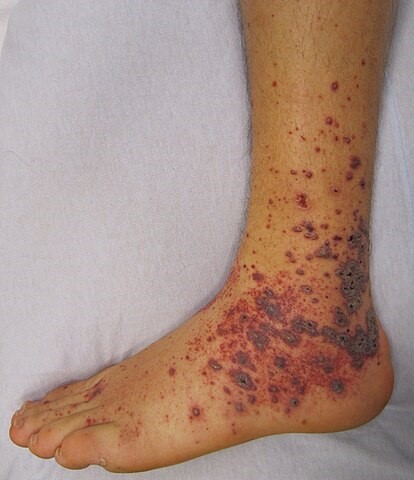
© James Heilman, MD, CC BY-SA 3.0, via Wikimedia Commons
Nodules
Common causes of a nodule include a kyste sébacé, lipome, cancer de la peau, or a wart.
Other causes include rheumatoid nodules (associated with polyarthrite rhumatoïde) and Heberden's nodes (associated with l'arthrose).
Blisters
Skin inflammation, including reactions to medicines, irritante ou allergique, eczema. Eczema on your legs may be caused by varicose veins (eczéma variqueux).
Diseases of your immune system - eg, pemphigoïde bulleuse.
Viral infections - eg, varicelle, maladie de la main, du pied et de la bouche.
Skin infection: a germ (bacterial) infection with impétigo or viral infection with herpes simplex (boutons de fièvre ou herpès génital) or with herpes zoster (shingles).
Rarer causes include pemphigus et pemphigoid.
Pustules
Skin infection by a virus (eg, boutons de fièvre due to herpes simplex virus) or bacterial germs (impétigo).
Inflammation - eg psoriasis.
Pustular skin reaction to medicine you are taking.
Pustules on your face may be acne or rosacea.
Ulcères
Ulcers may be due to venous leg ulcers, escarres de pression, diabetes skin ulcers ou cancerous (malignant) skin ulcers.
This leaflet is a guide but if you have any concerns, you must telephone or see your GP, especially if:
The rash doesn't quickly disappear.
Vous vous sentez mal.
The rash does not fade with pressure (the best way to test this is to press a glass gently against the rash to see if it fades).
You are not sure what has caused the rash or have any other concerns.
Sélections des patients pour Éruptions cutanées

Santé de la peau, des ongles et des cheveux
Kystes épidermoïdes et pilaires
Les kystes épidermoïdes et pilaires sont communément appelés 'kystes sébacés' (prononcé 'sé-bay-ssé'). Ce sont des excroissances de cellules cutanées (appelées kératine) maintenues ensemble dans une petite capsule ou sac. Ce sont des bosses lisses et inoffensives juste sous la surface de la peau. Ils ne sont pas cancéreux et ne nécessitent pas d'être retirés à moins qu'ils ne vous dérangent par leur apparence ou leur sensation. Ils peuvent apparaître presque n'importe où sur le corps, mais se trouvent couramment sur le dos ou le cuir chevelu.
par Dr Doug McKechnie, MRCGP
Santé de la peau, des ongles et des cheveux
Urticaire
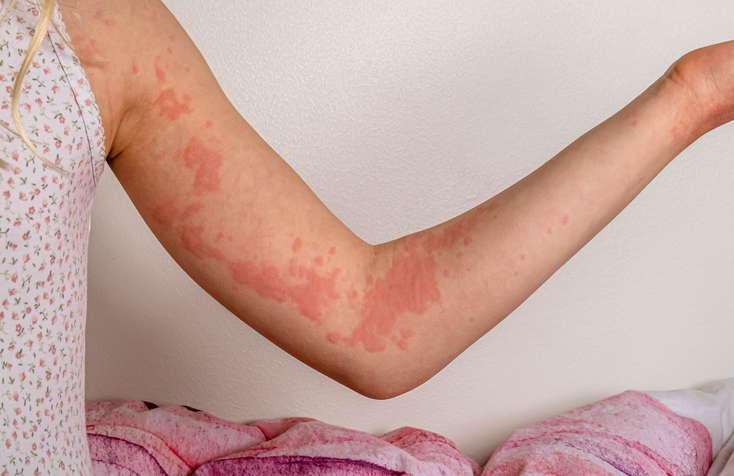
Les éruptions cutanées (également appelées urticaire) sont des bosses rouges ou blanches qui démangent sur la peau et ressemblent à une éruption d'ortie. Les éruptions cutanées sont courantes et sont souvent causées par une réaction allergique, le stress, des infections ou certains médicaments. La plupart des éruptions cutanées s'améliorent d'elles-mêmes en quelques jours. Ce dépliant discute des causes, des types et du traitement des éruptions cutanées.
par Dr Philippa Vincent, MRCGP
Questions fréquemment posées
Quelle est la différence entre une macule qui est rouge foncé ou violette et une purpura ?
Une macule rouge foncé ou violette est une zone de peau plate et anormalement colorée. Si elle ne s'estompe pas lorsque vous exercez une pression dessus, elle est classée comme une purpura. La purpura indique une gravité potentielle, telle que la méningite ou une infection sanguine, et nécessite une attention médicale urgente.
Les éruptions cutanées sur les paumes de mes mains peuvent-elles indiquer une condition grave ?
Oui, la rougeur apparaissant sur les paumes de vos mains peut être un signe de certains problèmes de santé sous-jacents tels que la maladie du foie, la grossesse ou une glande thyroïde hyperactive (hyperthyroïdie). Si vous remarquez cela, il est important de consulter un médecin.
Quelle est la distinction entre une vésicule, une pustule et une bulle ?
Ces termes décrivent tous des cloques, qui sont des gonflements de la peau contenant du liquide. Une vésicule est une petite cloque, de moins d'un demi-centimètre de diamètre. Si cette petite cloque est remplie de liquide jaune (pus), elle est appelée pustule. Une bulle est une cloque plus grande, de plus d'un demi-centimètre de diamètre.
Qu'est-ce qu'une éruption cutanée 'auto-limitante' comme le Pityriasis rosé ?
Une éruption cutanée 'auto-limitante', comme le Pityriasis rosea, signifie que l'éruption disparaîtra d'elle-même naturellement sans traitement médical spécifique. Elle se résout avec le temps sans intervention.
Toutes les macules brunes sont-elles un type de grain de beauté ?
Bien qu'une macule brune puisse être un grain de beauté, il est important de savoir que toutes les macules brunes ne le sont pas. Vous devriez consulter votre médecin si un grain de beauté change d'apparence ou si vous avez des inquiétudes qu'il puisse s'agir d'un mélanome, qui est un type de cancer de la peau.
Quand devrais-je m'inquiéter si une macule est rouge foncé ou violette ?
Si une macule est rouge foncé ou violette et ne s'estompe pas lorsqu'on applique une pression, on l'appelle purpura. Dans cette situation, vous devez consulter un médecin de toute urgence, car cela pourrait indiquer des conditions graves comme la méningite ou une infection sanguine (septicémie).
Lectures complémentaires et références
- Meningococcal infection rash images; DermNet NZ
- DermIS - Dermatology Information System
- Érythème fessier; NICE CKS, octobre 2023 (accès réservé au Royaume-Uni)
À propos de l'auteurVoir la biographie complète

Dr Hayley Willacy, FRCGP
Médecin généraliste, Auteur médical
MBChB (1992), DRCOG, DFFP, MRCOG (Part 1) MRCGP (2007), DFSRH (2013), MSc - medical education (2020)
Le Dr Hayley Willacy était médecin généraliste au NHS travaillant dans le nord-ouest de l'Angleterre, qui a pris sa retraite de la pratique clinique en 2022 après 30 ans.
À propos du critiqueVoir la biographie complète

Dr Colin Tidy, MRCGP
Médecin généraliste, Auteur médical
MBBS, MRCGP, MRCP (Paediatrics), DCH
Le Dr Colin Tidy est un médecin du NHS, basé dans l'Oxfordshire.
Historique de l'article
Les informations sur cette page sont rédigées et examinées par des cliniciens qualifiés.
Article également disponible en Anglais, Allemand, Espagnol, Français, Italien, Portugais, Hindi, Hébreu, Arabe, and Suédois.
Prochaine révision prévue : 12 fév. 2029
14 fév 2024 | Dernière version

Demandez, partagez, connectez-vous.
Parcourez les discussions, posez des questions et partagez vos expériences sur des centaines de sujets de santé.

Vous ne vous sentez pas bien ?
Évaluez vos symptômes en ligne gratuitement
Inscrivez-vous à la newsletter Patient
Votre dose hebdomadaire de conseils de santé clairs et fiables - rédigés pour vous aider à vous sentir informé, confiant et maître de la situation.
En vous abonnant, vous acceptez notre Politique de confidentialité. Vous pouvez vous désabonner à tout moment. Nous ne vendons jamais vos données.
Plus sur la santé de la peau, des ongles et des cheveux
- Albinisme
- Maladie des griffes du chat
- Dermatite de contact
- Eczéma discoïde
- Folliculite
- Ampoules aux pieds
- Infection fongique de l'aine
- Éruption cutanée due à la chaleur et chaleur épineuse
- Hidradénite suppurée
- Plaies infectées
- Sclérodermie localisée
- Cancer de la peau mélanome
- Test épicutané pour la dermatite de contact
- Dyshidrose
- Tache de vin
- Psoriasis
- Rosacée
- Ulcères cutanés
- Ulcères veineux des jambes